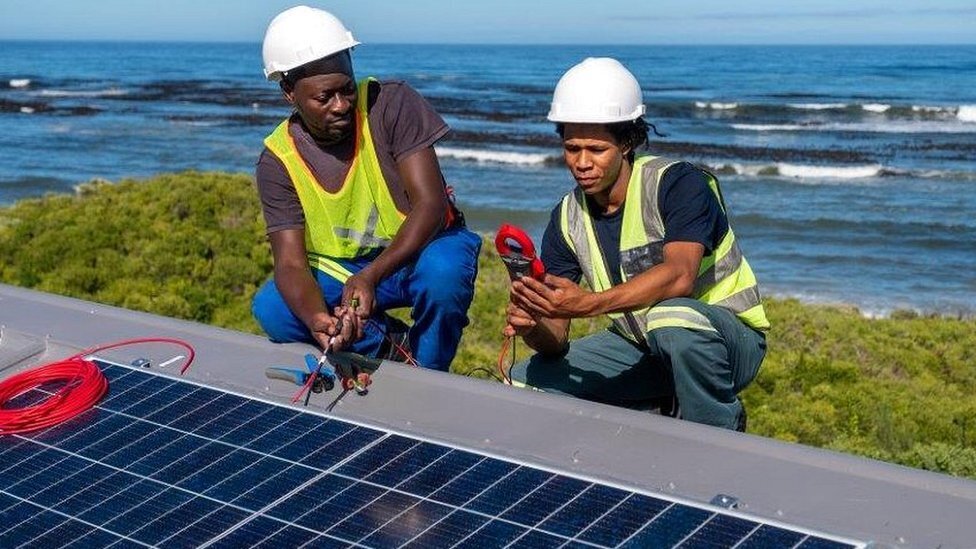
Renewed fuel price pressure is strengthening the case for alternatives to imported fossil fuels across African economies.
Renewables Rising reports recent pump-price increases in Kenya and South Africa, alongside growing solar imports.
The policy challenge is to convert interest in renewable energy into dependable services that households and businesses can afford, while addressing the immediate strain on transport and living costs.
Fuel pressures sharpen energy security concerns
Rising fuel costs are renewing pressure on African economies that rely on imported petroleum and strengthening the argument for investment in alternative energy systems.
In its 16 October 2026 briefing, Renewables Rising links the latest pressure to Middle East supply disruption and reports pump-price increases in Kenya and South Africa.
Its headline suggests the crisis has not peaked.
That is an editorial assessment of future risk, not a verified forecast of the highest price consumers will face.
- The immediate evidence concerns current pressure and the choices it creates for governments, businesses and households.
For a business planning deliveries or backup generation, the question is how much exposure they can reduce at an affordable cost.
A global argument for renewable energy becomes useful locally only when it links to the service the customer needs.
Recent indicators reveal different energy pressures
The newsletter reports a 6% increase in Kenyan fuel during the week and a 12% fuel increase in South Africa earlier in October.
- It also says African countries have imported more than 14 gigawatts of solar capacity so far in 2026.
- These figures come from the briefing and refer to different measures.
Imported solar equipment is not equivalent to commissioned electricity generation.
- Equipment still needs installation, suitable connections and, where required, complementary storage or grid support.
- It could be misleading to treat the import figure as proof that consumers already receive the corresponding energy service.
IRENA’s 2026 assessment of generation costs reports that more than 90% of utility-scale renewable projects commissioned in 2025 produced power below the cost of the cheapest new fossil-fuel plant in their market.
Those findings concern generation economics.
- It does not mean every household installation is affordable or that total retail electricity costs fall by an equivalent amount.

Transport fuel and electricity also serve different immediate needs.
A cheaper electricity source cannot automatically eliminate the need for petrol or diesel.
Renewables need financing that reaches users
SSA assesses that the strongest response combines energy security with access.
- A small firm may see the advantage of reducing generator use but still be unable to finance equipment.
- A monthly repayment structure could help only if its terms remain affordable through changes in business income and exchange rates.
Project design should begin with the customer’s demand pattern.
- Daytime electricity needs, evening loads and essential backup requirements call for different configurations.
- The cheapest equipment package may offer poor value if it fails when the customer needs power most.
Public institutions should also consider who benefits first.
- Support focused entirely on buyers already able to invest could leave poorer households exposed to rising costs.
- Programmes should explain how to address access, service quality and maintenance, rather than reporting installation totals alone.
Assess environmental benefits through actual use.
- A project that reliably displaces fuel consumption offers a firmer basis for evaluating emissions reductions than an announcement about equipment purchases.
Protect consumers while funding durable alternatives
Governments should distinguish immediate relief from investments that reduce future exposure.
- Any temporary support should explain who qualifies, how much it costs and when it will be reviewed.
- That would let the public assess whether relief reaches people under the greatest pressure.
Longer-term procurement should compare complete service costs, including finance, maintenance, network needs and equipment replacement.
- IRENA’s findings support close examination of renewable options; they do not remove the need for a local feasibility assessment.
Lenders and suppliers should provide customers with realistic performance assumptions and clear repair arrangements.
- For public projects, reporting should connect expenditure to functioning service and verified fuel displacement.
- These measures would make energy transition claims easier to evaluate.
Current pressure creates a reason to act, but urgency should improve project discipline.
Reliable installations, capable maintenance providers and affordable finance will determine whether user experience improves by using renewable energy.
Path Forward – Reduce fuel exposure through affordable alternatives
African governments should pair targeted short-term relief with investment in dependable electricity, suitable renewable systems and enabling infrastructure.
Financing must reach users facing upfront cost barriers.
Success should be measured through reliable service, affordable bills and verified fuel savings.
Equipment imports and project announcements are only part of that picture.
Culled from: The fossil fuel crisis has not yet reached its peak