
A Nature commentary warns that losing doctors from academic careers threatens the connection between research and patient care.
Evidence from the United Kingdom raises questions for health systems elsewhere, especially relating to Africa.
The challenge is to make clinical research a viable career alongside delivering essential services.
Academic medicine faces a growing retention challenge
Doctors need stronger career support and more stable funding to remain in research, according to a Nature commentary published on October 12.
The authors warn that losing physician-scientists could weaken the work that links medical discovery with improvements in care.
For African health systems, the warning raises an important question:
- How can institutions retain people who can identify clinical problems and investigate them rigorously?
- It does not establish the scale of academic doctor attrition across the continent.
SSA assesses that retention should be treated as part of health-system capacity.
- Training an individual is only the beginning.
- Institutions also need a credible route for that person to combine clinical responsibilities, research and professional advancement over time.
British figures underline a wider question
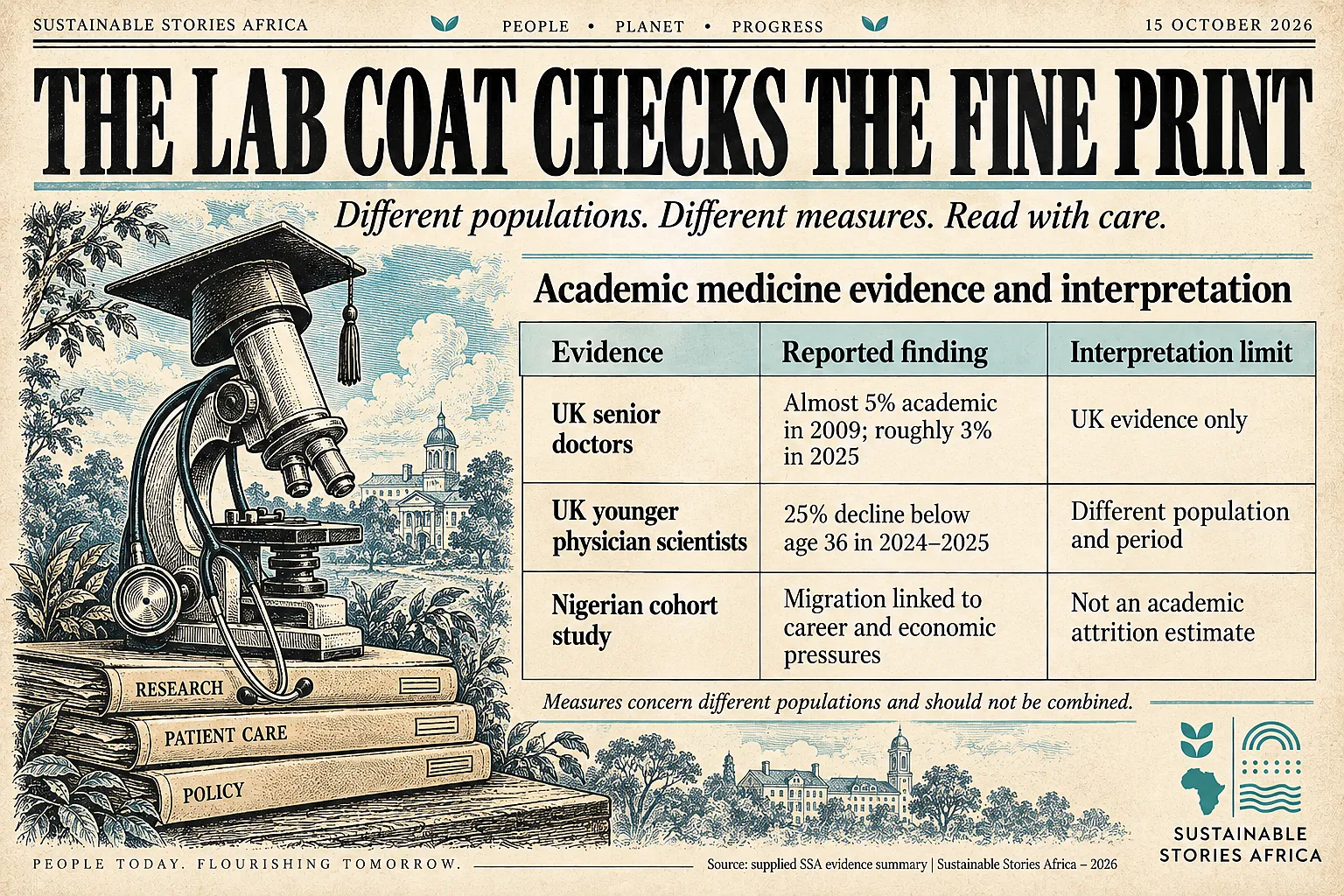
The commentary documents declining academic participation among senior UK doctors and a sharp recent fall in younger physician-scientists, as summarised in the table.
- These are UK observations, not estimates for Africa.
- Their value for other systems is to identify questions worth asking, while leaving the answers open to local evidence.
Relevant Nigerian evidence comes from a separate 15-year retrospective cohort study of doctors and dentists.
- Its findings associate migration with professional and economic pressures, including limited career prospects, and SSA will address this in another article.
- Migration and departure from academic medicine are different outcomes, so the study cannot be used to calculate an African academic attrition rate.
Together, the sources support closer attention to career conditions while requiring care about what each dataset measures.
A clinician may notice that patients struggle to complete a treatment pathway or return repeatedly with a preventable complication.
- Investigating that problem requires a clear question, appropriate methods, ethical review and time to analyse the results.
- Clinical observation is valuable, but has its basis and evidence in disciplined research.
This example shows why losing research-active doctors can matter beyond a university’s publication record.
- Health services need people who understand both the clinical setting and the limits of the evidence available to guide decisions.
SSA’s analysis is that institutions should value research addressing practical service problems alongside work with commercial potential.
- A useful study may improve a referral pathway, test whether guidance works locally or reveal that an assumed solution is unsuitable.
These contributions need transparent assessment rather than an expectation that every project will produce an immediate breakthrough.
Career support must include operational resources
Universities, teaching hospitals and funders should examine the full set of conditions that determine whether research time can actually be used.
- Protected hours have limited value if clinical cover is absent or basic research support is inaccessible.
- A retention strategy needs staffing arrangements as well as a funding announcement.
SSA recommends tracking entry, progression and departures by career stage, with attention to the reasons people leave.
- Institutions should separate movement between employers from withdrawal from research, and record where information is incomplete.
- This would help avoid designing programmes around an inaccurate picture of the problem.
Support should also reach the teams that make research possible, including research nurses, laboratory staff, statisticians and administrators.
- A doctor’s research career depends partly on whether those colleagues can work effectively.
For African policymakers, the practical opportunity is to build pathways around local priorities and accountable institutions.
- International collaboration can contribute expertise and resources, but agreements should clarify leadership, training responsibilities and access to results.
The objective is lasting capability to answer health questions, with patients’ interests guiding how that capability is used.
Path Forward – Keep clinical insight within research careers
Health ministries, universities and hospitals should investigate what is happening to their research workforce before selecting retention measures.
Reliable career pathways and usable research support deserve priority.
Protecting the link between clinical work and investigation can strengthen locally relevant evidence, provided support is sustained, and outcomes are assessed transparently.
Culled from: Keep medical doctors in academia — without them, health-care research will suffer | Nature