Lagos has directed telecommunications companies and value-added service providers to verify gaming partners’ licensing and tax status within 30 days of its public notice.
The regulator also seeks records supporting the assessment of outstanding obligations.
The directive brings digital intermediaries into the accountability chain, raising practical questions about due diligence, service suspension and customer protection.
Lagos extends scrutiny across gaming platforms
The Lagos State Lotteries and Gaming Authority has ordered telecommunications operators and value-added service providers that facilitate gaming in the state to verify the status of their gaming partners within 30 days of its notice.
- Nairametrics reported the directive on 14 October; the authority’s public notice appeared in PUNCH on 12 October.
The measure goes beyond betting companies to include infrastructure used by customers to access and pay for their services.
- For a customer using a phone, the interaction may appear to involve one service.
- Behind that transaction, several companies may share responsibility for enabling access and processing a charge.
SSA assesses that this broader oversight makes the quality of commercial partnerships a governance issue.
Telecom companies will need evidence on the businesses they host, alongside the technical ability to connect them.
Licence checks accompany retrospective transaction requests
According to Nairametrics, the authority requires transaction, carrier-billing and revenue-sharing records covering the period from 22 November 2024 to the notice date.
- It also directs providers to stop onboarding gaming businesses without recognised authorisation and suspend facilitation of existing unauthorised services.
The public notice states that NCC telecommunications or VAS approval does not itself authorise gaming in Lagos.
- It links the state’s position to the Supreme Court judgment of 22 November 2024 and sets out possible company and officer liability under the state law, subject to the stated legal conditions.
Those are regulatory positions and requirements.
- They do not establish that any named telecom company has committed an offence.
- Likewise, a request for historical records is not a published calculation of what a particular business owes.
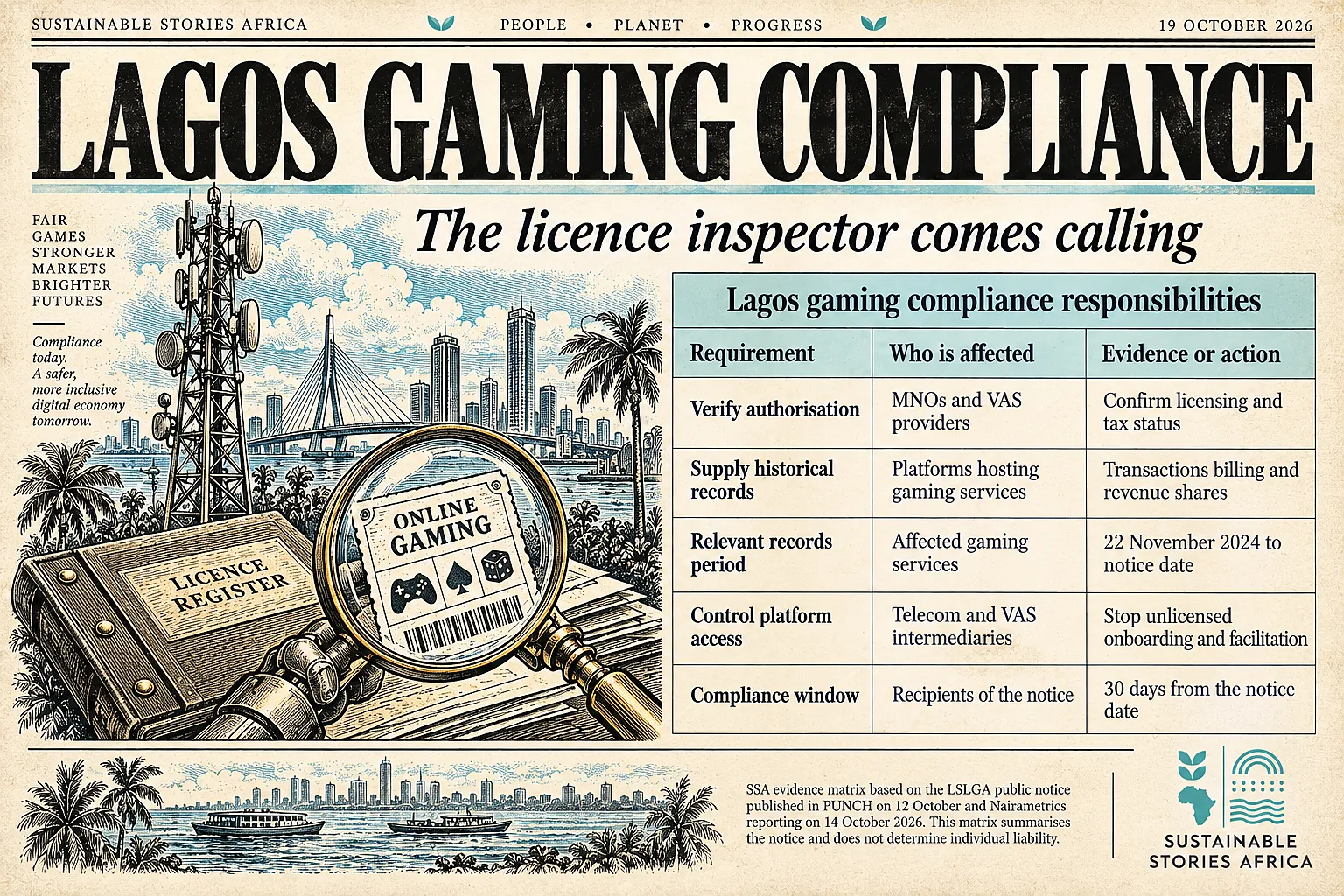
The 30-day period runs from the notice date.
- Operators should establish the controlling date with the authority instead of treating the later news report as the start of a fresh compliance window.
Better oversight should protect ordinary customers
The opportunity is a more accountable relationship between gaming businesses and the companies carrying their services.
- If authorisation checks happen before activation, problems can be identified before customers begin using an offering.
- This will make compliance part of product approval rather than an exercise triggered only by enforcement.
Customer protection should also shape any suspension process.
- Restricting an operator can leave users needing information about balances, pending transactions and complaints.
- Providers should plan how to answer these questions while complying with the regulator’s instructions.
The social dimension deserves equal attention.
- Licence verification alone does not demonstrate that a platform’s age controls or responsible gaming are in place.
- Companies assessing the directive should examine those controls separately, with evidence that managers can review and challenge.
This is SSA’s recommended governance response.
Directors need evidence of partner compliance
Affected providers should create a complete register of gaming partners and document the authorisation evidence checked for each.
- A record of the reviewer, verification date and unresolved issue would make the process auditable.
- If a licence cannot be confirmed, escalate to responsible managers to decide whether service can continue.
Finance and technology teams should agree how to reconcile the requested records.
- Inconsistent identifiers across billing and revenue-sharing systems could make it difficult to connect a transaction to the correct operator.
- Any discrepancy should be explained rather than removed from the submission without a record.
The authority, should in turn, offer a consistent verification process and clear procedures for handling disputed assessments.
- Published procedures would help companies understand what evidence is sufficient and give compliant businesses a predictable route through the exercise.
- Effective enforcement requires reliable information from both the regulator and the platforms it oversees.
Build accountable gaming through verified partnerships
Telecom and VAS providers should verify partners, preserve transaction evidence and act on unauthorised services within the applicable period.
Customer communications should accompany any disruption.
Lagos should make verification and dispute procedures accessible, allowing enforcement to strengthen accountability while giving businesses a clear basis for compliance.
Culled from: Lagos gives MTN, Airtel, others 30 days to verify betting firms’ licences - Nairametrics