
PCSK9 research is expanding the options for lowering LDL cholesterol, including a newly approved oral treatment in the United States.
However, evidence of cholesterol reduction or fewer cardiovascular events does not establish that a medicine extends healthy people’s lives or prevents dementia.
For African health systems, the practical challenge is linking proven treatment benefits with diagnosis, affordability and appropriate clinical care.
Cholesterol treatment advances beyond longevity headlines
PCSK9-targeted medicines are expanding cardiovascular treatment options, but their established benefits need to be separated from claims about longevity and brain health.
- The US Food and Drug Administration approved the oral PCSK9 inhibitor Lipfendra, or enlicitide, on 17 July 2026 for adults with high LDL cholesterol.
That development updates the November 2025 article by physician and neuroscientist Christin Glorioso, which discusses oral medicines as an emerging prospect.
A dated research explainer is useful background, but its development forecasts should not be reported as the current regulatory position.
For African readers, the distinction is consequential.
- An international approval does not establish local registration, availability, price or suitability for an individual patient.
- The news is a growing range of treatment tools, alongside a continuing need to judge each claim against the outcome actually studied.
Clinical trials establish specific treatment benefits
PCSK9 regulates the liver receptors that remove LDL cholesterol from blood. Inhibiting its activity can increase cholesterol clearance.
- The mechanism provides a treatment target, rather than a promise that altering one protein will resolve every process associated with ageing.
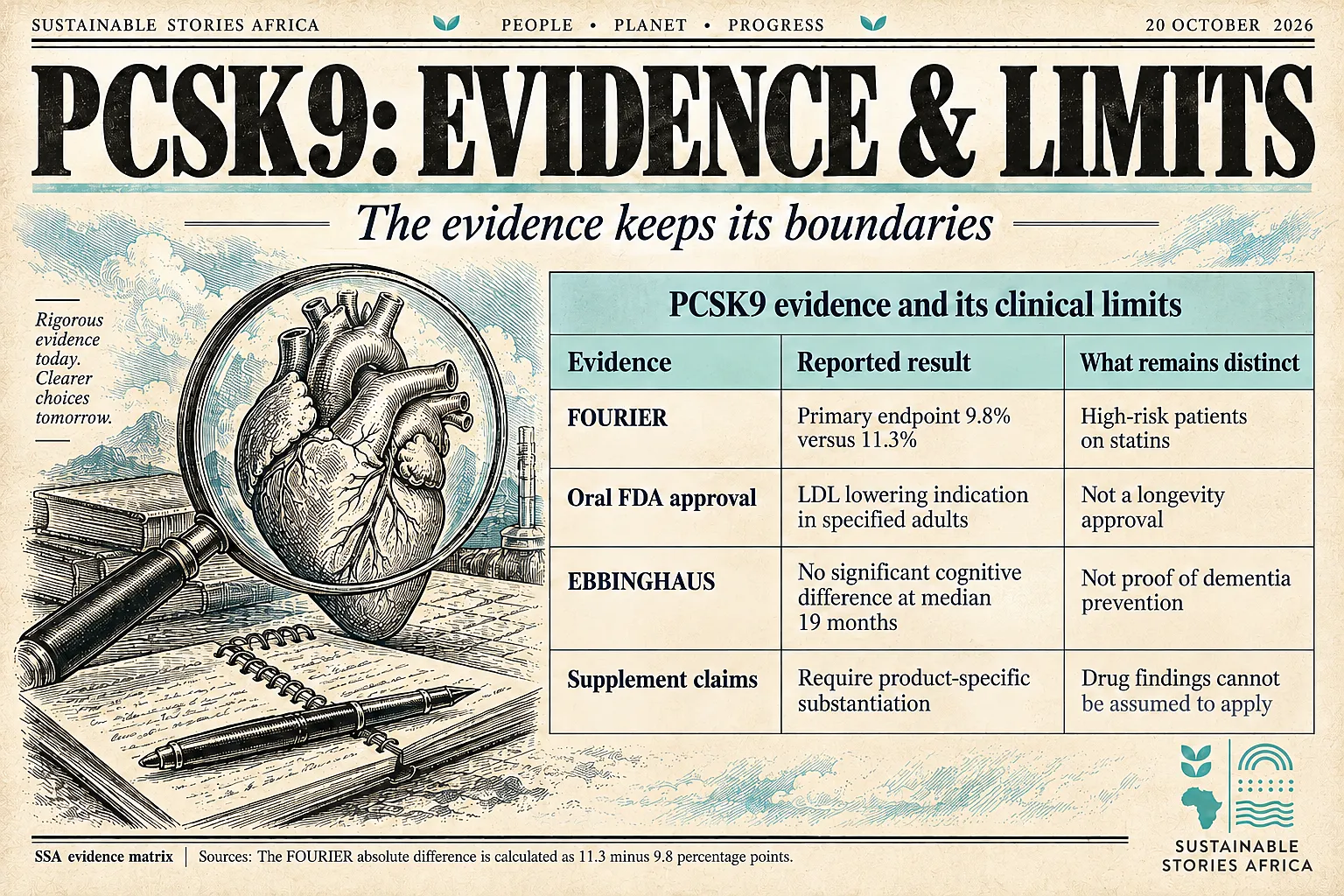
The FOURIER trial enrolled 27,564 patients with established atherosclerotic cardiovascular disease receiving statin therapy.
The primary composite cardiovascular endpoint occurred in 9.8% of the evolocumab group and 11.3% of the placebo group.
- That is a 1.5 percentage-point absolute difference in the studied population, not a universal reduction in an individual’s lifetime risk.
The FDA’s oral treatment announcement reports LDL-lowering trials, while a separate evolocumab cognition trial found no significant between-group cognitive difference over a median of 19 months.
These findings address different questions.
- Cholesterol reduction, cardiovascular outcomes and cognitive safety should not be merged into a single claim of longer life or dementia prevention.
Access determines whether scientific progress translates
For a patient with substantial cardiovascular risk, a new medicine becomes useful through a functioning care pathway.
- That starts with identifying the problem and understanding existing treatment, then assessing whether an additional intervention offers sufficient benefit.
- Follow-up and a reliable medicine supply remain important after prescribing.
SSA assesses that African health systems should evaluate new therapies alongside access to established prevention services.
- A highly visible innovation should not divert attention from the practical capacity needed to diagnose and manage risk.
- At the same time, people who may benefit from specialised treatment should not be excluded simply because a medicine is unfamiliar.
Procurement and reimbursement decisions need transparent evidence.
- Decision-makers should ask which patients were studied, whether outcomes improved and how the treatment compares with available alternatives.
- They should also distinguish a convenient formulation from a demonstrated improvement in clinical outcomes.
Easier administration may be valuable, but that benefit requires its own assessment.
Evidence should govern claims and adoption
The “longevity gene” can make complex research sound like a personal instruction.
- Genetic associations, biological mechanisms and clinical trials contribute different kinds of evidence.
- A naturally occurring variant does not necessarily produce the effect of a medicine later in life, and a change in a laboratory marker is not proof of additional years lived.
Supplement claims need the same discipline.
- The supplied article does not establish that a supplement duplicates the outcomes of a prescription PCSK9 medicine.
- FDA consumer guidance distinguishes supplements from approved treatments and warns against unsupported disease-treatment claims.
- Products should be judged on their own evidence rather than borrowing credibility from research on a biological pathway.
For clinicians, researchers and communicators, the priority is to explain uncertainty without obscuring genuine progress.
- Regulators and health purchasers should evaluate approved indications, relevant trial populations, adverse effects, affordability and follow-up needs.
- Public communication should state when a finding concerns cognitive safety rather than improved cognition, and when it concerns cholesterol rather than survival.
That precision protects informed choice and helps scarce healthcare resources support outcomes that have actually been demonstrated.
Health technology assessment should also account for the whole treatment pathway, including tests, administration and continued access.
A lower medicine price alone may not make care affordable if patients still face substantial costs at every other stage of treatment.
Path Forward – Translate cholesterol science into equitable care
PCSK9 advances deserve attention for the outcomes they have shown.
Broader claims about lifespan, supplements and dementia require their own clinical evidence.
African health systems should assess registration, affordability and patient selection while strengthening the diagnosis and follow-up services that turn a treatment option into effective care.