
South African unions are campaigning for restrictions on Shein and Temu, arguing that offshore e-commerce threatens local jobs.
The reported call is a union position, not an announced government ban on the two platforms.
The debate puts affordable shopping alongside manufacturing livelihoods, tax compliance and competition, and requires evidence on which measures would protect workers without imposing avoidable costs on households.
Union campaign brings retail tensions forward
South African labour organisations are pushing for a ban on Shein and Temu, according to a report by the South Africa Tribune.
The report says COSATU backed a campaign following a recommendation from the Southern African Clothing and Textile Workers’ Union, SACTWU.
- The position reflects concern about offshore e-commerce on domestic manufacturing and retail employment.
- It should not be confused with a government decision: the supplied report does not establish that a ban has been enacted.
For workers, retailers and shoppers, the issue involves competing interests that cannot be resolved by a slogan.
- Households may value low prices, while local producers want rules that prevent unfair competition.
- Policymakers need to identify the specific problem they intend to address and assess whether a restriction would deliver that outcome.
Tax enforcement remains central to competition
South Africa Tribune also reports concern from National Clothing Retail Federation executive director Michael Lawrence that a ban would be too narrow a response.
- It describes the need for closer scrutiny of how offshore platforms operate. [1] That is a reported stakeholder position, not evidence that every platform has breached a rule.
Historical SARS guidance provides important context.
- In August 2024, the revenue authority explained that a concession for imports below R500 had involved a flat charge and no VAT, and set out changes intended to address unfair competition concerns.
- The original announcement is background to the present debate, not a complete statement of every customs procedure applicable in October 2026.
SSA assesses that the policy discussion should distinguish tax design from tax enforcement.
- A rule may require equal treatment while compliance remains uneven.
- Conversely, an earlier concession does not prove that a particular business is currently evading tax.
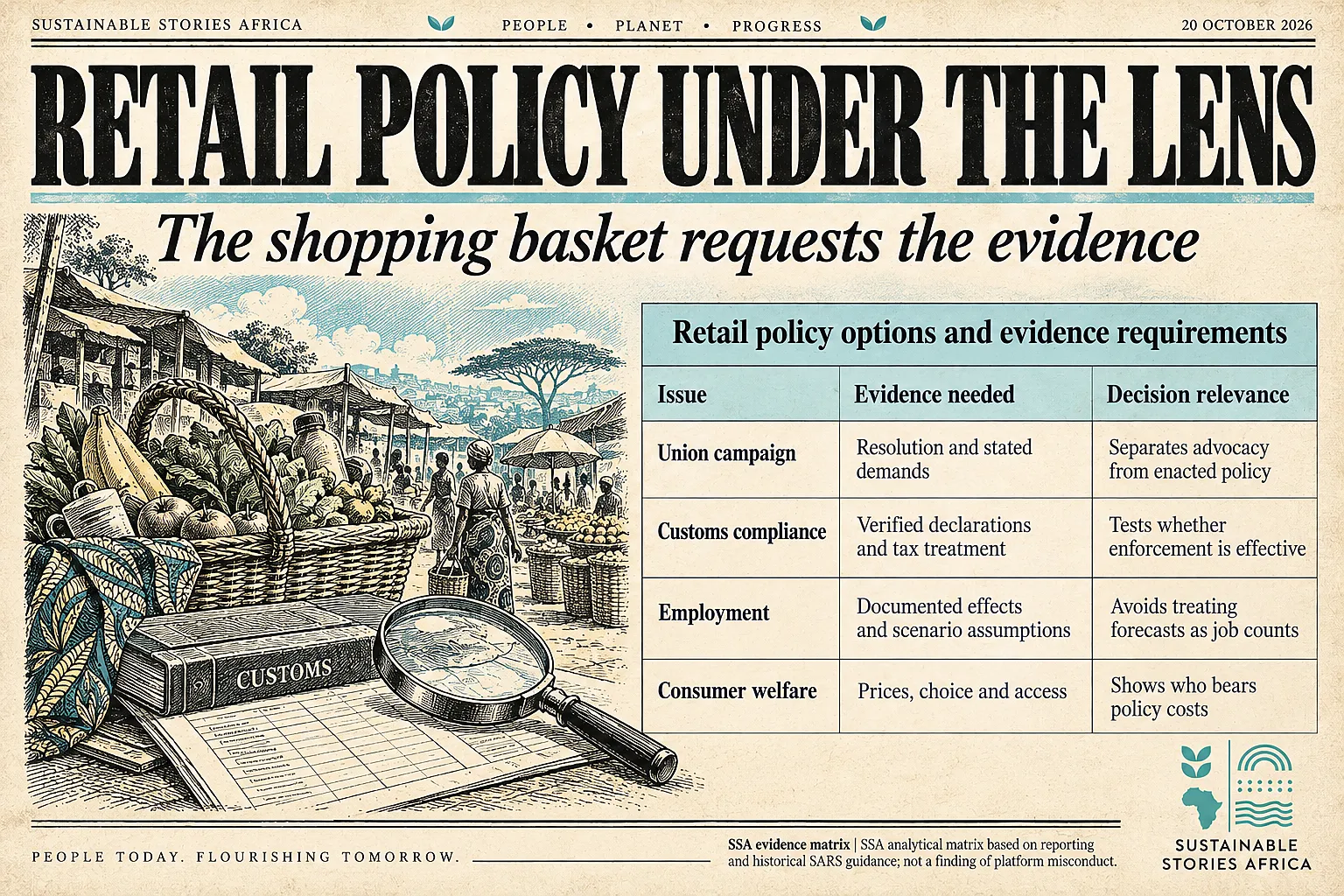
Jobs and household affordability both matter
For a garment worker, import competition can affect a factory and the security of household income.
For a shopper managing a tight budget, an inexpensive item may meet a real need.
- These perspectives do not cancel one another; they show why a policy assessment should make its distributional effects explicit.
Evidence should identify the activities affected, the time period examined, and the assumptions linking imports to employment.
- Forecast job losses should remain labelled as scenarios rather than reported as completed redundancies.
- The same discipline should apply to claims that a ban would automatically restore domestic production.
SSA’s analyses show that local competitiveness also depends on conditions within the production system.
- Reliable operations, delivery times, product quality and access to customers influence whether a local firm can win business.
- Trade enforcement may address an identified distortion, but it cannot be assumed to solve every constraint facing a factory or retailer.
Policy choices need evidence and proportionality
Authorities should assess proposed measures through clear questions: what conduct is unlawful, what evidence establishes it and which remedy addresses it most directly?
- Customs compliance, product standards and consumer protection may require different responses.
- A blanket restriction should be examined for likely benefits, costs and practical enforceability rather than treated as the only available option.
The public debate would benefit from platform-specific evidence and responses from the companies concerned.
- This article does not establish wrongdoing by either platform, and the supplied report should not be used as a substitute for an official investigation.
- Allegations need fair scrutiny and an opportunity for the relevant parties to respond.
Support for local manufacturing should also have measurable objectives.
- Evaluate training, supplier development, and improvements in operating conditions by results rather than commitments alone.
- If public support is provided, citizens should understand its cost and expected benefit.
The sustainability question extends across the value chain.
- Worker welfare, durable products and responsible consumption deserve attention, but a low price or a domestic label does not establish good environmental or labour performance.
Imported and locally produced goods need transparent evidence.
- That gives the debate a stronger basis than a simple division between foreign platforms and local interests.
A fair assessment would also identify unintended effects, including how sellers or consumers might change their behaviour in response.
That makes implementation evidence essential to judging a proposed remedy.
Path Forward – Protect workers through fair accountable competition
South Africa should examine the union campaign alongside evidence on jobs, affordability and compliance.
A proposed ban remains a policy demand until government adopts a lawful measure.
Effective enforcement and practical support for competitive local production can protect public interests, provided costs and outcomes are explained and affected businesses receive fair treatment.
Culled from: Unions Push to Ban Shein and Temu in South Africa