The World Bank Group plans to expand metals and minerals support to US$19 billion over fiscal years 2026 – 2030.
Country partnerships include four African economies and link mineral development with jobs, infrastructure and domestic supply chains.
The test is whether financing delivers accountable local benefits while protecting workers, communities and the environment, rather than treating a mineral’s strategic value as proof of sustainability.
Minerals strategy moves towards country implementation
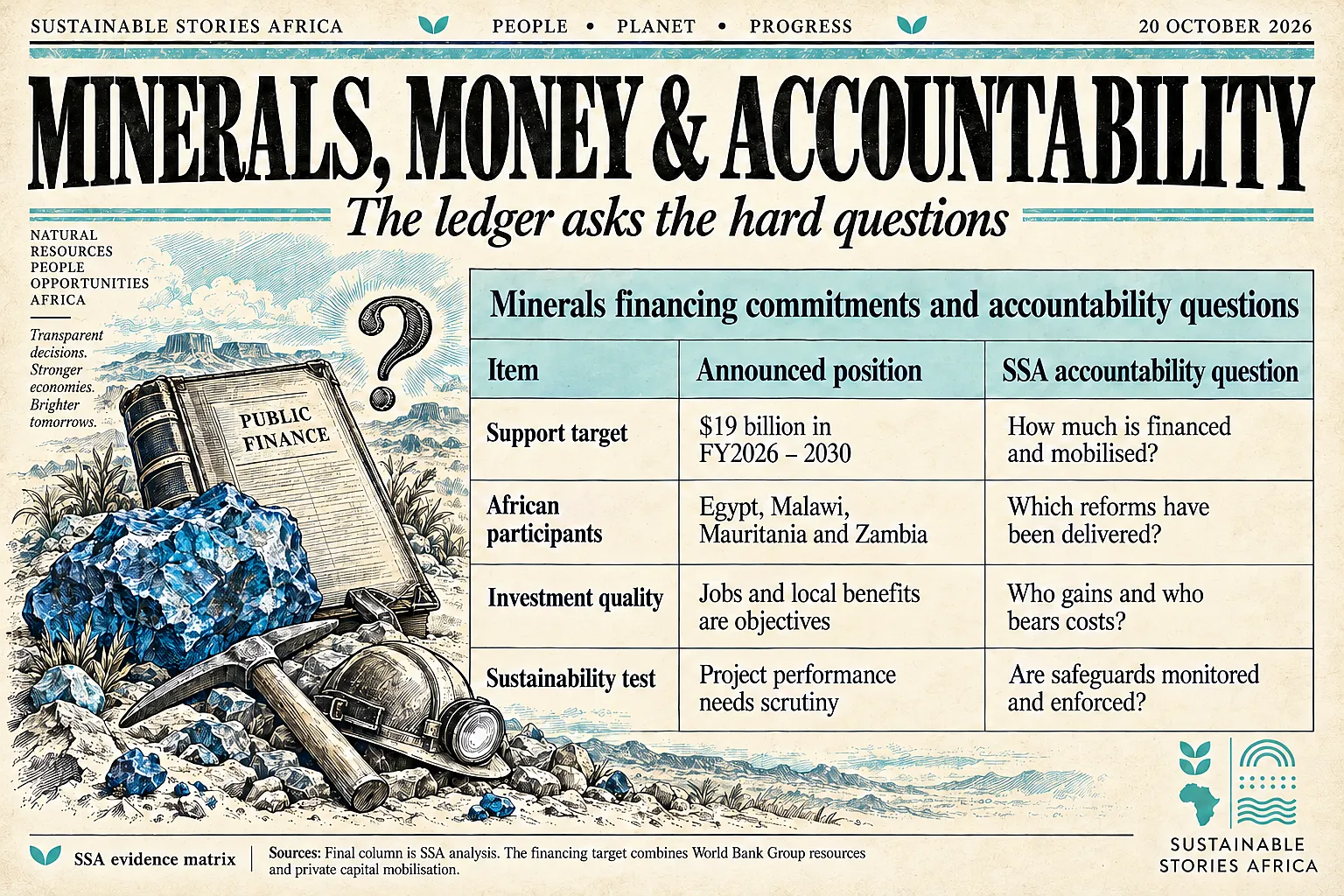
The World Bank Group has set a $19 billion metals and minerals support target for fiscal years 2026 – 2030, combining its financing with expected private capital mobilisation.
- Eight governments launched country partnerships and compacts on 16 October, including Egypt, Malawi, Mauritania and Zambia.
The announcement shifts attention from the strategic importance of mineral resources to the conditions under which projects can attract investment and generate domestic benefits.
- The target is not $19 billion already disbursed, nor an allocation reserved entirely for Africa.
For producing countries, the opportunity is to secure more value from resources used across energy, transport and digital infrastructure.
However, increasing financing is only an input.
Its development significance depends on what is built, who gains access to opportunities and how environmental and social responsibilities are met over each investment.
Country commitments connect investment with reform
The partnerships cover reforms, infrastructure, workforce skills and local suppliers.
The World Bank’s announcement assigns policy advice and public financing to the Bank, private investment mobilisation to IFC and risk-management guarantees to MIGA.
OneStop ESG’s analysis of that bankability and sustainability requires separate scrutiny.
- It identifies environmental performance, community and labour safeguards, governance and accountability as issues to track.
- These considerations are particularly important when a project is described as supporting the energy transition: the destination of its output does not establish how responsibly it operates.
SSA assesses that country targets should be accompanied by project-level evidence.
- A processing ambition needs dependable electricity, transport and water, as well as firms able to supply the operation.
- A jobs commitment needs a definition of what is counted and information about training, duration and working conditions.
Without that detail, a national ambition can remain difficult to evaluate.
Domestic value requires more than extraction
For a local business, the relevant question may be whether it can qualify for a supply contract, receive payment on time and acquire capabilities that remain useful beyond one mine.
- For a nearby community, it may be whether water remains safe and whether a grievance receives a meaningful response.
- These examples illustrate the different ways a project creates or diminishes public value.
The compacts could help connect these concerns with investment planning.
- Shared infrastructure, skills programmes and transparent procurement could widen benefits if designed around practical needs.
- They should be assessed as potential outcomes until delivery is documented.
SSA’s view is that value addition should also be tested commercially.
- Processing a mineral domestically is not automatically beneficial if the activity depends indefinitely on expensive support or creates liabilities larger than its gains.
- Countries need an honest account of costs, market prospects and the distribution of benefits, including the resources required for regulation and environmental oversight.
Public finance must carry clear conditions
Governments and development financiers should publish measurable commitments and explain how progress is assessed.
- That should include the amount financed, the private capital actually mobilised and the conditions attached.
- A guarantee, a loan and an announced investment ambition are different instruments and should not be combined without explanation.
Specify environmental and social responsibilities before construction and monitor them during operation.
- Relevant questions include water management, worker protection, land access and the financing of closure and rehabilitation.
- An institution’s participation should not be treated as a substitute for examining those details.
The OneStop ESG article makes a useful distinction between standards that govern different risks.
SSA implies that public reporting should say which requirements apply to a project and which body checks compliance, rather than rely on a broad sustainability label.
For African countries participating in the initiative, negotiation capacity matters.
- Officials need the resources to assess contracts, revenue assumptions and long-term obligations.
- Community engagement should also have a route into decisions.
Projects become more credible when concerns are addressed before finance is committed and when promised benefits can be compared with independently reviewable results.
Monitoring should continue after the initial investment announcement.
- Changes in project design, financing or expected benefits should be disclosed so that communities and public institutions can assess whether the original development case still holds.
Path Forward – Make mineral investment deliver lasting value
The financing target creates an opportunity for African countries to connect mineral resources with stronger local economies.
Judge delivery through responsible operations, viable domestic linkages and public accountability.
Clear financing records and enforceable safeguards can help prevent strategic mineral demand from becoming a reason to overlook community costs or weak project economics.
Culled from: The World Bank’s $19 Billion Critical Minerals Plan Puts Sustainable Finance to the Test | OneStop ESG