Carbon removal businesses are increasingly seeking investment through products and services that generate income alongside carbon credits, according to the Green Finance Institute.
Its October briefing highlights potential resilience benefits in agriculture, wastewater, construction and ecosystem restoration.
For African developers and financiers, the opportunity is to test these business models locally while proving removal integrity and keeping projected co-benefits separate from measured results.
Carbon removal finance looks beyond credits
Carbon dioxide removal projects could become more investable by combining carbon revenue with commercially valuable products and resilience benefits, the Green Finance Institute argues in an October 2026 briefing.
Its report, Financing Resilience, describes businesses adapting to investor demands and uncertainty in voluntary carbon markets.
The argument gives African developers a practical question to examine: can a project solve an existing problem while delivering independently verified carbon removal?
- Potential applications include soil management, waste treatment and materials, although suitability depends on local conditions.
GFI does not present additional revenues as a guarantee of success.
- Its examples show why investors may be interested in a business whose customers purchase a useful service as well as a climate outcome.
- Each source of income still needs credible demand, realistic costs and a clear account of the obligations attached.
Briefing links revenues with resilience benefits
The report identifies biochar, enhanced rock weathering and alkalinity enhancement as pathways whose additional products or services may help financing.
- It also discusses restoration, soil carbon and mineralisation in concrete, with different potential adaptation benefits.
- These are pathway-specific propositions, not evidence that every project delivers the same outcome.
GFI’s CDR Catalyst, launched with Terraset as a founding partner, is intended to help projects access different forms of capital.
- The briefing says its first supported transaction involved a loan from Oxbury Bank to biochar company Restord.
- Nick Evans, Oxbury’s co-founder and managing director, links the investment to potential environmental and rural-business benefits.
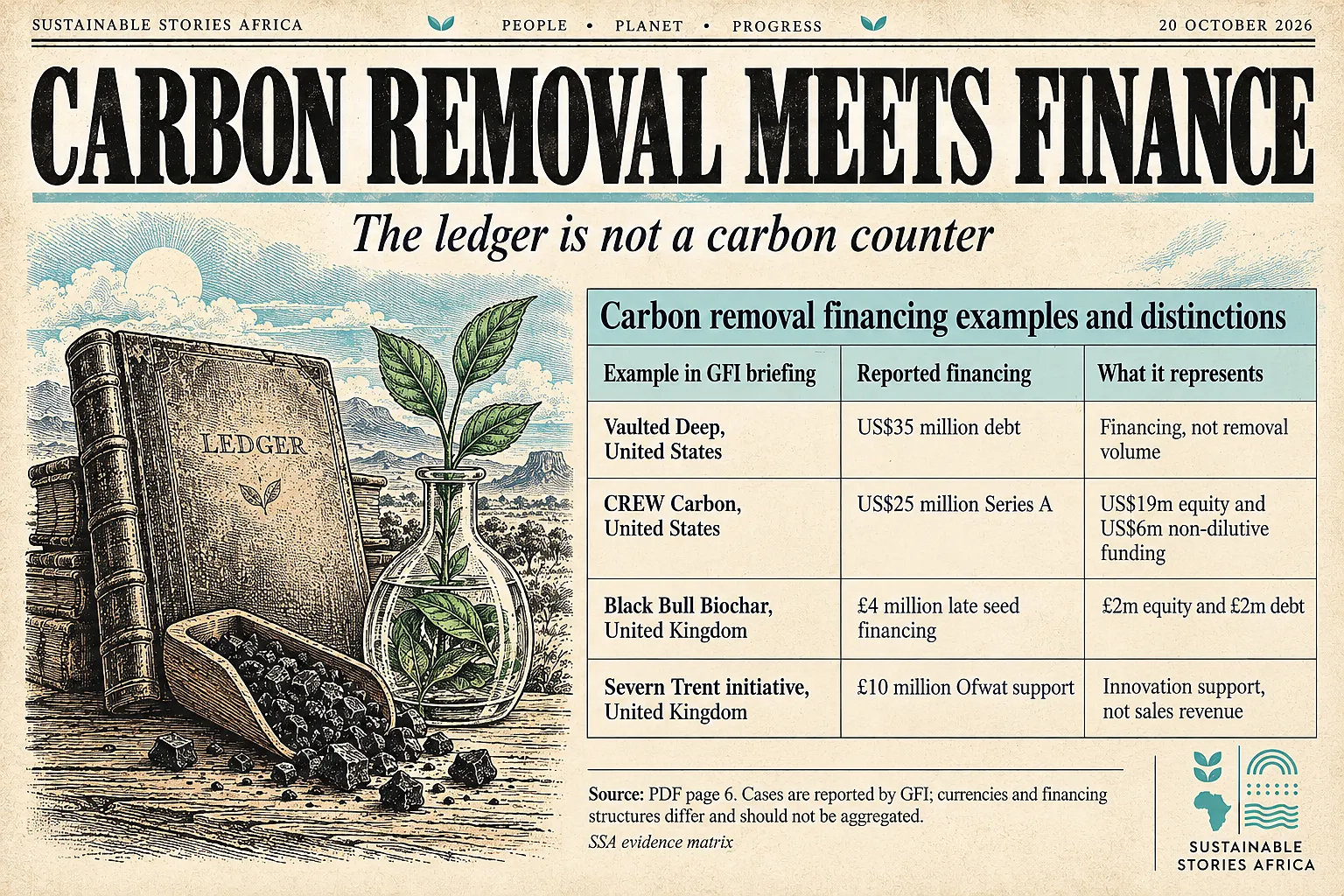
The accompanying table separates selected financing examples from the outcomes they would need to demonstrate.
- Debt, equity, grants and purchase agreements have different conditions; the sums should not be treated as directly comparable measures of project performance.
African opportunities need locally grounded evidence
For an agricultural business, an attractive proposition could be a product that improves a commercially relevant soil characteristic while supporting a verified removal claim.
For a water utility, it could be a treatment process with an operational benefit.
- These are possible applications, not African project results established by the briefing.
SSA assesses that local testing should come before broad claims about scale.
- Feedstock availability, competing uses, transport costs, energy needs and environmental safeguards can change the economics.
- A process that works in one setting may face different constraints elsewhere.
The report cites UK biochar field trials with yield improvements, alongside other business examples.
- Those results should retain their geographical and experimental context.
They should not be applied as expected yield gains for African crops or soils without evidence.
The same discipline applies to resilience.
- Plausible mechanisms, such as improved moisture retention, should be linked to measured outcomes under relevant conditions.
That would let financiers distinguish an additional benefit worth supporting from an attractive statement that remains untested.
Revenue diversification still requires credible accounting
Multiple revenue streams can reduce dependence on a single buyer, but they can also introduce operational complexity.
- Developers need to explain how producing one product affects another, what happens if demand changes and whether the carbon claim remains valid.
- The physical fate of captured carbon matters when assessing whether an activity constitutes durable removal.
GFI discusses hybrid direct air capture models involving both utilisation and storage.
- SSA implies that carbon sold for use should not automatically be described as permanently stored.
- Accounting must follow the actual outcome, with clear boundaries and appropriate verification.
African financiers should assess each revenue stream on its own terms before considering the combined model.
- Customers for a product, buyers of credits and providers of concessional capital may require different evidence.
- Forecasts should identify those dependencies rather than assume that one positive feature resolves all risks.
Public and philanthropic support could help test promising models, provided objectives and results are disclosed.
- Projects should report who receives resilience benefits and whether those benefits continue when support changes.
- Carbon removal should also remain complementary to deep emissions reductions.
The briefing’s central opportunity is a more grounded investment case, not permission to weaken mitigation commitments or lower standards for measuring climate outcomes.
Path Forward – Finance removal through demonstrated local value
African carbon removal projects should test useful products and resilience benefits alongside credible carbon accounting.
Diverse revenues can strengthen a business case only when customers, costs and obligations are understood.
Well-designed pilots, transparent results and independent verification can help investors identify models that deliver value for communities while meeting rigorous removal standards.