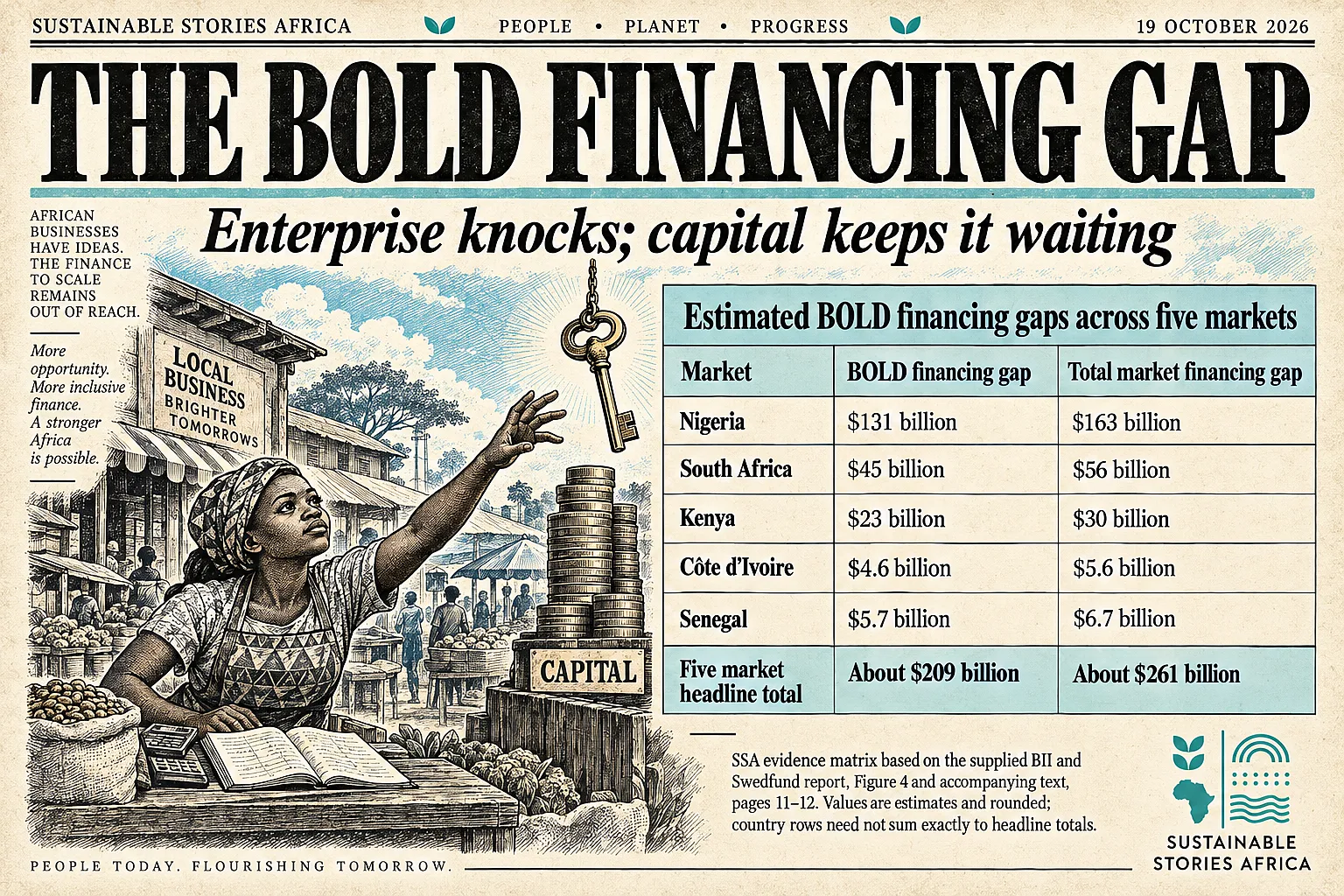
Black-owned and -led businesses account for roughly $209 billion of the estimated $261 billion financing gap across five African markets, according to a BII and Swedfund-commissioned study.
The research finds that representation declines as firms move into larger business segments.
Its recommendations focus on intentional investment, better sourcing networks and finance matched to business needs.
Business ownership outpaces access to capital
Black-owned and -led businesses face a disproportionate share of unmet financing demand across five African markets, a report commissioned by British International Investment and Swedfund finds.
The study estimates a BOLD financing gap of about $209 billion and a combined $261 billion gap in Côte d’Ivoire, Kenya, Nigeria, Senegal and South Africa.
BOLD refers to Black Ownership and Leadership for Development, the framework used to classify businesses in the study.
The report says these businesses’ aggregate funding gaps are approximately four times those of non-BOLD businesses across the markets assessed.
- This is not evidence that every individual Black entrepreneur is four times more likely to be rejected for finance.
The finding matters because forming a business and financing its expansion are different challenges.
A large presence among smaller firms can coexist with restricted pathways into sectors and company sizes requiring substantial growth capital.
Five markets reveal uneven growth pathways
Open Capital Advisors conducted the research, combining market analysis with consultations involving more than 70 stakeholders.
- It reports estimated BOLD financing gaps of $131 billion in Nigeria, $45 billion in South Africa, $23 billion in Kenya, $4.6 billion in Côte d’Ivoire and $5.7 billion in Senegal.
- The rounded country figures do not sum precisely to the rounded headline total.
BOLD businesses account for between 89% and 99% of small-cap firms across the five markets.
- Representation is lower in larger segments, though the pattern varies: the report puts BOLD participation in large-cap businesses at 35% in South Africa, compared with 78% in Nigeria and 85% in Senegal.
The report also extrapolates an indicative sub-Saharan financing gap of up to $1.842 trillion.
- That broader estimate depends on modelling from the research approach; it should not be presented as a directly observed sum of rejected investment applications.
Capital should match different business realities
The consultations identify barriers including investment readiness, suitable financing and access to networks. Country context matters.
- Nigerian participants emphasised hard-currency financing constraints;
- South African discussions highlighted the legacy of apartheid, wealth accumulation and investor relationships.
The report recognises that some barriers also reflect business size and maturity rather than ownership alone.
For investors, the opportunity is to assess businesses that familiar sourcing networks may miss.
- The report recommends intentional BOLD strategies, stronger pipelines, greater Black representation among capital allocators, tailored finance and technical assistance.
Its examples show how financing can support concrete activities.
- BII’s reported $40.5 million senior secured debt investment in Nigerian cocoa processor Johnvents supported facility expansion and modernisation.
- A $5 million flexible debt investment in Lovegrass Ethiopia supported working capital and growth.
These examples illustrate financing approaches rather than proving that one instrument suits every BOLD business.
Investors should measure decisions and outcomes
SSA assesses that implementation should begin before the investment committee receives a proposal.
- Funds should examine how opportunities enter their pipeline, which firms leave the process and the reasons recorded.
- This would help distinguish weak sourcing from unsuitable terms or unmet investment requirements.
Businesses also need a clear explanation of investors' requirements.
Governance support can be valuable when it addresses a specific constraint, such as financial reporting or succession planning.
- It should be designed with the company rather than imposed as a generic readiness exercise.
Portfolio targets need transparent definitions and outcome measures.
- The report identifies a target of at least 60% BOLD exposure for Growth Investment Partners Zambia and a 75% target for Aruwa Fund II.
- These are commitments, not evidence that the stated allocation has already been achieved.
Investors should publish progress against such commitments alongside commercial and development results, allowing scrutiny of both capital allocation and the businesses’ ability to grow.
Path Forward – Match inclusive investment commitments with delivery
Investors should broaden sourcing, tailor financing and support governance improvements that help businesses absorb capital.
Country differences should guide implementation.
Transparent pipeline and portfolio reporting would make commitments reviewable.
Closing financing gaps requires demonstrable investment and business growth, with estimates and targets clearly distinguished from achieved outcomes.