
Artificial intelligence is reshaping supply chain planning by enabling businesses to respond to changing conditions more continuously.
A new McKinsey discussion suggests that AI-enabled systems could reduce dependence on fixed planning cycles while improving operational flexibility.
However, successful adoption will require stronger governance, reliable data, workforce development and continued human accountability.
Artificial Intelligence Redefines Supply Chain Planning
Artificial intelligence is emerging as a significant force in global supply chain management, potentially transforming how businesses anticipate disruptions, coordinate resources and make operational decisions.
A McKinsey & Company discussion published in October 2026 examines how advanced planning systems are moving beyond traditional software platforms towards continuous, AI-enabled decision-making.
- The analysis appears in Voices on Planning: The AI-Powered Future of Supply Chain, part of the McKinsey Talks Operations series.
- The discussion brings together host Daphne Luchtenberg and McKinsey specialists Andrew Shih and Mike Raftery.
The central argument is that supply chain planning could shift from fixed daily, weekly or monthly schedules towards systems capable of analysing changing information and supporting decisions in real time.
This transition may improve organisational responsiveness, but it also introduces new challenges involving governance, workforce capabilities and technological accountability.
Continuous Planning Challenges Traditional Operating Models
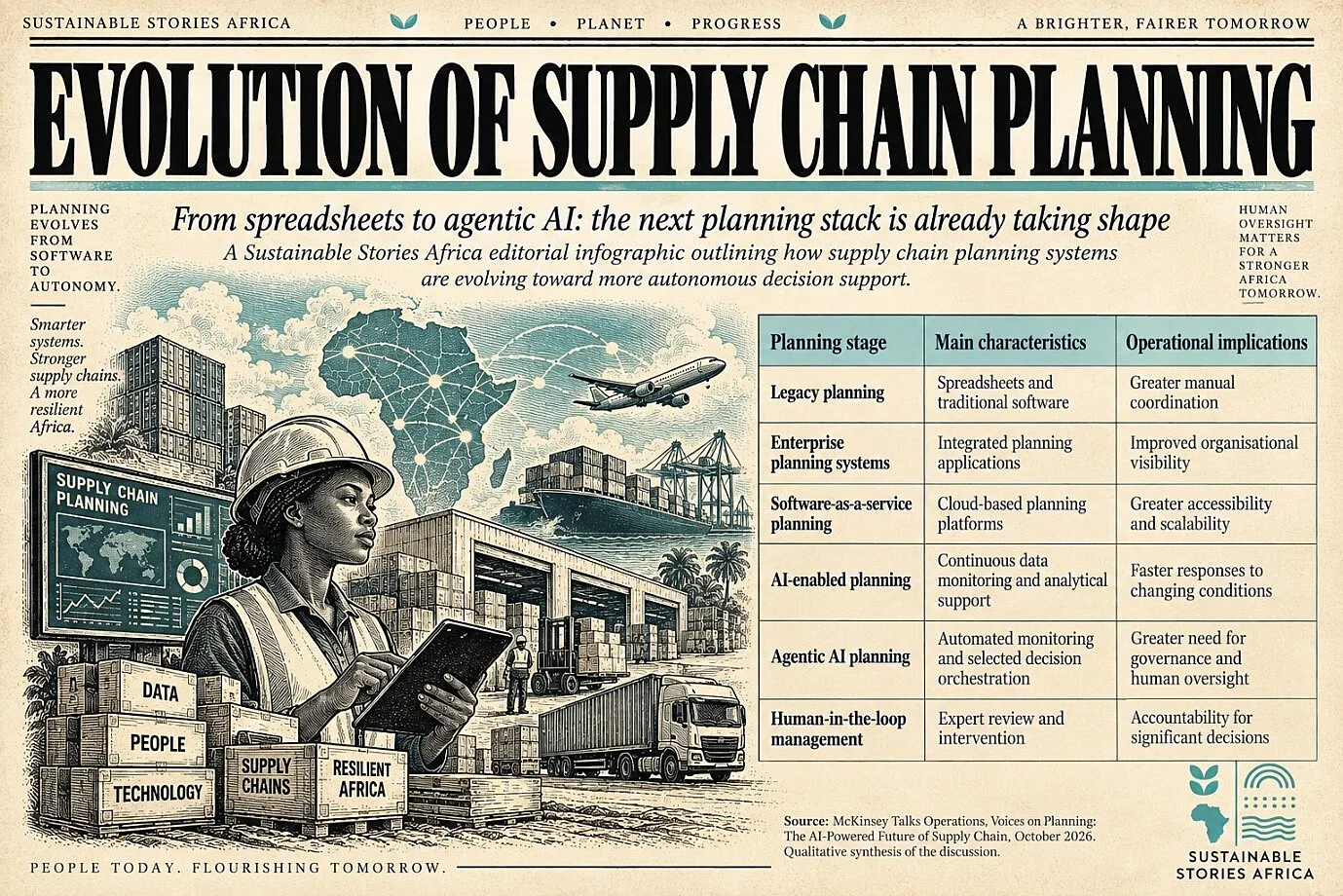
Advanced planning systems have undergone several major technological transitions.
- Businesses initially moved from spreadsheets and legacy applications towards enterprise planning platforms.
- The widespread adoption of software-as-a-service models subsequently changed how organisations accessed, managed and maintained planning technologies.
Artificial intelligence is now creating the possibility of another transition.
According to Andrew Shih, agentic AI systems can continuously observe information and coordinate planning activities as conditions change.
- He explained that organisations could increasingly plan according to real-world developments rather than fixed calendar schedules.
This approach could reduce the delays associated with waiting for scheduled planning meetings or system updates.
- For example, a manufacturer experiencing an unexpected supply interruption could potentially use AI-assisted systems to identify alternative suppliers, assess inventory implications and evaluate possible responses.
However, the technology's effectiveness depends on the quality of the data available and the rules governing automated decisions.
Human Expertise Remains Essential Despite Automation
The McKinsey discussion emphasises that AI adoption should not be treated solely as a software replacement exercise.
- Organisations may need to redesign processes, establish governance systems and prepare employees for new responsibilities.
Shih identifies several important changes in the role of supply chain planners.
- These include teaching AI systems relevant operational context, making critical decisions and overseeing the activities of automated planning tools.
- Human accountability remains essential, particularly when decisions involve significant financial, operational or reputational consequences.
Raftery also highlights the need for organisations to reconsider established planning practices rather than simply reproduce existing workflows using more sophisticated technology.
For African businesses, these developments could be particularly relevant.
- Supply chains across the continent frequently face challenges involving infrastructure bottlenecks, transport reliability, foreign exchange pressures, energy availability and fragmented information systems.
- AI-assisted planning could potentially improve inventory management, supplier coordination, logistics scheduling and responses to disruption.
For agricultural supply chains, better planning may help reduce delays and prevent avoidable product losses.
For manufacturers and retailers, improved visibility could support more efficient stock allocation and procurement.
However, these benefits depend on dependable data, suitable infrastructure and realistic implementation strategies.
Businesses Must Strengthen AI Governance Systems
Organisations adopting AI-enabled supply chain planning should begin by reviewing their existing data systems and operational processes.
- Reliable information on suppliers, production, inventory, customer demand and transportation is essential for useful decision-making.
Businesses should also define which activities can be automated and which require human approval.
- Governance frameworks should address data security, accountability, system reliability and the management of unexpected outcomes.
Workforce development is equally important.
- Supply chain professionals will need stronger skills in data interpretation, scenario analysis, technology supervision and strategic decision-making.
For African enterprises, a phased implementation approach may be particularly valuable.
- Pilot projects can help businesses assess potential benefits before committing to extensive technology investments.
- Performance monitoring should examine operational results, including service reliability, inventory efficiency, working capital and customer satisfaction, rather than focusing only on the sophistication of the technology.
Path Forward – Responsible AI Can Strengthen Supply Resilience
AI-enabled planning offers opportunities to make supply chains more responsive, efficient and resilient.
Its success will depend on whether organisations combine technological capabilities with reliable data, workforce development and accountable management.
For African businesses, adopting AI responsibly could support stronger logistics systems, improve commercial performance and reduce vulnerability to supply chain disruption.