New research suggests that climate change and the adoption of low-carbon technologies can interact to reshape electricity demand in unexpected ways.
A United States modelling study covering 183 counties projects that these combined effects could substantially alter peak electricity requirements by 2060.
The findings have implications for power system reliability, climate adaptation and infrastructure planning in African electricity markets.
Climate And Technology Reshape Power Demand
Power systems may face far greater uncertainty than conventional electricity forecasts suggest as rising temperatures interact with the adoption of new technologies.
A study published in Proceedings of the National Academy of Sciences on 20 October 2026 found that climate change and technology diffusion can produce combined effects on building electricity demand that differ substantially from their individual impacts.
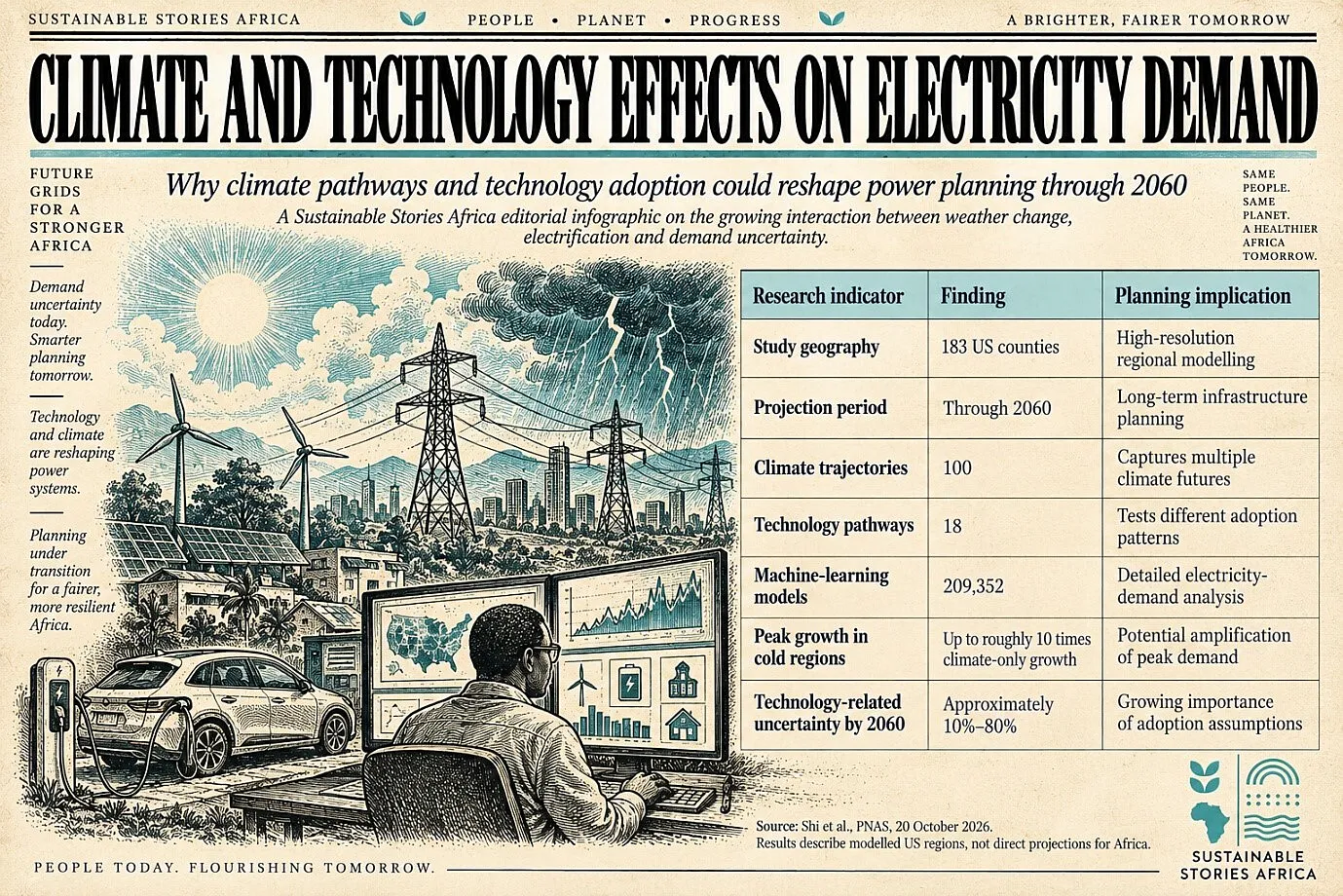
The research, conducted by Mai Shi, Ziqi Wei, Flavio Lehner and Michael T. Craig, examined residential and commercial building electricity consumption across 183 United States counties through 2060.
- The researchers investigated how changing climate conditions interact with the adoption of air-source heat pumps and building insulation.
- Their findings indicate that electricity demand may change not only in magnitude, but also in timing and seasonal distribution.
These factors are important because electricity grids must maintain sufficient capacity to meet peak demand, not simply annual consumption.
Regional Climate Conditions Produce Different Outcomes
The study developed a modelling framework incorporating 100 climate trajectories, 18 technology diffusion pathways and more than 209,000 machine-learning models.
Its results demonstrate that the combined impact of climate change and technology adoption is not necessarily additive.
- In colder electricity-grid regions, the interaction between warming and the adoption of low-carbon technologies could produce peak-demand growth up to approximately ten times greater than the increase associated with climate change alone by 2060.
- In hotter regions, technology diffusion can partially offset climate-driven increases in peak electricity demand.
This difference reflects the competing effects of greater cooling needs, more efficient technologies and the electrification of heating.
The researchers also found that climate-related uncertainty dominates near-term peak-demand projections, while uncertainty surrounding technology adoption becomes more influential over time.
By 2060, technology-diffusion uncertainty accounts for approximately 10% to 80% of total uncertainty in certain regional projections.
Integrated Forecasting Can Improve Grid Resilience
The study offers important lessons for electricity infrastructure planning.
- Traditional forecasts that assess temperature trends and technology adoption separately may underestimate or mischaracterise future peak demand.
- As households and businesses introduce efficient cooling systems, electric heating technologies and other electricity-dependent equipment, patterns of energy consumption may shift.
In African cities, rising temperatures are likely to increase the importance of cooling demand.
- At the same time, appliance efficiency, building insulation, solar electricity and new energy technologies could influence the timing and magnitude of grid requirements.
However, the US study cannot be directly applied to African electricity systems without accounting for local climate conditions, electricity access, household incomes, building characteristics and infrastructure reliability.
- Its relevance lies in the modelling approach: planners should analyse interacting drivers rather than assuming their effects can simply be added together.
This could help reduce the risk of underinvestment in generation, transmission, distribution and energy storage.
Energy Planners Must Model Interacting Risks
Electricity utilities and regulatory authorities should strengthen the integration of climate science with technology adoption forecasts.
- This requires detailed information on weather patterns, building energy consumption, appliance efficiency, electricity access and future technology deployment.
- Scenario-based planning can help institutions examine how peak demand may change under different climate and investment conditions.
For African economies, improved modelling could also support decisions about grid modernisation, efficient cooling, distributed solar systems and energy storage.
Governments should encourage coordination among electricity utilities, urban planners, climate agencies and research institutions.
Such cooperation can improve infrastructure investment decisions while reducing the likelihood of avoidable supply interruptions.
Path Forward – Smarter Electricity Planning Builds Climate Resilience
The research demonstrates that future electricity demand cannot be understood through climate or technological change alone.
African electricity planners can draw on this insight by integrating local climate projections, efficiency improvements and technology adoption into investment decisions.
More comprehensive forecasting can support reliable electricity systems, stronger climate resilience and a transition that meets growing development needs.