
A global survey of sustainability experts suggests that moral arguments are becoming less effective in driving environmental and social progress.
Nearly seven in ten respondents believe ethical appeals have lost influence over the past five years.
The findings challenge businesses, governments and sustainability advocates to connect environmental responsibility with economic resilience, affordability and practical outcomes.
Sustainability's Moral Case Faces Growing Resistance
The argument that businesses and governments should pursue sustainability simply because it is morally right may no longer be sufficient to generate meaningful action.
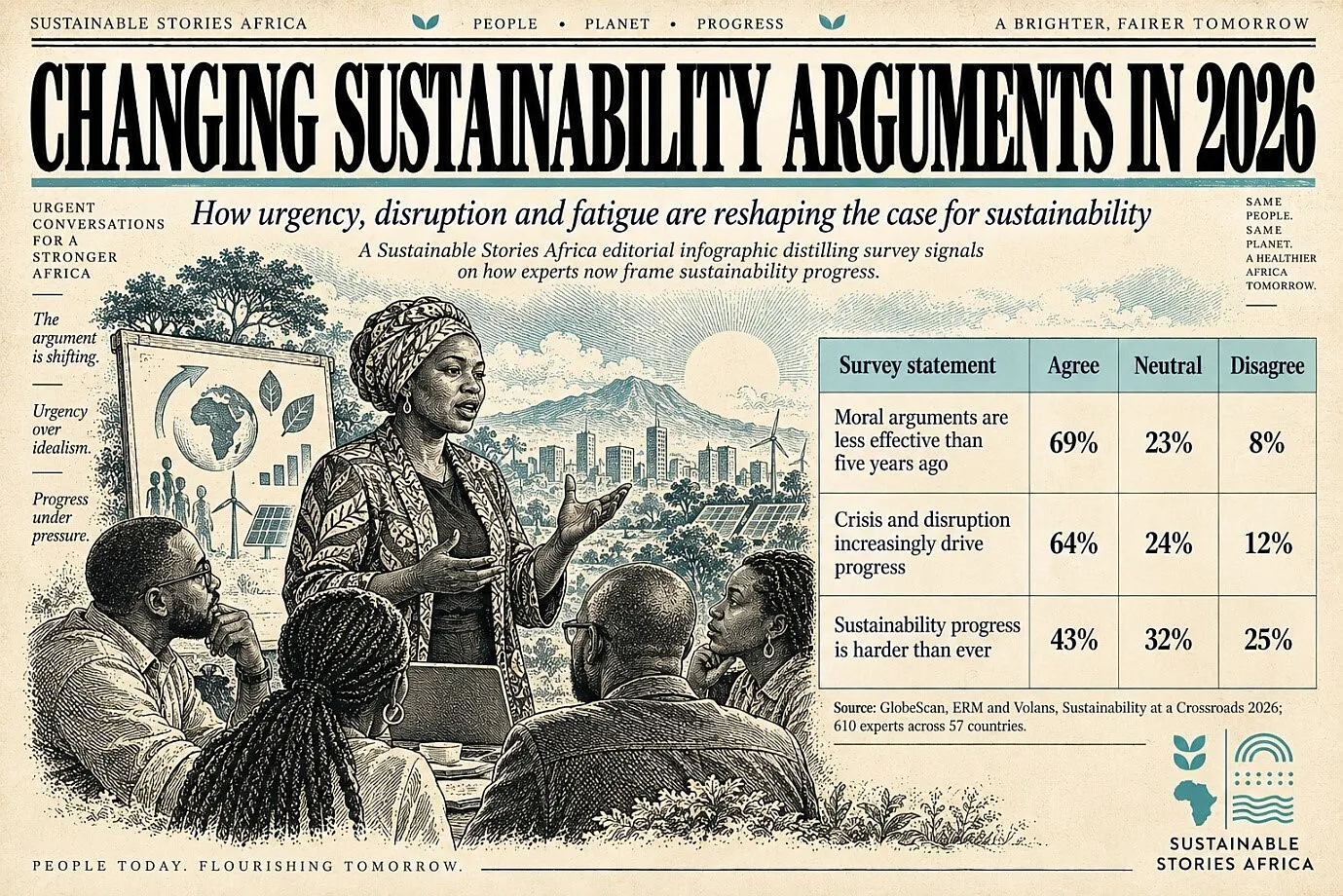
New research published on 21 October 2026 by GlobeScan indicates that 69% of sustainability experts believe moral arguments have become less effective over the past five years.
The findings, drawn from the Sustainability at a Crossroads 2026 survey conducted by GlobeScan, ERM and Volans, reflect responses from 610 sustainability experts across 57 countries between June and August 2026.
The research also found that 64% believe progress is increasingly driven by crises and disruptions rather than planned collective action.
These findings raise an important question for sustainability communicators:
- How can organisations build support for long-term environmental and social goals when ethical arguments are no longer persuasive enough on their own?
Global Experts Describe Changing Sustainability Priorities
GlobeScan's findings suggest that the sustainability agenda is undergoing a change in how it gains legitimacy and attracts investment.
- Although 69% of experts agreed that moral arguments are less influential, only 8% disagreed.
- Furthermore, 64% agreed that crises and disruptions now drive progress, compared with 12% who disagreed.
Opinions were more divided on whether advancing sustainability has become harder than ever.
- While 43% agreed, 32% remained neutral, and 25% disagreed.
The results suggest that sustainability professionals are not necessarily abandoning the agenda.
Instead, they acknowledge that strategies for gaining political, commercial and public support must evolve.
For African economies, the implications are particularly relevant.
- Businesses and policymakers must often pursue sustainability objectives alongside immediate development priorities, including affordable electricity, employment, food security, public infrastructure and industrial competitiveness.
A climate action proposal that demonstrates how renewable electricity can reduce energy costs, strengthen business continuity and create employment may attract broader support than one presented exclusively as an ethical obligation.
However, economic arguments should complement rather than replace environmental justice, human rights and intergenerational responsibility.
Practical Benefits Can Rebuild Public Support
The research indicates an opportunity to strengthen sustainability communication by connecting long-term objectives to present-day concerns.
- Rather than communicating only the environmental importance of cleaner energy, organisations can explain how energy efficiency affects operating costs and how renewable technologies can improve resilience to volatile fuel prices.
Similarly, arguments for responsible supply chains can incorporate labour protections, market access, product quality and reduced exposure to disruption.
For African businesses navigating changing sustainability requirements, the strongest narratives will combine credible evidence with operational relevance.
- This shift could help address a common weakness in ESG communication: the tendency to focus on commitments and aspirations without demonstrating measurable outcomes.
However, a more commercially grounded narrative must not become an excuse to exaggerate financial benefits or obscure environmental trade-offs.
Sustainability Communicators Must Demonstrate Tangible Value
Governments, development institutions and corporate sustainability teams should reconsider how they present ESG policies, investments and programmes.
- The immediate priority is to link sustainability goals with outcomes that audiences can assess.
These may include lower energy expenditure, reduced exposure to flooding, improved workforce safety, stronger agricultural productivity and more reliable infrastructure.
- Corporate reporting should also explain implementation costs, uncertainties and trade-offs.
Effective sustainability advocacy requires a combination of ethical responsibility, financial realism and public accountability.
The survey's findings reinforce the importance of evidence-based communication that addresses both long-term environmental risks and the immediate needs of communities.
Path Forward – Making Sustainability Relevant Before Crises Strike
The path forward requires sustainability leaders to frame environmental and social responsibility around resilience, competitiveness, security, affordability and measurable outcomes.
For African economies, this means communicating sustainability not as an additional burden, but as an approach to solving development challenges while protecting future generations.
Effective action must begin before another crisis makes the consequences of delay unavoidable.
Culled from: When Being Right Stopped Being Enough