
New behavioural research suggests that even minor rule violations can contribute to widespread noncompliance when individuals imitate or exceed the misconduct they observe.
A study involving 750 participants found that observing severe violations increased subsequent rule-breaking, particularly among socially connected individuals.
The findings offer new insights into governance, organisational ethics and the importance of protecting social norms.
Small Violations Can Trigger Wider Misconduct
A seemingly minor breach of a rule can produce consequences far beyond the original offence, according to new research examining how rule-breaking spreads through social influence.
The study, Contagion and Escalation of Rule Violations, published in Proceedings of the Royal Society B in 2026, combined behavioural experiments with simulations to investigate how observing misconduct affects subsequent decisions.
Researchers Lucas Molleman, Karlijn Hoyer, Gerben A. van Kleef, Christin Scholz and Jan Hausfeld examined whether people merely imitate violations or sometimes exceed them.
- Their findings indicate that observing major violations increases the likelihood of further rule-breaking, especially when the misconduct is committed by socially close individuals.
More significantly, the researchers found that occasional escalations beyond observed violations can disproportionately undermine collective compliance.
The findings provide a behavioural explanation for how otherwise cooperative systems can gradually become environments in which rule-breaking is normalised.
Experimental Evidence Reveals Escalating Social Influence
The researchers conducted a preregistered behavioural experiment involving 750 participants in the United States.
- Participants made decisions about whether to comply with a rule that imposed an immediate personal cost, before observing another person's behaviour and making subsequent decisions.
The experiment distinguished full compliance, minor violations and more substantial departures from the rule.
- Researchers found that outright rule-breaking occurred in 22.7% of initial decisions.
- Across subsequent observations, approximately 4.4% of trials involved participants escalating beyond the level of misconduct they had witnessed.
Although this proportion was relatively small, simulations showed that such behaviour could substantially accelerate the spread of rule violations.
Approximately 58% of trials produced no change in participants' decisions after observing another person, showing that social influence was not universal.
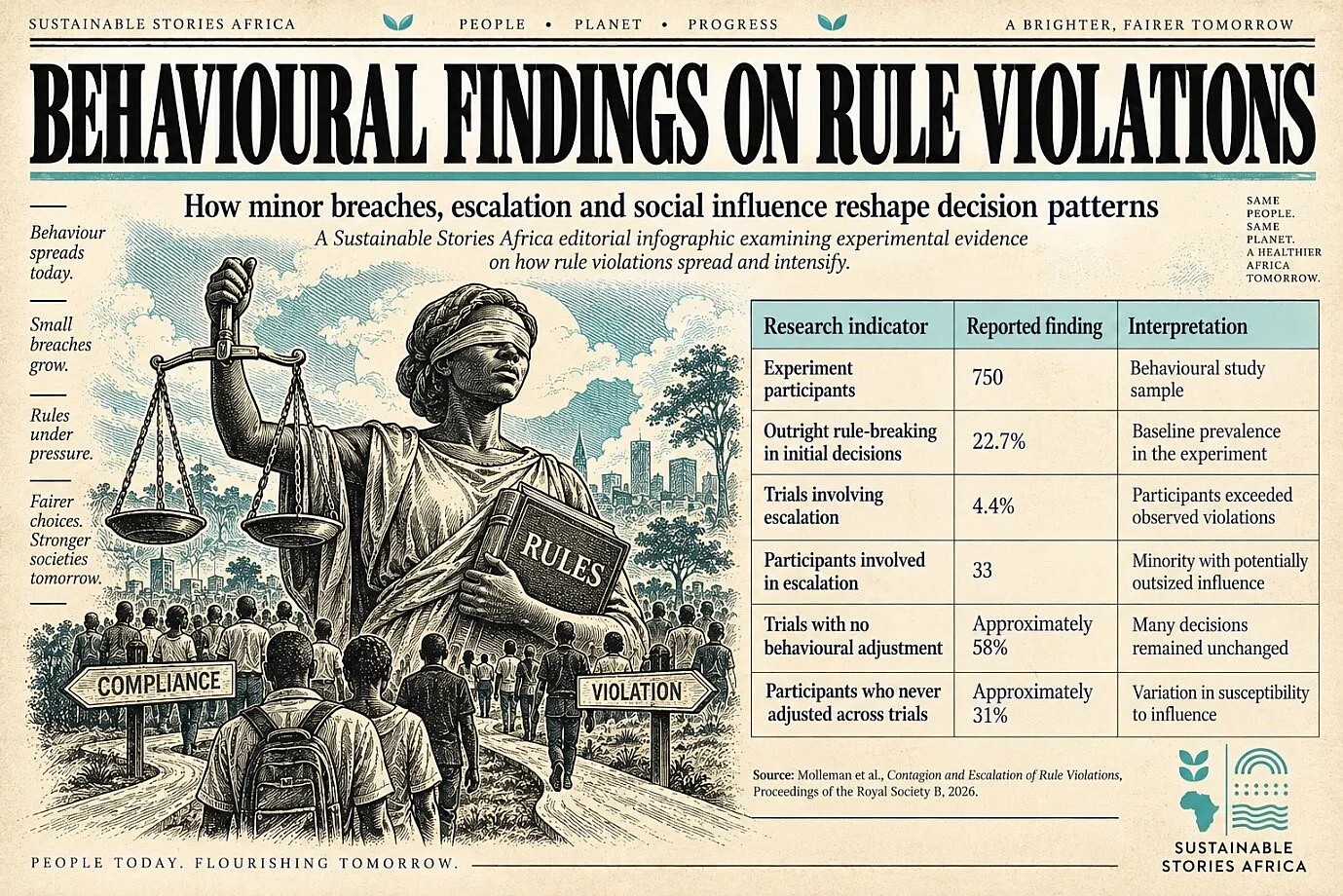
- These results indicate that the distribution of behavioural responses matters as much as average levels of compliance.
- Most individuals may resist misconduct, but a smaller number of people who escalate violations can substantially influence wider patterns of behaviour.
Stronger Social Norms Can Protect Institutions
The research has implications for institutions in which compliance depends partly on trust and voluntary cooperation.
- Public services, workplaces, transport systems and corporate organisations all rely on individuals respecting formal and informal rules.
- A minor procurement irregularity, for example, may encourage more serious misconduct if colleagues interpret it as acceptable behaviour.
Similarly, small departures from workplace safety procedures can weaken expectations that established standards should be followed.
These are potential applications of the findings, not situations directly tested by the researchers.
- For African businesses and public institutions, the study reinforces the importance of ethical leadership, transparent procedures and consistent enforcement.
Strong compliance cultures depend on visible examples of responsible behaviour, alongside credible systems for addressing misconduct.
Institutions Should Interrupt Escalation Before Normalisation
The findings suggest that policymakers and organisational leaders should respond to rule violations before they become socially established.
- Preventive measures could include clear behavioural expectations, consistent accountability mechanisms, ethical leadership training and accessible reporting channels.
Organisations should also assess how influential individuals shape workplace norms.
- Where misconduct is observed among colleagues or leaders who command trust, the potential for imitation may be particularly important.
However, the study's experimental setting does not establish that the same escalation rates will occur in real-world institutions.
- The research isolated social influence under controlled conditions and did not reproduce the full effects of punishment, culture, moral judgement or complex institutional incentives.
Its principal contribution is demonstrating a plausible mechanism through which small violations can produce wider behavioural changes.
Path Forward – Preventing Misconduct Requires Consistent Ethical Leadership
The study highlights the importance of addressing early rule violations through fair enforcement, transparent expectations and responsible leadership.
For organisations and governments, protecting compliance requires more than punishing major misconduct after it occurs.
Institutions must also prevent minor violations from becoming accepted practices, particularly where influential individuals can shape the behaviour of others.