
The global business aviation market continues to expand despite supply chain constraints, infrastructure pressures and shortages of specialised personnel.
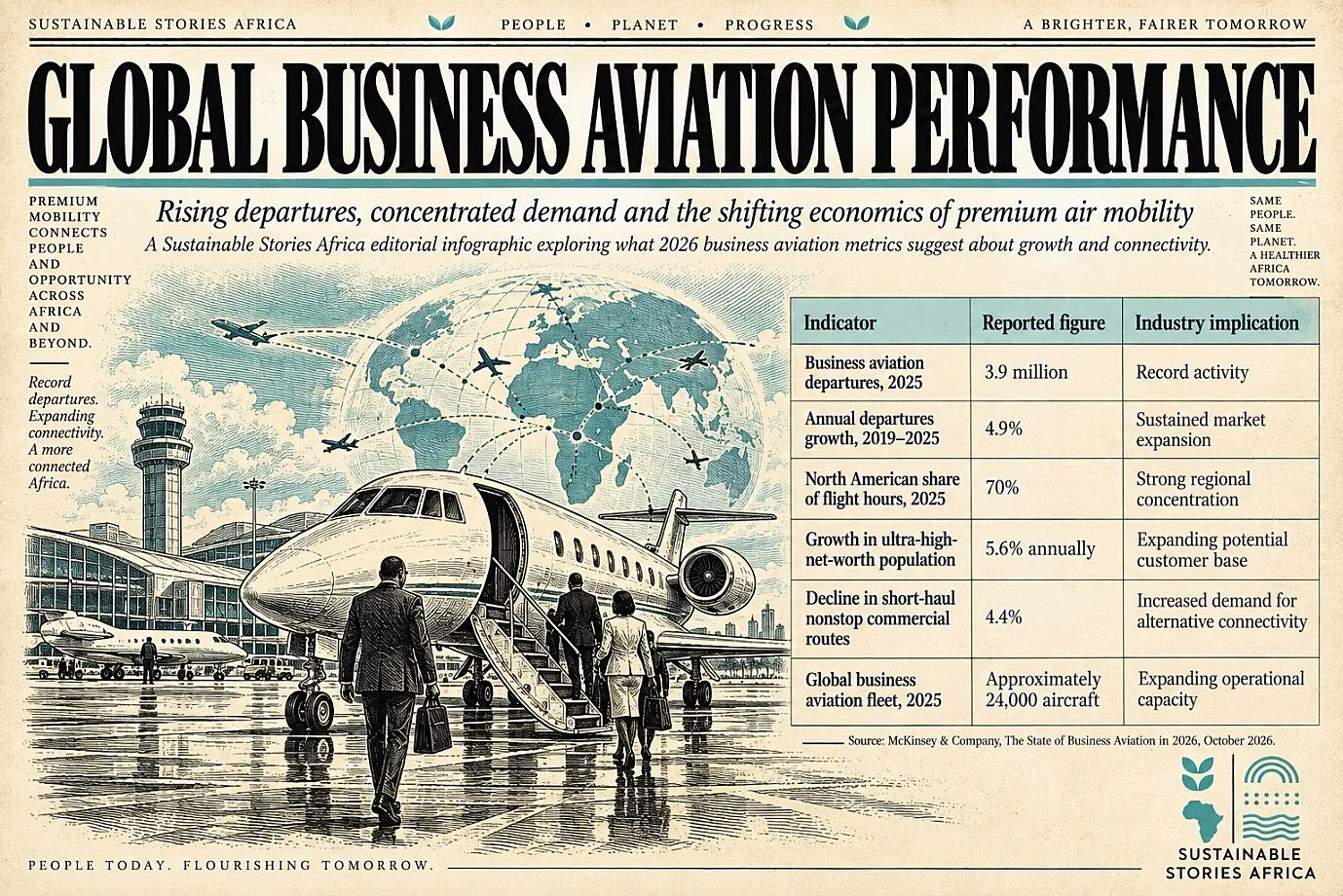
A new McKinsey analysis reports that business aviation departures reached a record 3.9 million in 2025.
The findings highlight opportunities for aviation investment while raising questions about operational efficiency, emissions, infrastructure development and sustainable industry growth.
Business Aviation Demand Continues Strong Expansion
Global business aviation has maintained strong demand despite economic and operational pressures, with industry activity reaching record levels as operators confront increasingly constrained aircraft supply and infrastructure capacity.
A McKinsey & Company analysis published in October 2026 reports that business aviation departures reached approximately 3.9 million in 2025.
The study, The State of Business Aviation in 2026: Resilient, Despite Headwinds, found that departures increased by approximately 4.9% annually between 2019 and 2025.
Business aviation recovered rapidly following the COVID-19 pandemic, with global flight hours returning to pre-pandemic levels by March 2021.
Commercial airline traffic took considerably longer to recover.
The findings suggest that private aviation has gained a stronger position in the global travel market, supported by demand for flexible schedules, direct access to destinations and personalised services.
However, this expansion creates new pressures on aircraft manufacturers, airports, maintenance providers and aviation personnel.
Rising Demand Exposes Aviation Infrastructure Constraints
North America remains the dominant business aviation market, accounting for approximately 70% of global business flight hours in 2025.
- The McKinsey report also identifies increasing activity in other regions, including Africa, Asia-Pacific and Latin America.
Growth is partly linked to rising numbers of ultra-high-net-worth individuals and changing demand for premium air travel.
- The global population of individuals with net worth exceeding $30 million grew about 5.6% annually between 2019 and 2025, according to figures cited in the analysis.
Another contributing factor is the reduction of certain commercial airline routes.
Globally, the number of nonstop commercial routes covering distances below 1,000 kilometres declined by approximately 4.4% between 2019 and 2025.
- Such changes can increase business aviation attractiveness, especially for travellers seeking direct access to underserved destinations.
However, operators must contend with aircraft production constraints, crew availability, hangar capacity, maintenance requirements and airport congestion.
Sustainable Infrastructure Could Strengthen Aviation Markets
The growth of business aviation creates opportunities to invest in airport infrastructure, maintenance services and technical workforce development.
For African economies, business aviation may help connect locations where scheduled commercial services remain limited.
- It could support business activities, investment travel and specialised transport requirements.
However, aviation expansion also raises environmental questions.
- Private aircraft can have high emissions per passenger, particularly when carrying small numbers of travellers.
Sustainable industry growth therefore requires attention to fuel efficiency, aircraft utilisation, operational practices and the development of lower-emission aviation technologies.
- Sustainable aviation fuel could reduce emissions, but costs, supply constraints and the availability of suitable feedstocks remain important considerations.
For emerging aviation markets, investment decisions should balance economic connectivity with environmental performance and infrastructure efficiency.
Industry Leaders Must Address Capacity Shortages
The McKinsey analysis suggests that competitive advantage increasingly depends on coordinating aircraft availability with supporting operational capacity.
- Aircraft purchases alone cannot resolve shortages of qualified crews, engineers, maintenance facilities and airport infrastructure.
Operators should prioritise workforce development, efficient fleet utilisation and infrastructure partnerships.
Regulators and airport authorities can improve sector resilience through coordinated capacity planning, safety oversight and investment frameworks.
Environmental reporting also deserves greater attention as aviation activity expands.
For African markets, a sustainable aviation strategy should include technical training, modern safety systems, efficient infrastructure and credible emissions monitoring.
These measures could strengthen the sector's economic contribution while managing operational and environmental risks.
Path Forward – Aviation Growth Must Align With Sustainability
Business aviation's resilience reflects continued demand for flexible travel, but future growth will depend on overcoming increasingly complex capacity constraints.
For African aviation markets, the opportunity lies in developing efficient infrastructure, skilled personnel and responsible operating practices.
Long-term competitiveness will require operators to combine reliable connectivity with transparent environmental performance and sustainable investment.