The African Development Bank Group has approved $68 million for Madagascar’s second-phase financial governance and resilience programme.
The financing comes as the island nation seeks wider fiscal space, stronger institutions and renewed investor confidence.
For households and businesses, the test is practical: whether reforms improve services, energy access and opportunity.
Madagascar’s Reform Test Gets Fresh Backing
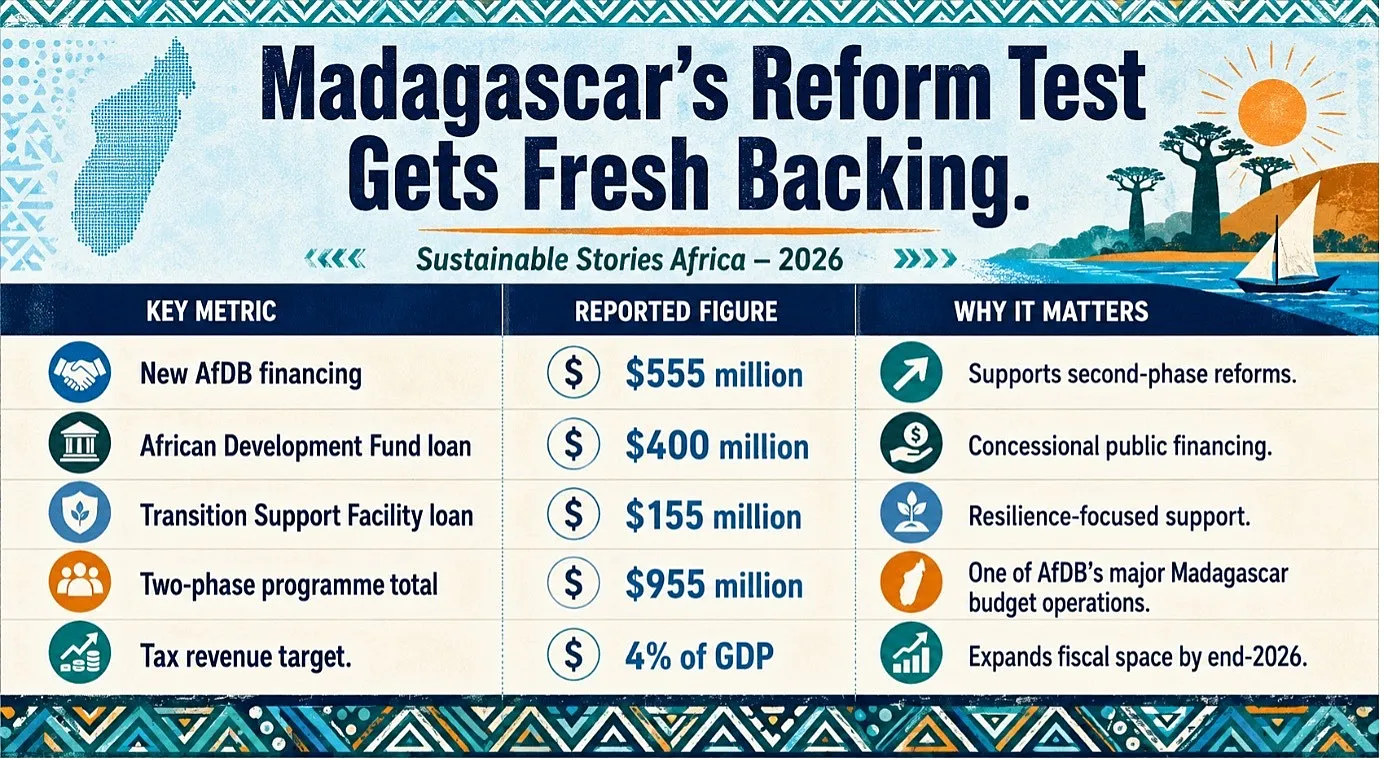
The African Development Bank Group has approved a $68 million financing package for Madagascar, strengthening support for the country’s public financial management, private-sector competitiveness and economic resilience at a time when fiscal pressures, energy gaps and institutional reform remain central to its development path.
The package supports the second phase of Madagascar’s Financial Management and Economic Resilience Support Programme.
It combines a $27.2 million concessional loan from the African Development Fund with a $40.8 million concessional loan from the Transition Support Facility, bringing total support under the two-phase programme to $136 million.
For Madagascar, this is more than a budget support operation. It is a governance signal.
The financing is designed to help the country collect more revenue, improve transparency, attract investment and direct reforms toward sectors that affect daily life, especially energy access and rural inclusion.
Reforms Move From Paper To Systems
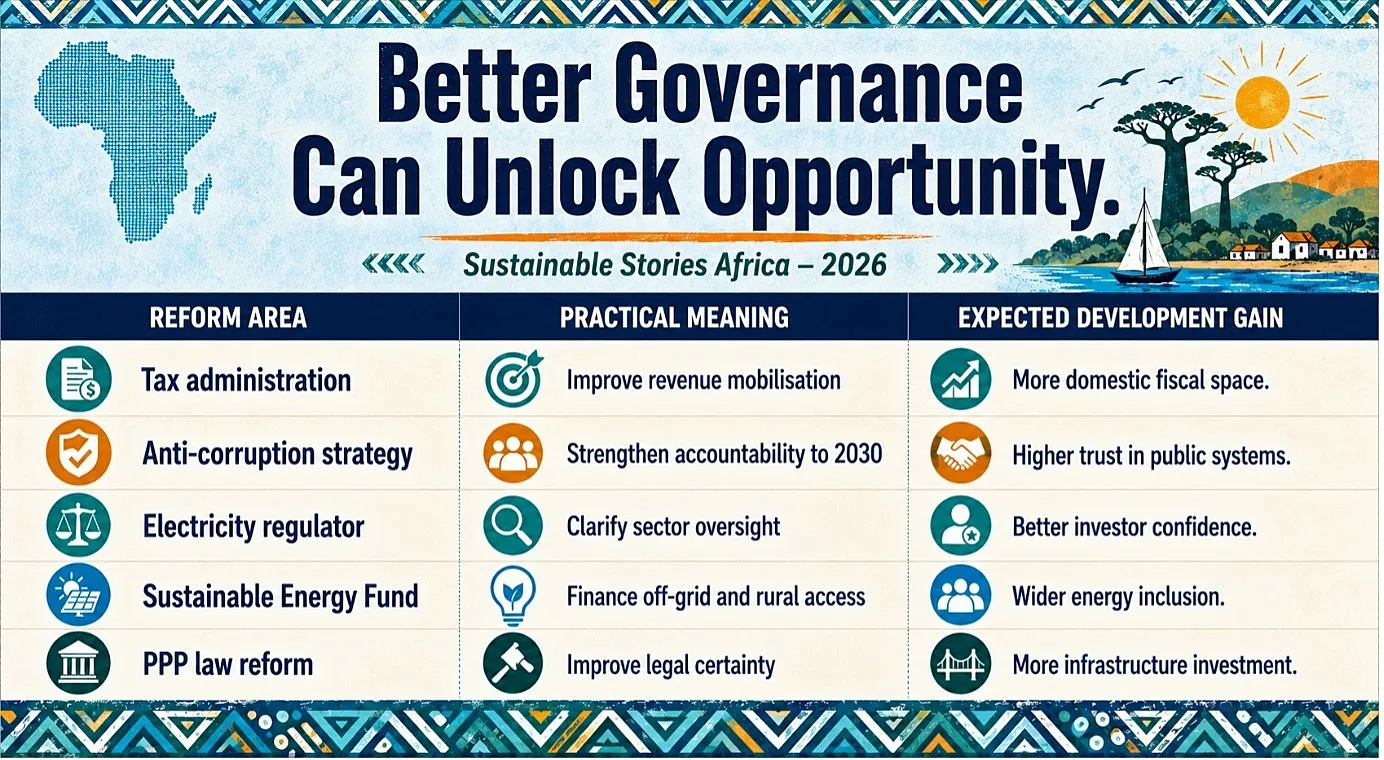
The programme builds on earlier reforms that included the rollout of a modern tax administration system nationwide and the adoption of a national anti-corruption strategy running to 2030. These are technical reforms, but their effects are deeply human.
When tax systems work better, governments can plan. When procurement is cleaner, public money travels further. When investors trust the rules, capital is more likely to flow into power, roads, agriculture, logistics and services.
For a trader in Antananarivo, a farmer in a rural district, or a small business waiting for reliable electricity, governance reform is not abstract. It shapes costs, delays and confidence.
AfDB Country Manager for Madagascar Adam Amoumoun said the country had shown “political will and institutional capacity” to implement reforms in difficult conditions.
His point matters because reform financing only works when money is tied to credible execution.
The second phase focuses on public financial management, private-sector competitiveness and energy-sector governance.
It supports the creation of an independent electricity regulator and a National Fund for Sustainable Energy, with attention to off-grid and rural electrification in areas where poverty remains concentrated.
Better Governance Can Unlock Opportunity
Madagascar’s reform agenda carries a simple promise: stronger institutions can widen opportunity.
If the programme succeeds, the government should gain more fiscal room, investors should face clearer rules, and underserved communities could see stronger links between public finance and basic services.
The energy component is especially important. Electricity remains one of the clearest markers of economic exclusion across African markets.
Without reliable power, clinics struggle, schools lose learning hours, farmers cannot preserve produce, and small manufacturers remain trapped in low productivity.
The programme’s support for a modernised public-private partnership framework also matters.
Clean energy and infrastructure projects require long-term capital. Investors need legal certainty, transparent regulation and bankable project pipelines.
Madagascar’s challenge is to convert reform language into projects that reach people and productive sectors.
Implementation Will Decide The Outcome
The next test is delivery. Madagascar’s authorities, development partners and private investors now need to ensure that the programme is not reduced to compliance language.
The reforms must be monitored through clear milestones: revenue performance, procurement transparency, energy access expansion, regulator independence and measurable improvements in investment conditions.
- For policymakers, the priority is discipline. Revenue gains should translate into productive spending, not fiscal leakage.
- For investors, the opportunity is to engage where reforms create credible project pipelines.
- For citizens and civil society, the task is accountability: asking whether new financing improves services and strengthens public trust.
Budget support is most powerful when it changes behaviour inside institutions. Madagascar’s $68 million package will be judged by whether it helps the state become more transparent, the economy more investable, and public services more reliable.
Path Forward – Turn Reform Promises Into Delivery
Madagascar’s next priority is execution: stronger tax systems, transparent governance, credible energy regulation and investment-ready infrastructure frameworks.
AfDB’s support gives the reform programme financial weight, but outcomes will depend on implementation.
If delivered well, the package can advance ESG goals by strengthening institutions, widening clean energy access and improving resilience in one of Africa’s most climate- and development-vulnerable economies.