
Africa has launched its first solar manufacturing credit guarantee scheme, targeting a critical bottleneck in the continent’s clean energy transition: access to affordable industrial finance.
The facility aims to unlock domestic panel assembly and component production by reducing lender risk and crowding in private capital.
Backed by development partners and structured to catalyse local value chains, the guarantee marks a strategic pivot from dependencies on imports to energy industrialisation.
De-Risking Solar Manufacturing Investment
Africa imports most of its solar panels, despite being one of the fastest-growing solar markets globally. The newly launched solar manufacturing credit guarantee seeks to reverse that imbalance.
By underwriting a portion of lender exposure, the facility reduces default risk for commercial banks financing local manufacturers. The objective is clear: unlock long-term debt for factories producing modules, mounting structures, inverters and related components.
For policymakers, the move aligns energy access with industrial policy. For investors, it creates a structured risk-sharing mechanism in a capital-intensive sector.
The initiative signals a transition from installation-led growth to production-led competitiveness.
Finance Bottleneck Constrained Local Production
Despite robust demand for solar deployment, domestic manufacturers have struggled to scale. High interest rates, short loan tenors and currency volatility have deterred local banks from extending meaningful credit to industrial players.
Manufacturing requires:
- Significant upfront capital expenditure
- Stable working capital lines
- Medium- to long-term repayment horizons
Without guarantees, lenders price risk conservatively, limiting factory expansion and local assembly ambitions.
The new facility addresses this structural constraint by absorbing a defined share of credit losses, thereby encouraging banks to extend larger, longer-term facilities.
Guarantee Structure and Intended Impact
Component | Strategic Objective |
|---|---|
Partial Credit Risk Coverage | Reduce lender default exposure |
Blended Finance Backing | Crowd in private commercial banks |
Local Manufacturing Eligibility | Promote domestic industrial capacity |
Performance Monitoring Framework | Ensure quality and repayment discipline |
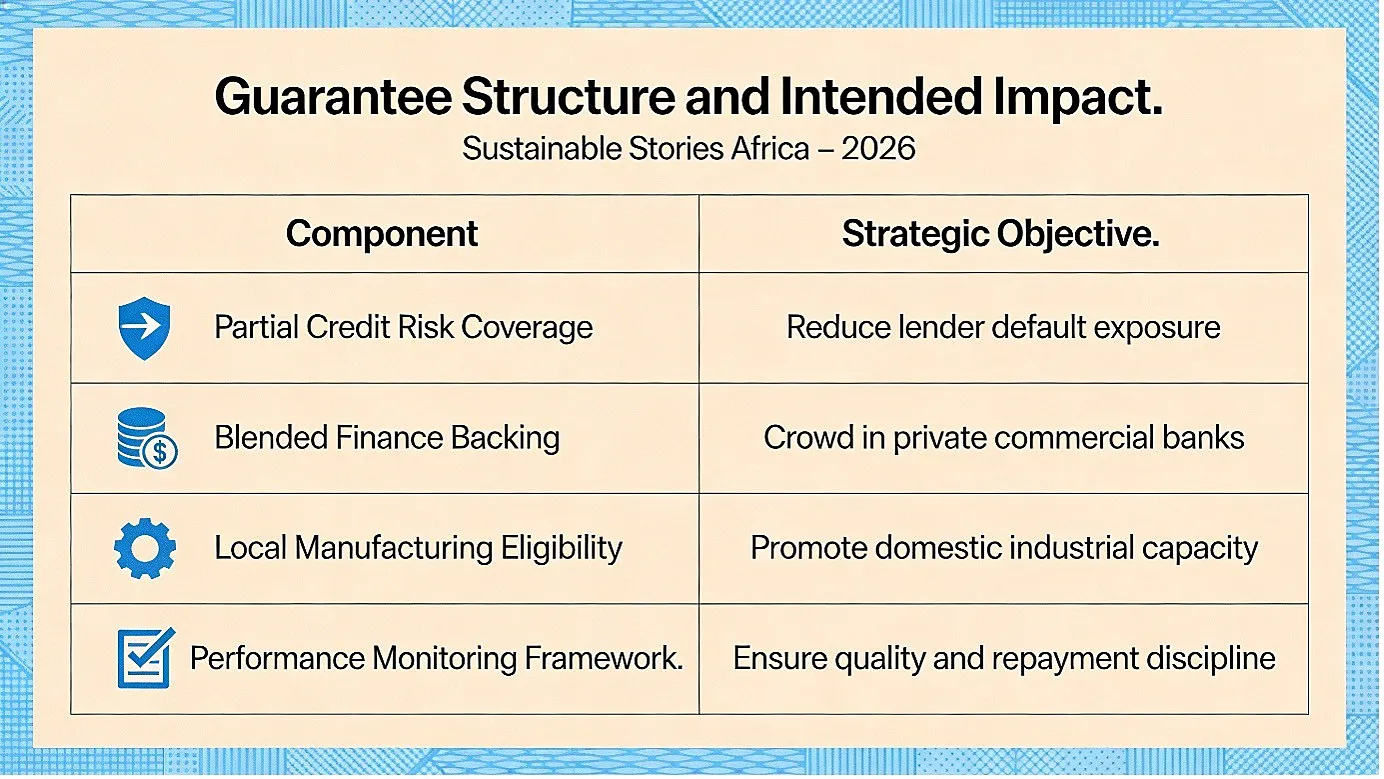
The guarantee is expected to catalyse new solar manufacturing capacity, strengthen supply chains and reduce foreign exchange outflows associated with imports.
If scaled effectively, it could lower system costs over time and support job creation across engineering, assembly and logistics segments.
Building Domestic Solar Supply Chains
Early-stage manufacturers are expected to benefit first, particularly firms engaged in module assembly and balance-of-system components. Over time, policymakers envision deeper localisation — including cell production and upstream material processing.
The credit guarantee also supports broader industrialisation goals:
- Technology transfer and skills development
- Reduced project lead times
- Enhanced energy security
By aligning financial engineering with climate policy, the initiative bridges development finance and private-sector execution.
From Installation Market to Industrial Powerhouse
Africa’s solar growth has been deployment-heavy but import-reliant. The new guarantee represents an opportunity to reposition the continent within the global clean energy value chain.
Industrialising solar manufacturing delivers multiple dividends:
- Job creation across technical and vocational segments
- Reduced exposure to global supply chain shocks
- Strengthened regional trade integration
Failure to localise production risks perpetuates dependency, foreign exchange strain and missed industrial opportunities.
The guarantee reframes solar not merely as an environmental solution, but as an economic transformation tool.
Path Forward – Scaling Guarantees, Strengthening Ecosystems
The next phase requires expanding guarantee capacity, standardising eligibility criteria and coordinating with industrial parks and trade policy frameworks.
Local banks must deepen technical appraisal expertise to evaluate manufacturing risks effectively.
If replicated across markets, the credit guarantee model could anchor Africa’s transition from a solar consumer to a solar producer, embedding resilience, competitiveness and climate leadership into its growth trajectory.
Culled From: Launching the first solar manufacturing credit guarantee