African health ministers have endorsed a plan to add and retain three million health workers by 2035.
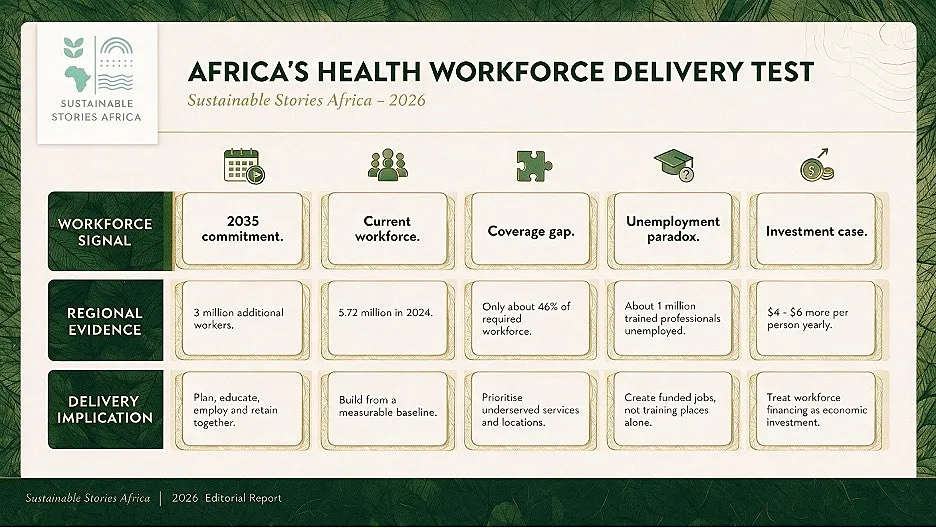
The agenda responds to a region with only 46% of its required workforce, even as about one million trained professionals remain unemployed.
Success will depend on financing jobs, fair deployment and retention, not simply expanding training institutions.
Africa Shifts From Training To Employment
African health ministers have endorsed the Africa Health Workforce Agenda 2026 - 2035, committing countries to plan, educate, employ and retain three million additional health workers by 2035.
Adopted during the 76th session of the WHO Regional Committee for Africa in Addis Ababa, the agenda shifts the policy focus from producing graduates alone to building functioning health labour markets.
The distinction is urgent.
- Africa's health workforce reached an estimated 5.72 million in 2024, yet the region has only about 46% of the workers it needs.
- Without decisive action, the shortage could exceed six million by 2035, leaving millions of people without timely access to essential services.
The Numbers Reveal A Labour Paradox
The shortage exists alongside unemployment.
- WHO estimates that about one million trained health professionals are without jobs, and more than half of newly qualified nurses, doctors and midwives in several countries cannot secure employment soon after graduation.
- Facilities need staff; qualified people need work; public budgets and planning fail to connect them.
This is not merely a supply problem.
- Governments must forecast population needs, align education places with required skills, create funded posts and deploy workers fairly between capitals, secondary cities and rural communities.
- Retention also depends on safe workplaces, adequate equipment, supportive supervision, professional growth and pay that does not push skilled people to leave public service or migrate.
Health Jobs Can Multiply Economic Returns
WHO estimates that closing the workforce gap would require an additional $4 to $6 per person each year.
- The organisation says every dollar invested can generate up to $10 in economic returns and around 30 times its value in broader social benefits through healthier populations, higher productivity and stronger economies.
Those figures make health employment a development strategy, rather than simply a recurrent cost.
- More midwives can reduce preventable maternal and newborn deaths.
- More community health workers can expand vaccination and early detection.
- More laboratory, pharmacy and public-health professionals can strengthen outbreak preparedness.
Women also make up a large share of the health workforce, so fair employment and leadership pathways can advance gender equality.
The economic case should not obscure working conditions.
- A nominally filled post adds little capacity if staff lack medicines, electricity, security or supervision.
- Burnout and delayed salaries drive attrition and undermine quality.
Workforce investment must therefore include the tools and team structures that allow professionals to practise safely.
Retention indicators should measure where people remain, for how long and under what conditions, not just the number recruited.
Finance The Posts, Not Just Schools
Implementation requires ministries of health, education, finance, labour and public service to work from one workforce plan.
- Countries should publish annual targets for training, recruitment, deployment, retention and attrition, disaggregated by profession, gender and geography.
- Development partners should support national priorities instead of funding short projects that pull scarce workers between programmes.
The agenda will ultimately be judged in clinics, not communiques.
- Three million additional workers must mean staffed facilities, shorter waiting times and reliable care where people live.
- If countries train without employing, or recruit without retaining, the headline target will conceal the same structural gap.
The promise becomes credible only when a qualified worker can build a career and a patient can reach that worker in time.
Path Forward – Turn Training Into Service
Countries should cost-fund posts, align education with labour demand and publish annual recruitment and retention results.
The regional target will matter only when trained professionals can work, and underserved communities can consistently reach competent, supported health teams.
Culled from: https://www.downtoearth.org.in/africa/africa-adopts-plan-to-add-3-million-health-workers-by-2035