Australia is consulting on whether to delay or narrow tougher assurance requirements under its mandatory climate-reporting regime.
The review aims to reduce compliance costs, particularly around immature Scope 3 data and supplier requests, without weakening confidence.
Its choices could influence how other jurisdictions, including African markets, phase credible sustainability disclosure into law.
Australia Reopens The Cost Credibility Tradeoff
Australia's Treasury has opened a consultation on changes intended to reduce the cost of mandatory climate reporting while preserving the credibility and comparability of corporate disclosures.
The central question is whether the planned move from limited to reasonable assurance should proceed from mid-2030, be delayed to 2035 or be narrowed to mature data that is audited rigorously.
Mandatory climate-related reporting was legislated in 2024 and began applying to the largest companies and asset owners in 2025.
That makes the review more than a technical adjustment.
- It is an early test of whether governments can respond to genuine implementation costs without allowing disclosure reform to slide backwards.
Three Options Carry Different Reporting Risks
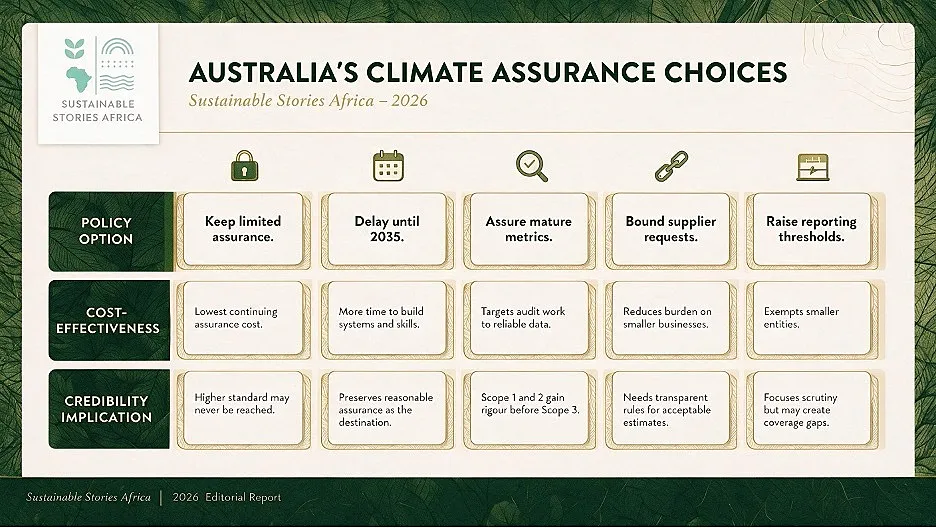
The first option would retain limited assurance indefinitely, lowering recurring audit costs but abandoning the original destination of a stronger standard.
The second would preserve reasonable assurance but delay it until 2035, giving companies, auditors and data providers more time to build controls.
The third would apply reasonable assurance only to established measures such as Scope 1 and Scope 2 emissions, while keeping more complex Scope 3 information under limited assurance.
The data challenge is especially acute in value chains.
- Large companies can send detailed emissions requests to hundreds or thousands of smaller suppliers that lack sustainability teams or measurement systems.
Treasury is considering clearer boundaries for reasonable information requests and wider use of domestic emissions factors, allowing estimates where primary supplier data would impose disproportionate cost.
Cheaper Compliance Could Strengthen Better Systems
A well-designed delay can improve reporting if it is used to build evidence, controls and assurance capacity.
- Rushing weak Scope 3 numbers into a high-assurance label could create false confidence.
However, an open-ended retreat would also carry costs:
- Investors may struggle to compare companies, boards could face less pressure to improve data, and Australia could fall behind jurisdictions that maintain stronger assurance pathways.
The consultation follows 2026 Budget changes that would exempt companies below A$100 million in revenue and A$50 million in assets from audited financial and sustainability reports.
- Together, the measures show a wider recalibration toward larger entities and more proportionate compliance.
- The test is whether proportionality simplifies the system or creates blind spots around material climate risks.
Reasonable assurance is more demanding because auditors must gather enough appropriate evidence to reduce engagement risk to a low level.
- That usually requires documented controls, repeatable calculations and stronger testing across business units.
- Limited assurance involves less extensive work and therefore a lower level of confidence.
The difference matters to capital markets: assurance is not a decorative badge, but an independent test of whether reported information can reasonably support decisions.
Protect Assurance While Reducing Supplier Burdens
Regulators should define a firm end-state, publish milestones for data maturity and require companies to explain where estimates replace primary evidence.
- Assurance standards can be phased by metric, but the rationale and timetable should remain public.
- Smaller suppliers need standard templates, shared emissions factors and protection from duplicative requests.
African regulators watching Australia should take a similar lesson
- Credible ESG rules need sequencing, capacity support and cost discipline, especially for SMEs. But comparability cannot be sacrificed.
If every difficult metric is deferred indefinitely, sustainability reports risk becoming polished narratives without decision-useful proof.
Path Forward – Calibrate Costs Without Retreating
Australia should retain a clear route to reasonable assurance, match audit intensity to data maturity and publish measurable transition milestones.
Supplier protections and common emissions factors can lower costs without making climate information less useful to investors, communities or regulators.
Culled from: Australia Considers Delaying Stricter Climate Assurance Rules to Cut Reporting Costs