A Brookings-led working group says ending extreme poverty is financially achievable, even after a decade of stalled global progress.
Its proposed starting point is a five-year, government-embedded cash-transfer programme backed by $1 billion annually in philanthropic seed funding.
For Africa, where most people in extreme poverty now live, the test is whether digital delivery can turn affordability into accountable national action.
An Affordable Goal Returns to Focus
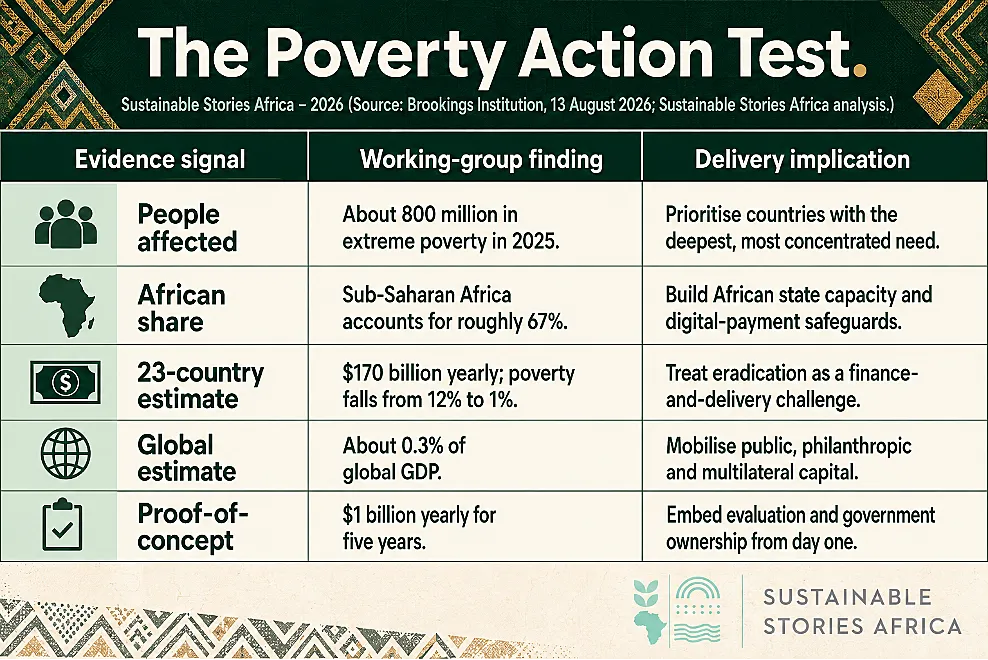
The world could reduce extreme poverty to below 1% of the population at a cost equal to roughly 0.3% of global GDP, according to a Brookings 17 Rooms working-group proposal published on August 13.
The authors estimate that about 800 million people still lived in extreme poverty in 2025, after progress slowed sharply during the past decade.
Their analysis focuses on 23 countries that contain about half of the world’s poorest people.
- It estimates that $170 billion a year could cut the average extreme-poverty rate in those countries from 12% to 1%, less than $500 per beneficiary.
- Sub-Saharan Africa accounts for roughly 67% of people living in extreme poverty, making African delivery systems central to any credible global plan.
Digital Cash Moves Beyond Small Pilots
The proposal builds on two decades of evidence that well-designed cash transfers can improve consumption, food security, savings, school attendance, health-service use and resilience.
- A 2025 meta-study covering 72 programmes in 34 low- and middle-income countries found positive average effects across most major outcomes and no average evidence that unconditional cash discouraged work.
Design still matters.
- Regular payments tend to support consumption, lump sums are more often invested, and transfers directed to women may strengthen household income and consumption outcomes.
The unanswered questions are national: fiscal sustainability, targeting errors, political pressure, foreign-exchange effects and whether village-level gains survive when a programme changes labour markets and prices across an entire economy.
Success Could Reset Development Finance
The group argues for a national proof of concept rather than another fragmented pilot.
- Even under pessimistic assumptions, millions would receive income immediately, if only 10% achieved a lasting exit from extreme poverty.
- Between 500,000 and one million people could move beyond deprivation in a moderately sized programme.
A successful national test would also produce evidence strong enough to reshape how donors, governments and development banks allocate capital.
Cash is not a substitute for roads, clinics, schools or productive transformation.
- It can, however, give households the stability to eat, learn, save and withstand shocks while longer-term investments are built.
- That distinction keeps the proposal ambitious without presenting direct transfers as a cure-all.
Fund Learning, Ownership and Public Trust
The immediate call is for wealthy individuals and philanthropic institutions to provide $1 billion annually for five years, identify a willing government and agree on clear success criteria before money moves.
- Independent experts should oversee evaluation, while national institutions should own targeting, payments, grievance systems and monitoring.
For African governments, participation should require strong privacy protection, transparent beneficiary selection, inflation monitoring and a published plan for what happens when philanthropic funding ends.
- The opportunity is large, but legitimacy will depend on whether citizens can see who qualifies, where funds go and what changes.
A national trial should also measure effects beyond the poverty headcount.
- Food security, school participation, women’s control over resources, local prices, employment and household assets would show whether income support creates durable capability.
- Publishing disaggregated results would help policymakers see who benefits, who is missed and whether digital systems reproduce exclusion.
The proposal becomes more persuasive when it is treated not as a one-number promise, but as a public experiment with immediate human value and a duty to learn openly.
Path Forward – From National Proof Toward Global Scale
The priority is one government-embedded national programme with independent evaluation and predetermined measures of poverty reduction, inclusion and macroeconomic stability.
If it succeeds, funders and multilateral institutions can expand the model across high-poverty countries while combining direct transfers with jobs, infrastructure and human-capital investment.
Culled from: End of extreme poverty: A case for action and a plan to start | Brookings