Three recent banking commitments suggest renewable-energy and green-economy finance is moving closer to ordinary credit business in Nigeria.
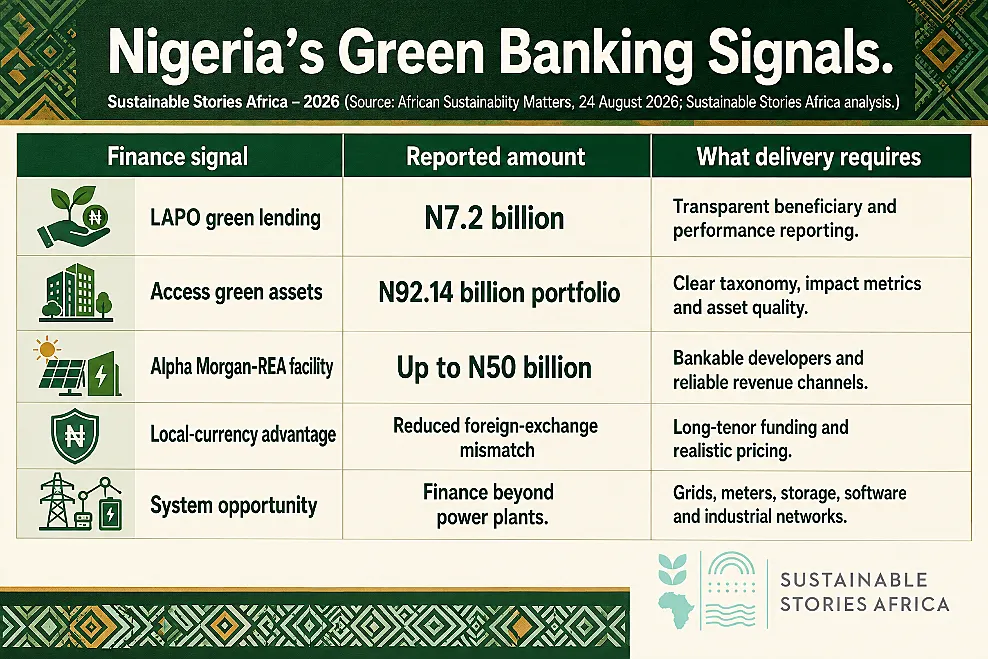
LAPO reported N7.2 billion in green lending, Access Holdings disclosed a N92.14 billion green portfolio, and Alpha Morgan Bank offered up to N50 billion for REA-linked developers.
The opening is significant, but dependable revenues, credible data and bankable projects will decide whether commitments become operating assets.
Green Lending Enters Regular Banking Conversations
Nigeria’s green economy is beginning to attract larger pools of domestic bank finance, with three recent disclosures signalling that renewable energy and climate-linked lending are moving beyond donor programmes.
- LAPO reported N7.2 billion in lending to households, farmers and small businesses.
- Access Holdings disclosed a N92.14 billion green asset portfolio
- Alpha Morgan Bank agreed to provide up to N50 billion for renewable-energy developers working with the Rural Electrification Agency.
The figures do not describe identical products or stages of deployment, so they should not be added as a single financing total.
Together, however, they show banks applying familiar capabilities, such as customer assessment, loan structuring, repayment management and portfolio aggregation, to projects previously treated as specialist development finance.
Bankability Now Matters More Than Announcements
Local currency finance can reduce the mismatch created when projects earn naira but borrow in dollars.
- It can also broaden access for solar installers, mini-grid developers, productive-use businesses and households that cannot absorb foreign-exchange risk.
- Banks understand local customers and payment behaviour, giving them a potential advantage in financing distributed assets.
However, renewable projects require predictable cash flows.
- Developers need credible customers, enforceable contracts, accurate generation and repayment data, quality equipment and service networks that keep assets working.
- Lenders must understand technology performance, policy risk and the difference between financing an operating portfolio and funding an early-stage promise.
Finance Can Build the Missing Middle
A stronger lending market could address the gap between small grants and large utility-scale investments.
- Credit for meters, storage, transmission services, grid software and dedicated networks for industrial clusters may prove as important as finance for solar panels.
- Nigeria’s opportunity is to fund the electricity-delivery system around renewable generation.
The benefits extend beyond emissions.
- Reliable electricity can lower diesel exposure, improve productivity, create technical jobs and strengthen rural enterprises.
Poorly structured credit, however, could leave borrowers with non-performing equipment and banks with distressed green assets, undermining confidence in the whole market.
Standardise Evidence and Share Project Risk
The Central Bank, financial institutions and energy agencies should develop consistent definitions for green assets, minimum technical standards and comparable impact reporting.
- Credit guarantees and blended-finance structures absorb early risks without removing lenders' due-diligence responsibilities.
Banks should publish disbursement data, technologies supported and whether financed assets remain operational, while developers improve governance and maintenance systems.
- Mainstream status will be earned when green loans perform like sound loans and deliver measurable energy access.
Consumer protection must develop alongside the market.
- Households and small businesses need clear pricing, warranties and complaint channels for financed systems, with banks verifying installers and equipment quality rather than transferring technical risk entirely to borrowers.
A well-run market shows low default rates and real reductions in diesel spending, rather than simply growing announced facility values.
Longer loan tenors will be crucial, since energy assets repay over years, not months.
- Pension funds, development banks and guarantee providers can help commercial banks match funding duration while maintaining local-currency discipline, with regulators encouraging this maturity transformation without hiding credit risk or funding unsustainable projects.
Path Forward – Turn Green Commitments Into Performing Assets
Nigeria needs common green-finance definitions, credible project data, technical standards and risk-sharing tools that mobilise, rather than replace commercial discipline.
Banks should report disbursement, asset performance and impact so rising portfolio values translate into reliable renewable energy for households and businesses.