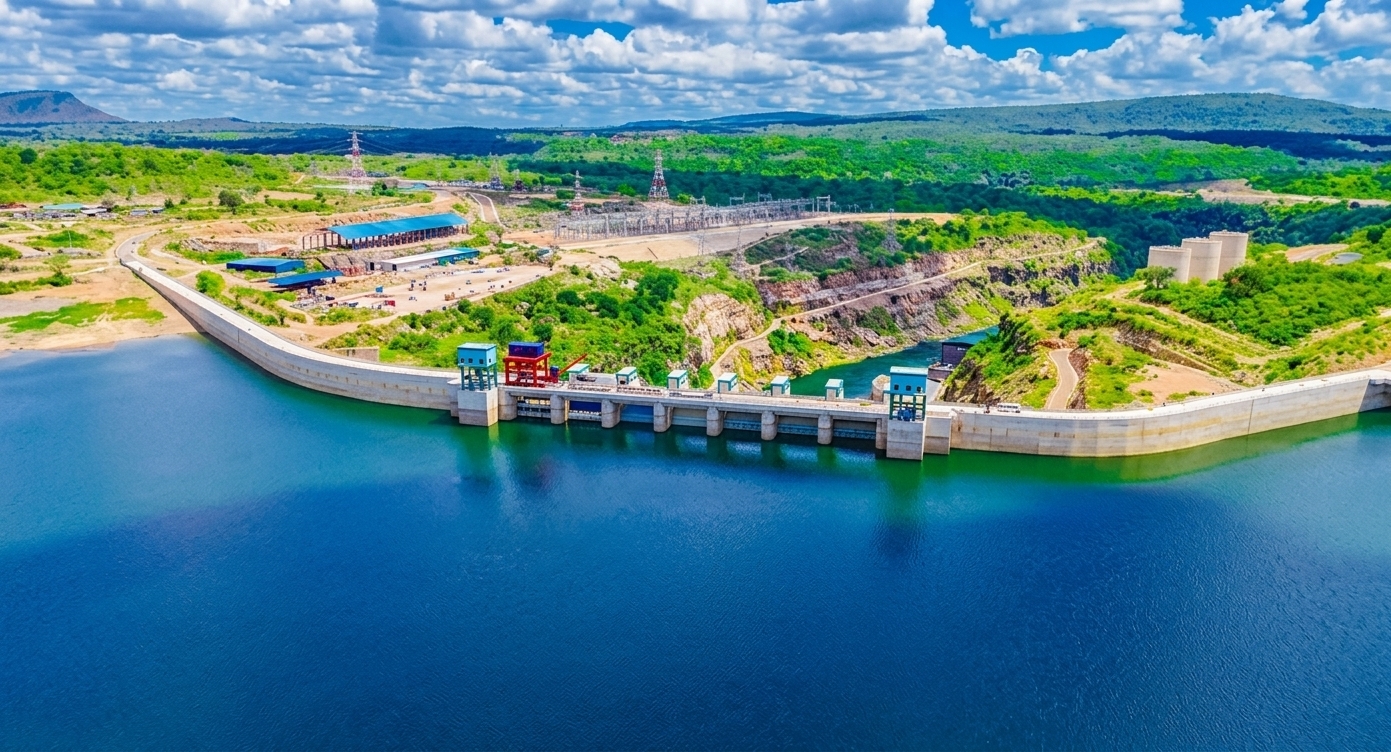
Tanzania has inaugurated the 2,115MW Julius Nyerere Hydropower Project, one of East Africa’s largest generating assets.
The state-financed plant adds nine 235MW turbines and could reshape industrial growth, electricity access and regional power trade.
Its real sustainability test now moves downstream: transmission, distribution, productive demand and responsible management of the Rufiji system.
A Generation Milestone Changes the Equation
Tanzania formally inaugurated the 2,115-megawatt Julius Nyerere Hydropower Project on the Rufiji River on August 22, adding the country’s largest power station to the national grid.
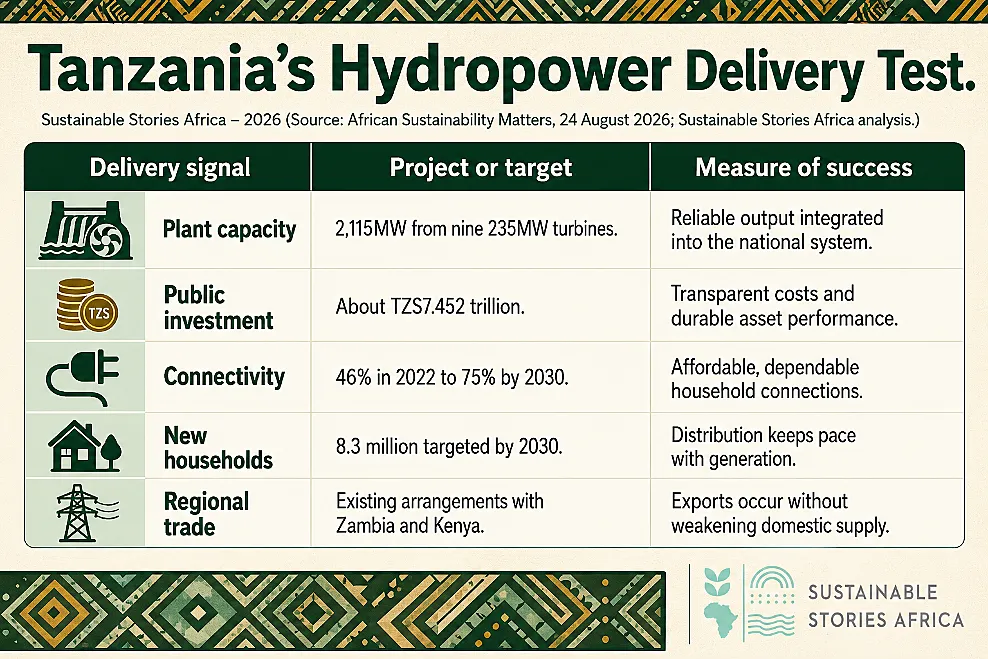
President Samia Suluhu Hassan opened the plant, which has nine turbines rated at 235MW each and cost about TZS7.452 trillion, according to the Ministry of Energy.
Built by Egypt’s Elsewedy Electric and Arab Contractors and financed by the Tanzanian government, the project was completed in March 2025 and had already started supplying electricity before the ceremony.
Its scale means Tanzania’s power debate can move beyond generation scarcity to whether the system can transport, distribute and productively use the new electricity.
Industry and Households Need Stronger Networks
Reliable power can reduce dependence on expensive backup generation and support mining, mineral processing, cold storage, irrigation and agro-processing.
- The government says output is being linked to Morogoro and Dodoma, while transmission is being strengthened toward Singida, Tabora, Shinyanga, Simiyu, Geita and Mwanza.
Access remains the more human measure.
- Tanzania’s National Energy Compact seeks to raise electricity connectivity from 46% in 2022 to 75% by 2030.
- Connect another 8.3 million households. TANESCO’s distribution programme includes medium- and low-voltage lines, transformers, smart meters and network automation. Without those assets, national generating capacity can rise while communities and enterprises remain underserved.
Power Surplus Can Support Regional Growth
Tanzania also sees an opportunity to trade electricity with neighbours.
- An agreement is in place with Zambia
- Arrangements enable trade with Kenya according to demand, and discussions are under way with other countries.
Regional exchange can improve efficiency because hydro, solar, wind and gas systems produce at different times and face different seasonal risks.
However, additional hydropower is not automatically resilient power.
- Hydrological variability, ecosystem impacts and transmission constraints remain material.
- Long-term value requires catchment management, transparent operating data and diversification so a single very large asset does not become a new single point of vulnerability.
Turn Megawatts Into Broad Economic Value
Government and TANESCO should prioritise transmission completion, distribution reliability and connection affordability. Industrial policies must link new electricity with credible demand from manufacturers, miners and small businesses, rather than assuming generation alone attracts investment.
Environmental monitoring around the Rufiji River should remain public and continuous.
- Tanzania's achievement will ultimately be judged by service quality, jobs, household access and ecological stewardship, not the nameplate capacity announced at inauguration.
Tariff design matters equally.
- The New generation can improve utility economics only if revenues support maintenance without making electricity unaffordable; targeted connection support, efficient metering and lower system losses can protect low-income users more effectively than broad subsidies that weaken the utility.
- Publishing plant availability, transmission constraints and connection progress would let citizens and investors distinguish installed capacity from electricity actually delivered.
The project's concentration risk should also shape planning.
- Drought management, reserve margins and complementary solar, wind or storage capacity can reduce dependence on one hydrological asset.
- Regional trading agreements need firm operating rules for scarcity periods to prevent expected surpluses from becoming future supply disputes.
Path Forward – Connect New Power to Productive Demand
Tanzania should complete grid reinforcement, accelerate affordable connections and publish reliability, environmental and financial performance data for the plant.
Regional trade can follow anywhere where domestic needs are protected, and cross-border interconnections improve resilience across East Africa.