
Investors are increasingly treating biodiversity, water, forests and ecosystems as economic assets rather than external environmental concerns.
A Sanlam ESG Barometer podcast argues that nature-related opportunities can deliver financial returns while supporting resilience, jobs and development.
For African businesses, the shift demands better measurement of dependencies, impacts and value created through regenerative and nature-positive investment.
Nature Enters the Investment Value Debate
More than half of global GDP depends moderately or highly on nature and the services it provides; however, ecosystems have often sat outside mainstream financial analysis.
The second episode of the Sanlam ESG Barometer podcast brings that dependency into the investment conversation, arguing that biodiversity, water systems, forests, oceans and healthy landscapes are productive economic assets.
Hosted by KhumaloCo chief executive and Sanlam ESG Barometer co-founder Andile Khumalo, the discussion features Kristen Fourie, ESG and impact analyst at Sanlam Investments, and Pavs Pillay, head of business development and marketing at WWF South Africa.
It explores how investors are moving beyond defensive risk management to seek opportunities that create returns and positive social outcomes.
Business Dependence Is Often Hidden Until Disruption
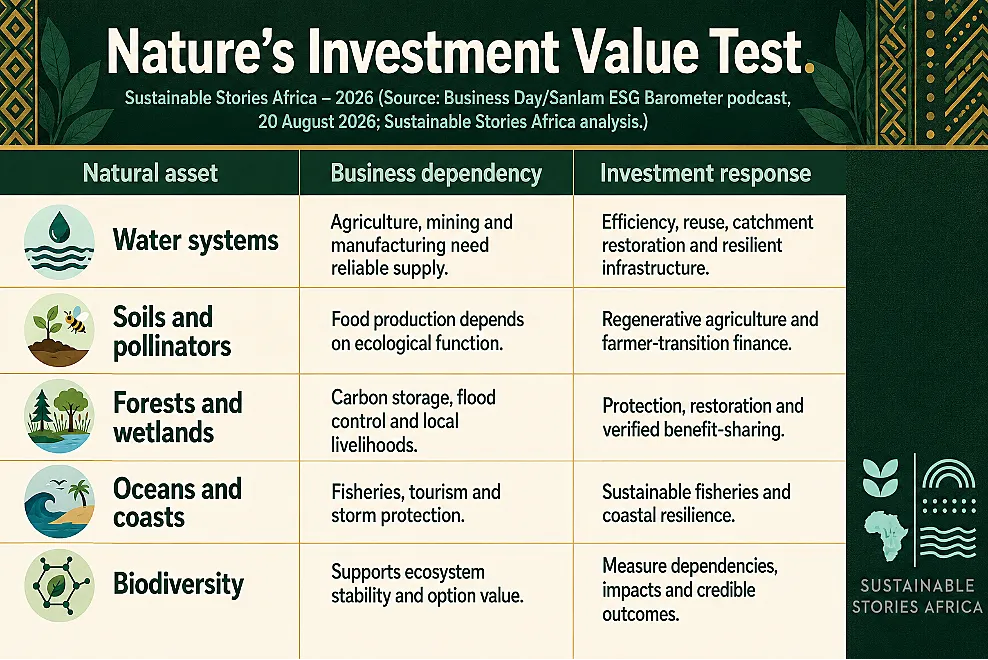
Agriculture relies on soil, water and pollination; mines and manufacturers require dependable water; tourism depends on landscapes and wildlife; and cities benefit from wetlands, forests and coastal systems that reduce heat and flood risk.
- When these services deteriorate, businesses face higher operating costs, interrupted supply and stranded assets.
Nature-related investment opportunities include regenerative agriculture, water resilience, biodiversity conservation, ecosystem restoration and nature-based climate solutions.
- In Africa, such activity can also create rural jobs and strengthen livelihoods.
However, the investment case must distinguish genuine cash flows and avoided losses from broad claims that nature is valuable.
Nature-Positive Finance Needs Measurable Outcomes
The opportunity is to direct capital toward assets and business models that restore natural systems while producing durable revenue.
- Water-security projects can protect production; regenerative practices can improve soil resilience.
- Ecosystem restoration can support tourism, carbon storage and community enterprises.
The danger is that nature becomes the next vague label.
- Baselines, location-specific data, additionality and community rights are harder to measure than a simple financed-emissions figure.
- Investors must avoid double counting and ensure that financial returns do not come from restricting customary access or shifting environmental harm elsewhere.
Put Dependencies Into Capital Allocation
Boards and investors should map where operations and supply chains depend on water, land and biodiversity, then integrate those findings into risk, strategy and capital expenditure.
Material exposures should be anchored on targets, governance and location-specific indicators.
Financial institutions can build pipelines with conservation organisations, communities and project developers; however, contracts must define ownership, benefit-sharing and monitoring.
The Sanlam ESG Barometer, launched in 2023 and researched by Krutham, provides one forum for tracking how listed companies in South Africa and Kenya are embedding ESG into operations.
Regulators and standard-setters can help by improving disclosure without pretending that every ecosystem fits one universal metric.
Companies should report material locations and decision-useful indicators while explaining uncertainty.
Investors, in turn, should test whether a nature claim changes capital allocation, operating practice or restoration outcomes.
That discipline will help nature-positive finance avoid the credibility problems seen in other fast-growing environmental markets and keep affected communities visible in investment decisions.
African pension funds and insurers may be natural long-term investors where projects generate stable cash flows; however, they need investable structures and risk-adjusted returns.
Public or philanthropic capital can support early project development and measurement, while commercial investors fund mature assets.
A clear separation between these roles will reduce subsidy confusion and reveal when nature finance has become commercially repeatable.
Path Forward – Measure Nature Before Claiming Sustainable Value
Investors should identify material ecosystem dependencies, establish credible baselines and connect capital to measurable operational and community outcomes.
Nature finance can scale when transparent data, local rights and durable revenue models support both financial performance and ecological recovery.