The African Development Bank and Nordic Development Fund are backing an $11.3 million facility to finance renewable mini-grids in 14 fragile African countries.
The mechanism will use future Peace Renewable Energy Certificate revenues to provide upfront hard-currency funding where conventional finance is scarce.
Its credibility will depend on additionality, transparent certificate claims and dependable electricity for communities and productive businesses.
New Revenue Stream Targets Fragility
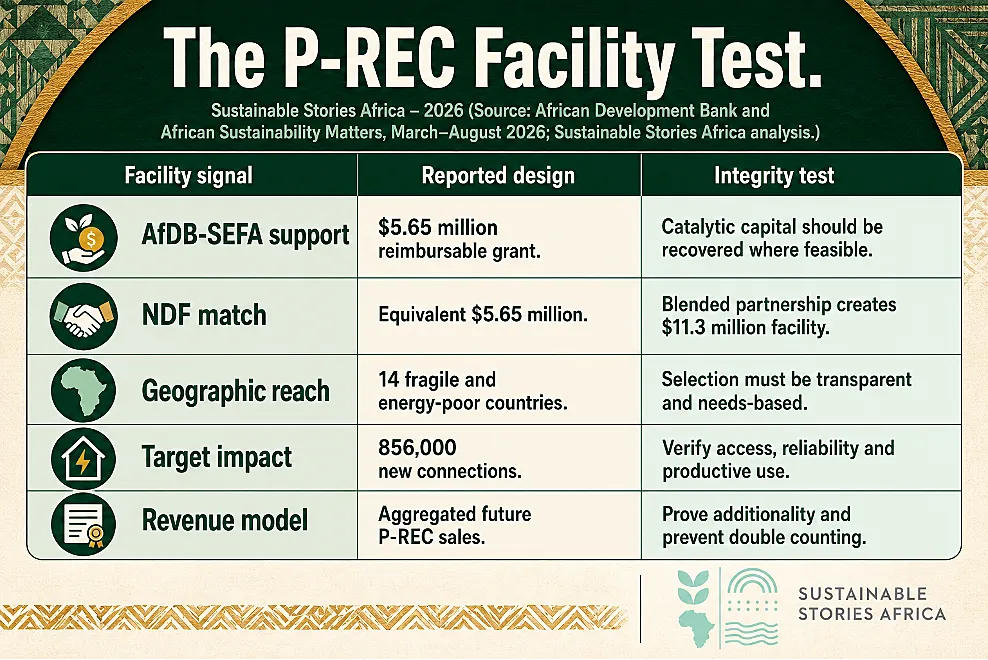
The African Development Bank has approved a $5.65 million reimbursable grant through the Sustainable Energy Fund for Africa to pilot a climate-finance mechanism for off-grid renewable energy in 14 fragile and energy-poor countries.
An equal commitment from the Nordic Development Fund will create an $11.3 million Peace Renewable Energy Certificate Aggregation Facility.
Managed by Camco Clean Energy and Energy Peace Partners, the facility will aggregate future revenues from Peace Renewable Energy Certificates, or P-RECs, and convert them into upfront hard-currency finance for qualifying mini-grids.
The AfDB says the instrument targets 856,000 new electricity connections and markets where project risk and limited local capital make conventional lending difficult.
Certificates Could Improve Project Bankability
Renewable-energy certificates represent the environmental attributes of electricity generation. P-RECs add a peace-and-development proposition by directing corporate purchases toward renewable assets in fragile settings.
Predictable certificate income could complement tariffs and concessional capital, improving the economics of projects that would otherwise struggle to reach financial close.
For communities, reliable power can improve clinics, schools, communications, agricultural processing and small-business productivity.
Mini-grids may also be cheaper and faster than extending national networks into remote or sparsely populated areas.
Businesses that now depend on diesel can reduce exposure to fuel prices, transport disruptions and foreign-exchange movements.
Integrity Will Decide Whether Markets Scale
The central question is additionality:
- Do certificate purchases unlock projects that would not otherwise be financed, or merely relabel revenue that was already available?
- Buyers also need credible rules against double counting, transparent registries and evidence connecting each claim to operating generation and community outcomes.
Commercial performance still depends on tariffs, customer demand, equipment reliability and local operations.
- Hard-currency certificate income cannot substitute for affordable service, capable operators or community consent.
- If those fundamentals are weak, the instrument may finance construction without sustaining electricity delivery.
Publish Outcomes Alongside Corporate Claims
Facility managers and development partners should publish project-selection rules, revenue flows, certificate ownership and verified connection outcomes.
Corporate buyers should state what their purchases financed and avoid claims broader than the evidence supports.
Governments should integrate mini-grids into national electrification plans, clarify tariff and interconnection rules, and protect customers if the main grid later arrives.
- The pilot should be treated as a learning platform whose success depends on both financial mobilisation and dependable service.
Fragile settings also require conflict-sensitive delivery.
- Developers should assess land rights, local power dynamics, security arrangements and who controls revenue-earning assets.
- Community engagement must continue after commissioning, with accessible grievance systems and transparent benefit-sharing.
- Gender-disaggregated access data can show whether women-owned businesses and essential services gain reliable power.
These safeguards are not peripheral to bankability:
- They reduce operational disruption and help certificate buyers demonstrate that climate finance supports peace rather than deepening local inequality.
The reimbursable structure should be explained in plain terms:
- When funds return.
- Who absorbs losses.
- Whether repayments recycle into new projects.
Publishing those flows would help governments and citizens understand the true subsidy and allow the pilot to inform future climate-finance design.
It would also give corporate buyers confidence that premium certificate payments support a durable pipeline rather than a one-off claim, with outcomes communities can independently verify.
Path Forward – Prove Additionality Through Transparent Energy Delivery
The facility should disclose how certificate revenue changes project viability, who benefits and whether electricity remains reliable and affordable.
Clear registries, independent verification and alignment with national electrification plans can turn corporate climate spending into credible infrastructure finance.