
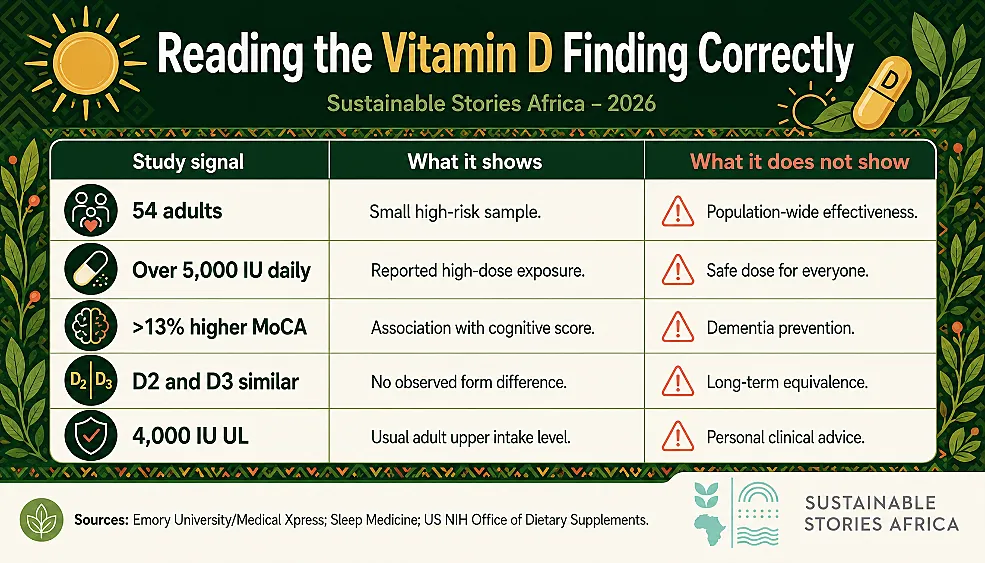
An Emory University study of 54 adults with sleep disturbance and mild cognitive impairment found an association between high vitamin D intake and stronger cognitive scores.
Participants reporting at least 5,000 IU daily scored more than 13% higher on a screening assessment than non-users.
Researchers call the finding preliminary; the dose is above the usual adult upper intake level and should not be self-prescribed.
Promising Signal Emerges From Small Study
Higher vitamin D intake may be associated with better cognitive performance among adults already at elevated risk of dementia, according to new research from Emory University.
The study involved 54 people with both sleep disturbance and mild cognitive impairment, a combination that may mark an early window for intervention.
Participants who reported taking at least 5,000 international units, or IU, of vitamin D each day scored more than 13% higher on the Montreal Cognitive Assessment than participants who did not take the supplement, after the researchers adjusted for other factors.
Lower daily doses were not associated with higher scores, and results did not differ between vitamin D2 and D3.
Association Does Not Yet Prove Treatment
The finding, published in Sleep Medicine, is important but limited.
- The sample was small, participants reported the use of supplements, and the study observed an association rather than randomly assigning a treatment.
- It therefore cannot establish that vitamin D caused the better scores or that high-dose supplementation prevents dementia.
The distinction matters because 5,000 IU a day is not a routine dose for everyone.
- The US National Institutes of Health lists 4,000 IU as the tolerable upper intake level for most adults.
- Excess vitamin D can raise calcium to harmful levels and may interact with health conditions or medicines.
- People should seek clinical advice and, where appropriate, testing before taking high doses.
Sleep and Cognition Share Complex Links
Vitamin D supports muscle and nerve function and may influence sleep-wake processes.
- Sleep disturbance is also common in people with Alzheimer’s disease, creating a two-way relationship in which poor sleep can accompany or worsen cognitive decline. Senior author
- Victoria Pak said the combination of sleep disturbance and MCI may represent a point when cognitive changes are emerging, but opportunities to support brain health remain.
For African health systems, the research highlights a broader need:
- Affordable investigation of nutrition, sleep, hypertension, diabetes, depression and other modifiable contributors to cognitive symptoms.
- Vitamin D status can vary with diet, sun exposure, skin pigmentation, age and health conditions.
- A single supplement message cannot replace individual assessment or stronger primary care.
Equity should shape the next phase of research.
- Trials need participants from different ethnic, geographic and socioeconomic backgrounds, including populations where vitamin D deficiency, sleep disorders and access to diagnostic services differ from the original sample.
- Researchers should also compare supplementation with broader sleep and lifestyle interventions.
Without that diversity, a statistically interesting result may not translate into a safe or affordable public-health option for the communities carrying the fastest-growing burden of age-related disease.
Larger Trials Must Test Real Benefits
Researchers now need larger, diverse randomised trials that measure blood vitamin D, verify dosage, track adverse effects and follow people long enough to assess meaningful outcomes, including daily function and progression to dementia.
Clinicians and media should present the current result as a research signal, not a prescription.
Path Forward – Evidence First, Supplement Decisions With Care
The next step is rigorous testing of who might benefit, at what dose and with what safety monitoring.
Until then, high-dose vitamin D should remain a clinician-guided decision.
Public-health communication must preserve hope without overstating causation.
Better sleep assessment, nutritional care and dementia-risk management already offer safer, broader routes to healthier ageing.
Culled from: High-dose vitamin D may improve cognition among those at risk of dementia, study finds