A Brookings analysis warns that the global economy is being squeezed by major-power rivalry and a vacuum in international leadership.
Protectionism, weaponised interdependence and weaker multilateral institutions are shifting trade and investment along geopolitical lines.
African economies need a stronger voice in distributed governance while building regional resilience against rules increasingly shaped by power.
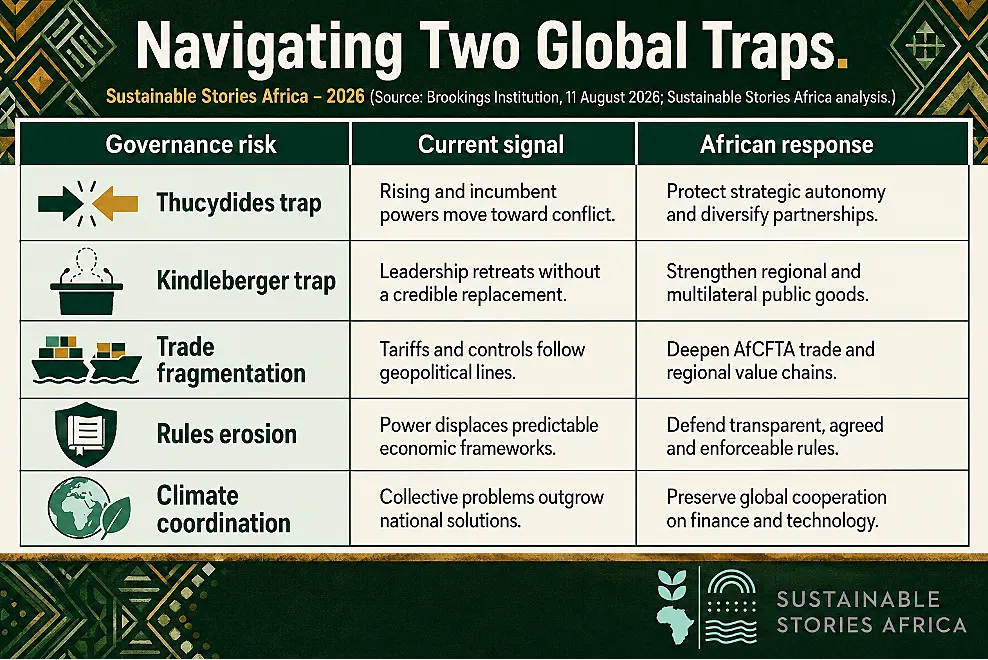
Two Traps Define Today’s Global Risk
Global economic governance is confronting a destabilising combination of conflict between an established power and a rising one, and the absence of a country willing and able to sustain the wider system.
Brookings senior fellow Zia Qureshi frames the problem through the Thucydides trap and the Kindleberger trap in an analysis published on August 11.
- The first describes the danger that rivalry between an incumbent and challenger escalates into conflict.
- The second captures instability when an old leader retreats but the rising power does not provide international public goods.
Today, the United States-China contest is reshaping trade, technology and investment, while no alternative ‘benevolent hegemon’ is ready to replace the post-war leadership model.
Economic Interdependence Becomes Strategic Leverage
Tariffs, subsidies, export controls and investment restrictions increasingly sit inside national-security policy.
- Economic interdependence, once treated mainly as a source of efficiency and peace, is being used as leverage.
- The result is a more fragmented economy in which supply chains and capital flows follow political alignment as much as price or productivity.
This matters acutely for African countries.
- Many rely on imported technology, external finance and commodity exports while trading with the United States, China, Europe and emerging powers at the same time.
- A forced choice between blocs could raise financing costs, narrow markets and slow climate and development investment.
However, a multipolar order could also create bargaining space if African states negotiate collectively.
Distributed Governance Can Widen Representation
Qureshi argues that governance will become less centralised, with legacy institutions sharing authority with plurilateral and regional arrangements. That need not mean disorder.
- A less prescriptive system could recognise different national preferences while retaining a core principle: international economic interaction should be governed by agreed rules rather than raw power.
For Africa, more distributed governance could elevate the African Union, AfCFTA institutions and regional development banks.
- It could also make reform of voting power, debt resolution and climate-finance architecture harder if new forums duplicate mandates or exclude smaller countries.
Representation must therefore be matched by coordination and implementation capacity.
Build Resilience Without Abandoning Cooperation
African governments should reduce exposure to any single market, currency, technology supplier or creditor.
- Regional payment systems, deeper local capital markets, strategic reserves and cross-border infrastructure can provide buffers.
- Businesses should map geopolitical dependencies across suppliers, data, logistics and finance rather than treating political risk as a distant diplomatic concern.
At the same time, resilience must not become isolation.
- Climate change, financial contagion, pandemics and digital standards still require global coordination.
- The practical task is to build stronger regional capacity while continuing to defend open, predictable rules.
The private sector also needs a response.
- African companies should scenario-test sanctions, tariff shocks, export controls and shipping disruptions, while banks examine concentrations in correspondent relationships and foreign-currency funding.
Civil society and research institutions can strengthen accountability by tracing how global rule changes affect food, energy and employment.
This turns a distant debate about hegemony into practical economic governance:
- Who bears adjustment costs, which sectors receive protection and whether national resilience strategies remain fair and transparent.
A common African evidence base on geopolitical exposure would give negotiators more leverage and help regional institutions prioritise the corridors, payment systems and standards that deliver collective protection.
It would also help governments explain trade-offs publicly rather than presenting every industrial policy or external partnership as cost-free.
Path Forward – Shared Rules Must Survive Power Shifts
Global institutions should share space with regional coalitions, accommodate policy diversity and preserve enforceable principles for trade, finance and climate cooperation.
African states can strengthen their influence by coordinating positions, expanding intra-African commerce and reducing vulnerabilities that make geopolitical pressure more costly.
Culled from: Global economic governance: Navigating the Thucydides and Kindleberger traps | Brookings