
A new commentary on Accra’s professional hierarchy argues that salary and title explain only the first four rungs of success.
At the transition from executive to established founder, access increasingly depends on positioning, visibility and trusted relationships built over time.
The argument raises a wider governance question: who gets invited into Africa’s most influential rooms, and how transparent are those pathways?
Money Maps Accra’s First Four Rungs
In Accra’s corporate economy, the visible markers of progress are familiar: a stronger title, a larger monthly salary and a move to a more expensive neighbourhood.
However, a commentary published on 23 August by brand strategist Karen Punch argues that this familiar ladder changes at the top.
The transition from C-suite executive to established founder is not simply another salary jump; it is a shift from performance-based advancement to access built through reputation and trust.
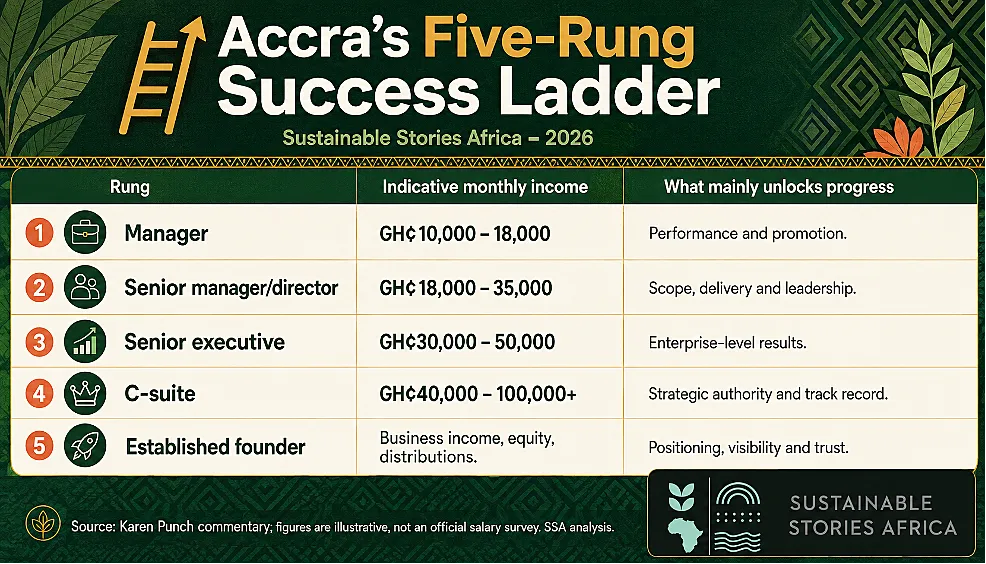
Punch’s illustrative ladder places managers at roughly GH₵10,000 – GH₵18,000 monthly, senior managers or directors at GH₵18,000 – 35,000, senior executives at GH₵30,000 – GH₵50,000 and C-suite leaders from GH₵40,000 to above GH₵100,000.
Founders, by contrast, may draw value through business income, equity and distributions rather than a conventional salary.
The figures are presented as a social map, not an official labour-market survey, but the central distinction is clear: income stops explaining the entire gap.
Performance Alone Cannot Purchase Strategic Access
The fifth rung, Punch writes, is reached when a name can move a deal or attract an opportunity before it is publicly advertised.
That kind of access is accumulated slowly through credible work, visibility in relevant rooms and a track record others will endorse.
- A highly paid executive can therefore remain commercially successful but professionally invisible beyond one company.
For African professionals and founders, the argument is especially relevant in markets where capital, board appointments and partnerships often move through relationship networks. Trust can reduce perceived risk and speed decisions. Yet reliance on informal networks can also reproduce exclusion when women, younger professionals or people outside established circles lack the same proximity to decision-makers. Reputation capital is valuable, but fair institutions still need transparent criteria and open routes into opportunity.
Visible Value Can Broaden Opportunity Pathways
Punch groups the work into three pillars: positioning clarity, visibility architecture and trust infrastructure. In practical terms, professionals should make their distinctive value understandable, document outcomes, share useful insight and cultivate relationships before they need a favour. For founders, this means building a credible public record alongside revenue; for executives, it means ensuring achievements are legible beyond an internal reporting line.
Done responsibly, visibility is not self-promotion without substance. It is evidence that helps investors, boards and partners assess competence. Organisations can support this by publishing selection criteria, widening nomination pipelines and recognising measurable contributions rather than familiarity alone.
The lesson also applies to institutions.
- Companies that want deeper leadership pipelines should not wait until a board vacancy appears before identifying talent.
- Sponsorship programmes, transparent succession plans, public speaking opportunities and cross-sector assignments can help capable people build the relationships and evidence normally accumulated informally.
This converts reputation from a private advantage into a more deliberate part of professional development, while still keeping competence and integrity at the centre of selection.
Build Reputation Before Opportunity Becomes Urgent
- Professionals should audit not only pay and title, but also who understands their work, who can verify it and where their ideas are discoverable.
- Employers, industry bodies and professional associations should create more public platforms for credible expertise, mentorship and board readiness.
The aim is not to replace performance with popularity; it is to ensure strong performance becomes visible, verifiable and transferable.
Path Forward – Trust Must Open Doors More Fairly
Accra’s fifth rung will remain powerful because high-stakes decisions depend on confidence. The priority is to build that confidence early while making access less closed.
Professionals need evidence, relationships and consistent visibility. Institutions must pair trust with transparent opportunity pathways so reputation capital expands inclusion rather than protecting an insider economy.