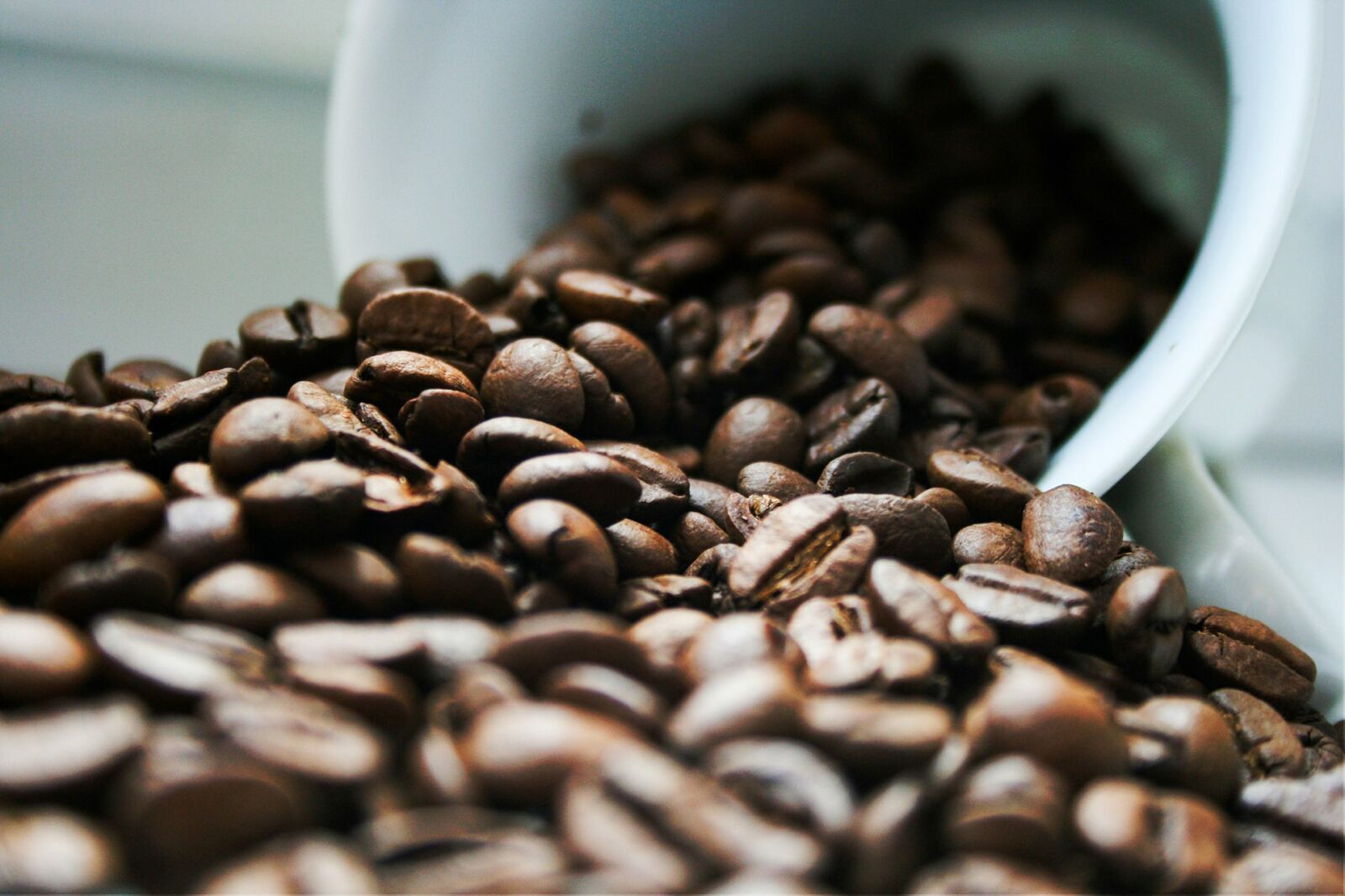
Coffee drinkers are still paying sharply higher prices even after arabica futures retreated from their 2025 peak.
A record Brazilian harvest could rebuild supply, but a potentially extreme El Niño threatens Vietnam, Colombia and future flowering while certified inventories remain thin.
For African producers, adaptation finance and better value distribution are becoming central to long-term competitiveness.
Cheaper Futures Have Not Reached Cafés
Coffee is not disappearing; however, producing and pricing it predictably is becoming harder.
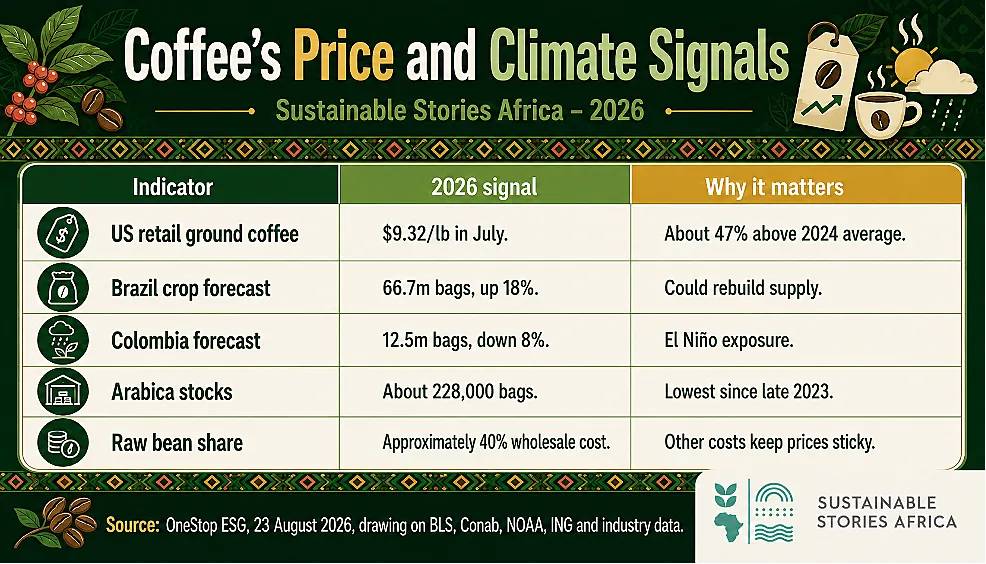
OneStop ESG reports that average ground coffee in US supermarkets reached $9.32 a pound in July 2026, compared with $6.32 across 2024, even though arabica futures have fallen from their February 2025 record of $4.41 a pound.
The gap reflects a supply chain in which green beans account for roughly 40% of the wholesale cost of roast and ground coffee.
Wages, energy, rent, packaging, freight and roasting do not fall automatically with futures.
Roasters also work through inventories and retailer contracts slowly, so a movement in bean prices can take at least nine months to reach consumers.
Climate Volatility Keeps Markets on Edge
Brazil and Vietnam together grow roughly half the world’s coffee, concentrating risk
- Drought and extreme heat disrupted Brazil’s flowering in 2024, while Vietnam faced drought followed by excessive rain.
- Green coffee prices roughly doubled as inventories tightened.
Supply may now improve:
- Brazil’s crop agency Conab projects 66.7 million bags in 2026, up 18%, while private forecasters estimate 75 – 76 million.
- However, traders are watching a potentially very strong El Niño that could bring drought to Southeast Asia and hotter, drier conditions to Colombia.
- Colombia’s federation expects output to fall 8% this year to 12.5 million bags. Exchange-certified arabica stocks were about 228,000 bags, their lowest since late 2023.
Farmers Carry Costs Without Capturing Windfalls
High prices do not automatically make coffee farmers wealthy.
- Some growers sold forward before the rally, while others harvested fewer bags as weather cut yields.
- Input costs, currency movements and local market structures can absorb gains.
- Repeated price shocks may encourage farm abandonment and make coffee less attractive to younger generations.
Adaptation requires capital.
- Shade trees and agroforestry can cool farms and improve soils, irrigation can protect against drought, and new varieties may tolerate heat or disease.
- However, these measures take time and money, and poorly planned expansion can shift production into forests.
African producers in Ethiopia, Uganda, Kenya, Tanzania and other origins face the same need to combine resilience with traceability and biodiversity protection.
African coffee policy must also focus on capturing of local value.
- Exporting green beans leaves most roasting, branding and retail margins elsewhere, while producers absorb climate and price risk.
- Regional roasting, quality laboratories, storage, logistics and origin-based brands can retain more value, although they require consistent standards and market access.
Adaptation finance should therefore be linked with processing and market development, giving farmers and producer countries more room to invest when global commodity prices swing.
Finance Resilience Across the Coffee Chain
Governments, traders, roasters and lenders should share adaptation costs instead of leaving smallholders to carry climate risk alone.
Long-term purchasing contracts, affordable credit, crop insurance, extension services, climate information and transparent farm-gate pricing can protect supply.
Buyers also need traceability systems that meet deforestation rules without excluding small farms unable to finance data collection.
Path Forward – Pay for Resilience Before Supply Breaks
The near-term price will depend on Brazil’s harvest, El Niño impacts and how quickly inventories recover.
The structural problem is a crop exposed to increasingly unstable growing conditions.
Coffee companies and governments must fund adaptation, reward farmers fairly and diversify resilient supply.
Consumers cannot expect stable prices from a chain that underinvests in the people and landscapes producing every cup.
Culled from: Why Coffee Is Getting More Expensive