Nigeria’s Federal Executive Council has approved NIGCOMSAT-2A and NIGCOMSAT-2B, two next-generation high-throughput communications satellites.
The programme is intended to complement terrestrial broadband, strengthen national resilience and extend services to underserved communities.
Its real test will be translating capital expenditure into affordable capacity, local expertise and measurable public value.
Approval Moves Satellite Programme Into Delivery
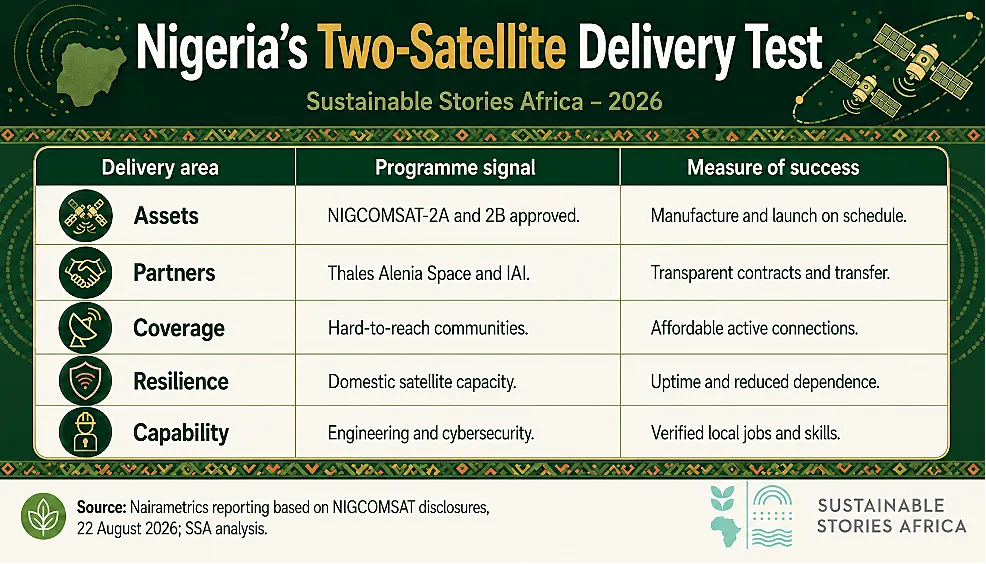
Nigeria has moved its long-planned satellite replacement and expansion programme into a new implementation phase after the Federal Executive Council approved the acquisition and deployment of NIGCOMSAT-2A and NIGCOMSAT-2B.
The high-throughput communications satellites are expected to expand domestic capacity and reduce reliance on external satellite infrastructure.
NIGCOMSAT said Thales Alenia Space of France and Israel Aerospace Industries will deliver the satellites; the state-owned company will lead implementation with the Federal Ministry of Communications, Innovation and Digital Economy.
Next steps include engaging with the technology partners, finalising the contract, technical planning, manufacture, launch and deployment.
New Capacity Targets Nigeria’s Hardest Locations
NIGCOMSAT Managing Director Nkechi Egerton-Idehen said the satellites would support critical communications and complement terrestrial broadband where fibre or mobile infrastructure is difficult or costly to deploy.
Intended uses include high-capacity broadband, broadcasting, enterprise connectivity, government services, defence communications and digital applications in education, health, agriculture and finance.
The programme also responds to the ageing profile of NIGCOMSAT-1R, launched in 2011 with a projected 15-year operational life. Nigeria has pursued additional partnerships, including low-earth-orbit services, while seeking stronger commercial performance from its own capacity.
Nairametrics reported that only about 7% of NIGCOMSAT broadband capacity was being used in 2025, although revenue rose from N650 million in 2023 to more than N2 billion in 2025.
Sovereignty Requires Use, Skills and Affordability
Owning more orbital capacity can improve resilience and bargaining power; however, hardware alone does not create digital inclusion.
- Ground stations, last-mile distribution, user terminals, service pricing and reliable power will determine whether rural schools, clinics and businesses can actually connect.
- Capacity must also be marketed and managed well enough to avoid repeating low-utilisation problems.
The government says the project will support knowledge transfer, local manufacturing, technical support, systems integration, satellite engineering, network operations and cybersecurity.
Clear local-content milestones and public reporting will be essential. Security uses must also be balanced with strong data governance, procurement transparency and civilian accountability.
Commercial discipline will be as important as engineering.
- NIGCOMSAT needs a clear route from satellite capacity to paying wholesale and retail demand, including service agreements with mobile operators, broadcasters, public agencies and connectivity providers.
- Public programmes for schools and clinics should define who funds terminals, installation and maintenance after pilot periods end.
- Environmental planning should also cover launch-related procurement, ground infrastructure, energy use and end-of-life responsibility, so the project’s resilience case is matched by credible sustainability management.
Publish Costs, Timelines and Service Targets
Government and NIGCOMSAT should disclose the final project cost, financing structure, launch timetable, coverage assumptions and performance indicators once contracts are concluded.
Priority metrics should include capacity utilisation, wholesale pricing, uptime, number of underserved locations connected, local jobs and skills transferred.
Private operators should be given fair, transparent access to capacity so public investment stimulates competition rather than displacing it.
Path Forward – Turn Orbital Assets Into Public Value
Nigeria’s approval is a milestone, not the outcome. Success will be measured by affordable services, resilient networks and stronger domestic capability after launch.
The next phase must connect procurement to transparent delivery targets, local skills and last-mile partnerships.
Sovereign infrastructure matters most when citizens, institutions and businesses can use it reliably.
Culled from: FG approves two new satellites to cut Nigeria’s reliance on foreign infrastructure - Nairametrics