
The Science Based Targets initiative has issued the first major update to its corporate Net-Zero Standard in five years.
Supporters say version 2.0 reflects operational reality; critics fear optional requirements and broad flexibility could blur the difference between ambition and delivery.
Its credibility will depend on supplier data, sector rules and whether validation rewards measurable emissions cuts.
A New Rulebook Resets Expectations
The Science Based Targets initiative has revised its flagship Net-Zero Standard for the first time since launch, reopening a central corporate climate debate: can greater flexibility accelerate action without lowering the bar?
Version 2.0 is presented as a move from ambition to implementation, but businesses and climate groups remain divided over whether its options are pragmatic pathways or avoidable loopholes.
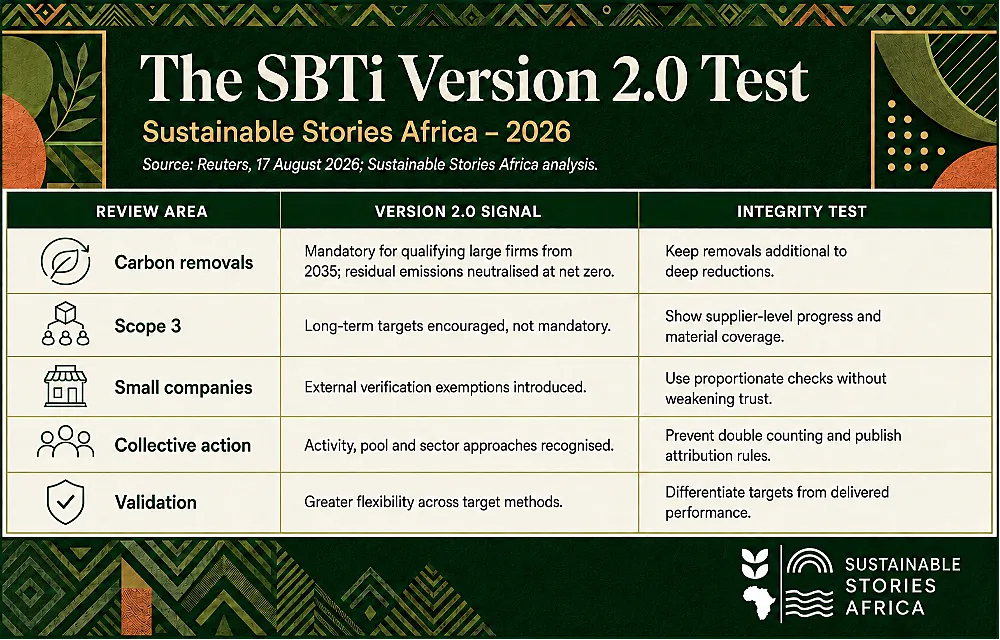
- The new framework removes the option of making a large purchase of offsets immediately before a net-zero date.
- Companies reaching that date must reduce emissions to zero or neutralise residual emissions with carbon removals.
From 2035, large companies in the recognition programme will also be required to support removals for ongoing emissions.
Flexibility Expands Across Emissions Scopes
The most contested changes concern flexibility.
- Small companies are no longer required to obtain external verification of base-year and target-year emissions.
- Long-term Scope 3 targets are encouraged rather than mandatory.
- Companies can use a wider range of methods for Scope 1 and Scope 2, including intensity targets, asset transition and low-carbon electricity shares.
Supporters argue that near-term five-year targets are more credible than precise promises extending to 2050.
The rules also recognise collective supply-chain action through an implementation hierarchy covering activity, pool and sector levels.
- That could help companies address emissions in fragmented value chains where one buyer cannot transform hundreds of suppliers alone.
The scale of that challenge is substantial: more than 11,500 companies hold SBTi validations, yet much of their footprint sits outside their direct operations.
For African suppliers, the new approach may create opportunities to join shared decarbonisation programmes, but it may also increase demands for reliable product, energy and emissions data.
Optional Best Practice Raises Concern
Critics point to the standard's best-efforts clause, which may allow a company that misses a target to retain validation if it can demonstrate external constraints.
They also question why practices such as hourly matching of clean-energy consumption and generation remain optional, despite evidence that tighter matching can support grid transformation.
Another concern is comparability.
- A single validation label can struggle to distinguish a company with ambitious targets but weak delivery from one with demonstrable performance.
- If leaders receive no visible recognition for doing more, the standard could weaken incentives to invest beyond minimum compliance.
This distinction is important where suppliers operate with thin margins and limited access to transition finance. Buyers should not simply transfer reporting burdens down the chain.
They can offer longer contracts, technical support and shared investment that make cleaner equipment and better data commercially possible.
Otherwise, Scope 3 flexibility may document constraints without changing the conditions that created them.
Sector Rules Will Decide Credibility
The next test lies in sector guidance.
- SBTi is finalising rules for power and automotive companies, scoping agriculture, buildings and finance, and expects work on oil and gas to follow.
- These standards can remove optionality where sector pathways are clear and require activity-level evidence that links targets to actual transition.
African companies should not wait for every detail.
- Boards can strengthen emissions inventories, identify material Scope 3 categories, improve supplier contracts and disclose which elements of the standard they treat as minimum requirements versus best practice.
- Investors, meanwhile, should evaluate performance beneath the validation badge.
Path Forward – Integrity Must Keep Pace With Flexibility
SBTi should pair flexibility with transparent performance tiers, strong sector benchmarks and consequences where repeated under-delivery cannot be justified.
Companies should use the revised rules to accelerate near-term reductions, fund credible removals and help suppliers build data capacity, ensuring pragmatism becomes a bridge to action rather than permission to delay.
Culled from: Business split over whether SBTi’s new net-zero standard will boost action or dilute ambition | Reuters