
South Africa’s digital-first Social Relief of Distress grant is facing a defining legal test after the High Court invalidated rules that enabled automated bank and database checks.
The government has appealed, placing efficiency, equality and social-security rights before the Supreme Court of Appeal.
The outcome could shape how African states use automated systems in high-stakes public services.
A Welfare Algorithm Meets Constitutional Rights
South Africa’s attempt to digitise emergency welfare has become a warning for governments adopting artificial intelligence and automated decision-making without strong human safeguards.
A High Court ruling found that parts of the process used to determine access to the Social Relief of Distress grant were unconstitutional and invalid, including provisions authorising automated bank verification and database checks.
The grant began in May 2020 as temporary support for people with no income or other social grant.
- It now pays R370 a month, less than half the country’s food poverty line, to a potential target group once estimated at 18.3 million people.
- However, the digital system made an administrative gateway into a constitutional question: can a state rely on opaque data matching when a mistaken rejection may mean hunger?
Digital Efficiency Produced Exclusion Risks
Applications became online-only under regulations introduced in April 2022.
- Eligibility was assessed through bank-account information and government databases, with automated outcomes often treated as final.
- Successful beneficiaries fell from about 16 million at the programme’s inception to 5.6 million in 2022
- Budget reduced by billions of rand.
The Institute for Economic Justice and the #PayTheGrants movement challenged the process in July 2023.
- They argued that the rules produced irrational, arbitrary and unfair exclusions.
- In January 2025, the High Court agreed that aspects of the framework impaired equality and access to social assistance.
- The government appealed, and the Supreme Court of Appeal is expected to consider the dispute.
The weakness was not automation alone, but the assumptions embedded in it.
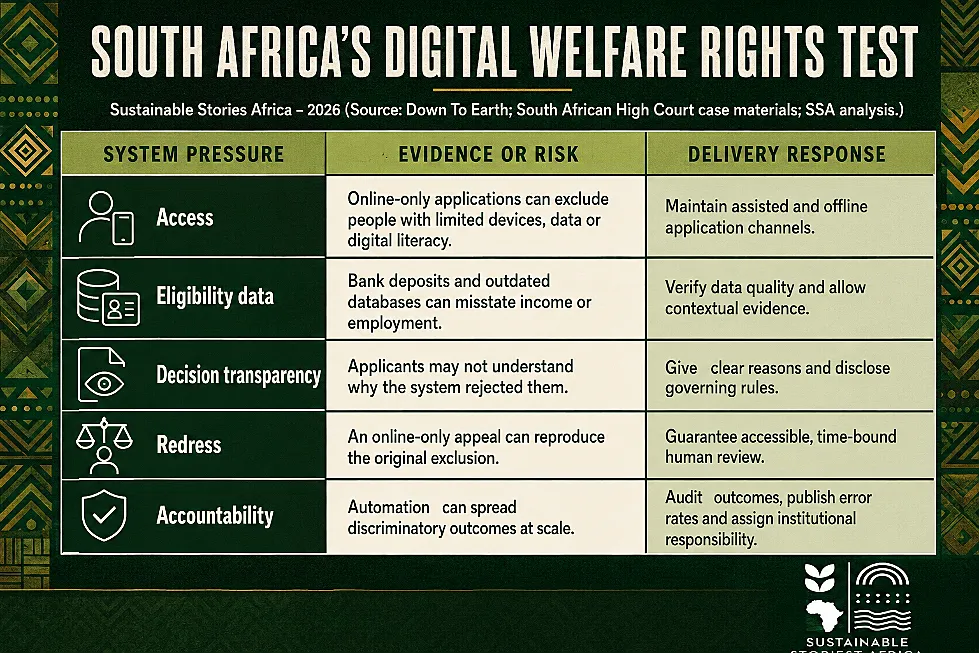
- Any bank deposit could be interpreted as income even when it was a temporary loan or money received for someone else.
- Employment databases could also be outdated.
- An automated system can apply a flawed rule consistently and still produce injustice at scale.
The case also matters beyond welfare.
- African governments are expanding digital identity, tax, health insurance and student-finance systems, often by connecting datasets created for different purposes.
- Those links can improve service delivery, but they can also make a single incorrect record travel across institutions.
Good governance therefore requires purpose limits, data correction rights and evidence that automated screening improves outcomes without disproportionately burdening poorer, rural, disabled or otherwise marginalised applicants.
Fair Digital Welfare Can Work Better
Digital administration can reduce queues, accelerate payments and detect fraud.
- However, those benefits depend on designing around the circumstances of the people being served.
- Applicants with limited connectivity, shared phones, irregular deposits or incorrect official records require accessible alternatives and a meaningful opportunity to explain their situation.
A rights-respecting model would combine automation with human review, disclose the reasons for adverse decisions, test data quality, monitor unequal outcomes and provide offline application and appeal channels.
That approach would make technology an aid to public officials, rather than an unchallengeable gatekeeper.
Governments Must Build Contestable Systems
The appeal should not pause administrative reform.
- South African agencies can publish decision rules, measure false rejections, repair databases and fund independent audits now.
- Other African governments digitising welfare, health, education and identity systems should treat the case as an early governance signal.
Where a public algorithm can determine whether a household eats, the standard must be higher than operational convenience.
Efficiency is valuable, but constitutional rights require decisions that are explainable, reviewable and ultimately accountable to people.
Path Forward – Human Review Must Anchor Digital Welfare
South Africa should preserve accessible application routes, improve official data and require human reconsideration before an adverse automated decision becomes final.
Across Africa, public-sector AI rules should make high-impact systems transparent, independently auditable and open to effective appeal.
Technology should widen access to social protection, not turn administrative errors into invisible barriers.