Industry estimates suggest that beans grown by more than half of Nigeria’s cocoa farmers may fail the EU’s new deforestation requirements when enforcement begins at the end of December.
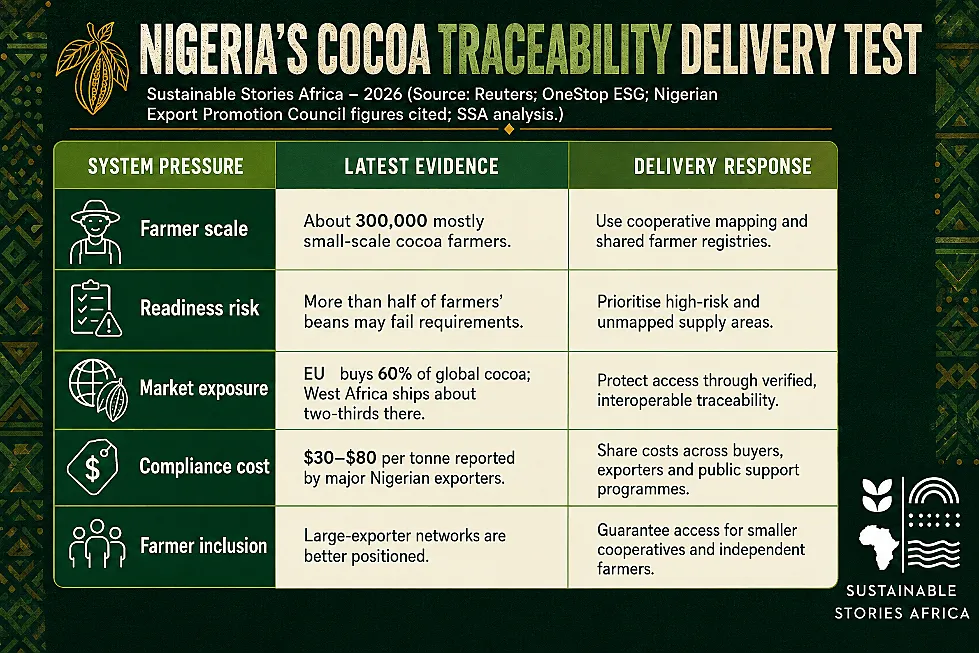
The challenge is traceability across roughly 300,000 mostly small-scale producers.
Without shared financing for mapping and verification, compliant exporters may advance while less-connected farmers lose market access.
A December Deadline Reaches Nigerian Farms
Nigeria’s cocoa economy is approaching a market-access test that will be decided farm by farm.
When the European Union Deforestation Regulation takes effect at the end of December 2026, industry experts estimate that beans grown by more than half of the country’s farmers could fail to satisfy the new requirements.
The regulation requires companies that place cocoa and other covered commodities on the EU market to demonstrate that production was legal and not linked to recent deforestation.
- That means collecting geolocation data, assessing land-use risk and maintaining traceability records through the supply chain.
- Nigeria, the world’s fourth-largest cocoa producer, has about 300,000 mostly small-scale farmers.
Traceability Costs Expose a Structural Divide
West Africa produces about 70% of global cocoa and sends roughly two-thirds of its output to the EU, which buys 60% of the world’s cocoa.
- The regulation therefore reaches deep into rural economies where production is dispersed across remote plots and beans may pass through several intermediaries before export.
The gap is not simply willingness.
- Mapping thousands of farms, verifying land use and maintaining digital records require money, trained field agents and trusted data systems.
In Côte d’Ivoire, only about half of cocoa can currently be traced to its farm of origin, according to Trase research cited in the reporting.
Some large Nigerian exporters are investing.
- Sunbeth Global says it mapped 124,000 hectares covering about 60,000 tonnes of cocoa over three years, for $30 to $70 per tonne.
- Starlink Global and Ideal report spending $40 to $80 per tonne on mapping and traceability.
Both illustrate a commercial problem: European buyers have resisted absorbing costs that exporters cannot carry alone indefinitely.
The experience of Ojo Ayaninuola, a farmer near Akure, highlights why trust is part of compliance.
- He initially resisted geolocation but agreed after Sunbeth, the buyer of all his cocoa, warned that EU access was at risk.
- Mapping touches sensitive questions about land, privacy and bargaining power
- Farmers need to understand who holds their coordinates, how the information will be used and whether registration produces a fairer price rather than another uncompensated demand.
Compliance Can Protect Forests and Livelihoods
A well-designed traceability system can do more than satisfy customs checks.
- It can help farmers demonstrate responsible production, improve access to premium markets and direct extension services towards plots facing deforestation or productivity risks.
- Better farm data can also support finance, land-rights clarity and climate-resilient agriculture.
However, an uneven transition could consolidate purchasing around large exporters and exclude farmers outside their networks.
- A compliant premium may emerge during an expected supply squeeze, yet it will not protect livelihoods unless part of that value reaches farmers and covers the cost of new obligations.
Build a Shared National Compliance Backbone
Nigeria needs a coordinated system linking public agencies, exporters, farmer organisations, banks and technology providers.
- Common geolocation standards, interoperable data, clear consent rules and independent verification would reduce duplication and prevent every exporter from remapping the same landscape.
European buyers must also share compliance costs through longer contracts and transparent premiums.
- The objective should be deforestation-free cocoa that keeps smallholders in legitimate supply chains, rather than a paperwork threshold that shifts trade elsewhere while vulnerable farmers absorb the loss.
Path Forward – Make Traceability Work for Smallholders Too
Nigeria should establish a shared traceability backbone, accelerate farm mapping and fund verification support for smallholders before the December 2026 compliance date.
Exporters and European buyers should agree on transparent cost-sharing and farmer premiums.
Success means proving cocoa is deforestation-free while keeping rural producers connected to valuable markets, not creating a two-tier system that rewards only the best-funded supply chains.
Culled from: Half of Nigeria's Cocoa Beans Set to Fail New EU Deforestation Rules