The African Development Bank is calling for stronger financing and coordination to transform land restoration from continental promises into investable projects that benefit communities.
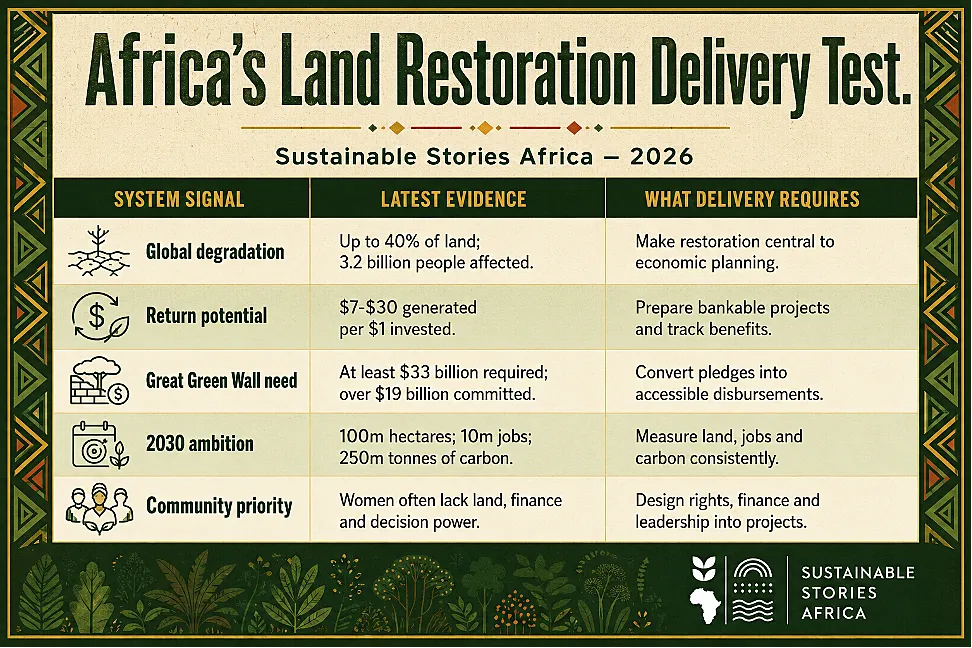
Up to 40% of the world’s land is degraded, while each dollar invested in restoration could generate between seven and thirty dollars in returns.
Ahead of UNCCD COP17, Africa’s challenge is to close the Great Green Wall funding gap and prove results on farms, rangelands and rural livelihoods.
Africa’s Land Crisis Demands Investable Solutions
Land degradation is stripping productivity from farms, rangelands and ecosystems while increasing pressure on food, water and rural livelihoods.
Ahead of the seventeenth Conference of the Parties to the United Nations Convention to Combat Desertification, the African Development Bank is urging governments and partners to treat restoration as an economic strategy, rather than only environmental repair.
In “Restoring Land, Rebuilding Hope,” Dr Arona Soumaré, the Bank’s Chief Climate Change and Green Growth Officer and Rio Conventions Focal Point, noted that up to 40% of the world’s land is degraded, affecting more than 3.2 billion people.
By 2050, drought could affect three out of every four people.
- The message is urgent, but it also carries an investment case: every dollar spent on restoration can generate between seven and thirty dollars in returns.
Practical Restoration Already Has A Toolkit
The solutions are familiar: assisted natural regeneration, agroforestry, sustainable rangeland management, water harvesting, climate-smart agriculture and participatory land-use planning.
Their value lies in being combined around the needs of a landscape and the people who depend on it, rather than delivered as disconnected projects.
The Great Green Wall remains the continent’s most visible framework.
- Its ambition is to restore 100 million hectares, create 10 million green jobs and sequester 250 million tonnes of carbon by 2030.
- However, at least $33 billion is required, while commitments have exceeded $19 billion.
- The central financing problem is no longer only attracting pledges; it is turning them into accessible capital and bankable, locally executable projects.
The Bank points to the Southern Africa Great Green Wall Accelerator, supported by a Global Environment Facility grant, as one route forward.
Covering the 16 Southern African Development Community member states, it is expected to strengthen coordination, prepare a costed investment plan and develop projects across water, energy, ecosystems, infrastructure, agriculture and inclusive development.
Communities Convert Restoration Into Real Returns
Restoration produces its highest value when people can see the result in yields, water security, income and reduced vulnerability.
- Women require particular attention because they are central to many natural-resource economies yet often have weaker access to land, finance, technology and decisions.
AfDB-supported shea initiatives in Burkina Faso and Togo are designed to reduce vulnerability among 7,500 women collectors and processors and reach more than 30,000 beneficiaries.
Across the wider shea economy, about 16 million women in 21 countries depend on a sector spanning nearly 275 million hectares. Protecting landscapes can therefore reinforce both biodiversity and women’s economic power.
The Bank also cites Sahel programmes that have rehabilitated more than 12,000 hectares, built 176 water-harvesting structures, established 35 nurseries, produced more than 512,000 seedlings, reforested over 2,000 hectares, created 1,228 kilometres of firebreaks and distributed more than 7,000 improved cookstoves.
These are the kinds of concrete outputs that can turn a continental vision into visible local value.
Finance Must Reward Delivery And Inclusion
The next phase requires governments to prepare credible pipelines with clear land tenure, community participation, measurable outcomes and long-term maintenance.
Development banks can use blended finance and guarantees to reduce risk, while private investors can back commercially viable value chains that depend on healthy landscapes.
UNCCD COP17 in Ulaanbaatar, Mongolia, from 17 to 28 August 2026 offers a chance to align land degradation targets with biodiversity commitments and national climate plans.
Africa should use that convergence to reduce fragmented reporting and make projects easier to finance.
The principle is simple:
- Restoration finance must reach the people managing land.
- As the Bank’s message concludes, restoring land means investing in communities, protecting nature and building more resilient growth.
Part Forward – The Path From Promise To Prosperity
Africa must close the Great Green Wall funding gap by converting pledges into bankable, community-led projects with transparent land, livelihood and gender outcomes.
At COP17, governments and financiers should align climate, biodiversity and land targets; expand blended finance; and fund proven practices.
Restoration will earn trust when communities can measure stronger soils, safer water, better incomes and durable resilience.
Culled from: Restoring Land, Rebuilding Hope