Liberia’s telecommunications regulator has introduced an automated licensing and renewal platform to replace paper-heavy applications and repeated office visits.
The system is intended to lower costs, shorten processing times and widen access for businesses and individuals across the country.
By keeping physical assistance available, the regulator is also testing whether digital government can improve efficiency without excluding people with limited connectivity.
Licensing moves from queues to clicks
The Liberia Telecommunications Authority has rolled out an automated licensing and renewal system, moving a core regulatory process from paperwork towards a digital platform.
Announced on 13 August 2026, the change is designed to streamline applications, reduce costs and processing times, and limit the repeated journeys applicants make to the regulator’s headquarters.
For a telecom business, a delayed authorisation can affect investment, equipment deployment and service expansion. For a small operator or entrepreneur outside Monrovia, the same delay may also mean transport costs, lost workdays and uncertainty about requirements.
The new platform turns administrative reform into an economic and access question.
Digital reform targets regulatory friction
The regulator said individuals, businesses and other entities will be able to submit applications electronically for licences and authorisations.
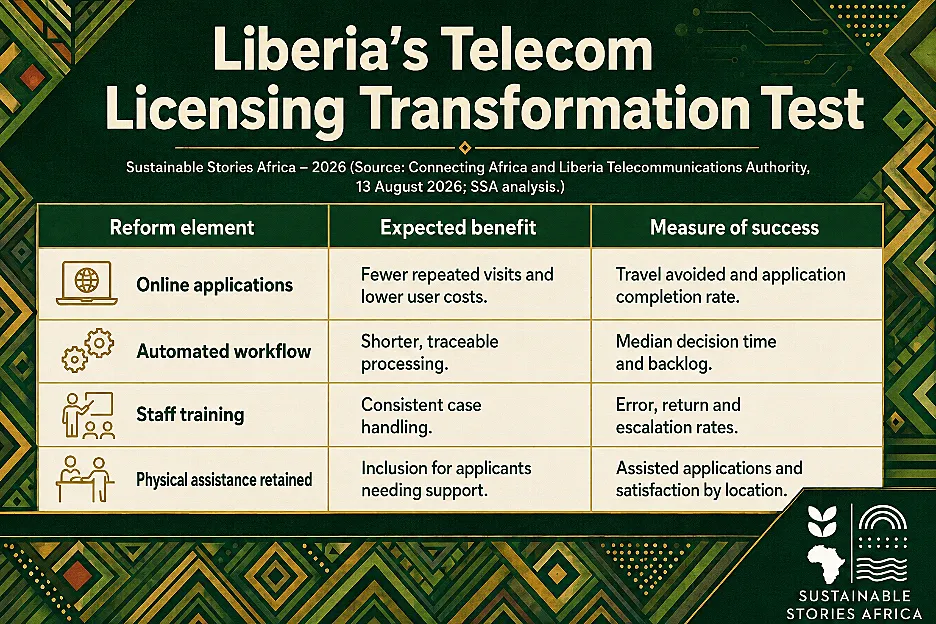
Staff are being trained to manage applications and related processes through the system, a step that matters because digitising a form without changing internal workflows rarely produces faster decisions.
The LTA described the platform as the result of careful work by its Licensing and Regulations Department.
- The immediate promise is a clearer and more modern process.
- The longer-term value will depend on whether applicants can see requirements, receive reliable status updates, make secure payments where applicable and obtain decisions through an auditable process.
Liberia is part of a wider African shift towards digital public services.
- Recent examples cited by Connecting Africa include Sudan’s digital procurement system, Uganda’s national e-commerce platform, South Africa’s Citizen Super App proof of concept, South Sudan’s instant payment system and Ghana’s CitizenApp.
The common objective is to reduce administrative distance between institutions and citizens.
A dual channel can protect inclusion
The LTA will keep physical access open for applicants who need assistance or prefer direct engagement.
That choice recognises a central risk in digital transformation:
- A service can become faster for connected users while becoming harder for people with weak internet, limited digital skills, disabilities or language barriers.
- A well-run dual system can provide a bridge during transition.
- Assisted submission, clear service standards and accessible help desks can keep applicants from relying on intermediaries.
Over time, anonymised service data can reveal where users abandon applications, which requirements create delays and whether processing times differ by licence category or location.
Transparency must accompany automation
The regulator should now publish application checklists, expected processing times, complaint channels and performance data.
Strong identity controls, cybersecurity, privacy safeguards and reliable records will be essential because licensing files can contain commercially sensitive and personal information.
Telecom operators and business associations should test the platform and report recurring problems.
Civil-society groups can help assess accessibility outside the capital. Automation will earn trust only if users experience fewer visits, clearer decisions and a fair opportunity to correct incomplete applications.
Path Forward – Measure service, access and public trust
The next priority is to turn the launch into measurable service improvement.
Liberia should track processing times, completion rates, user costs, system availability, complaints and the share of applicants receiving support.
Publishing those indicators would show whether the platform is expanding access or merely moving paperwork online.
If the dual-channel model works, it can become a practical template for other regulators modernising services while keeping citizens at the centre.
Culled from: Liberia launches automated telecom licensing, renewal system