
The United States has formally asked the European Union to narrow two flagship corporate sustainability laws, arguing their reach could burden American companies with obligations beyond the EU market.
The dispute centres on double materiality, supply-chain scope, worldwide-turnover penalties and private litigation.
Its outcome could reshape compliance expectations for companies and suppliers connected to European value chains, including African producers navigating multiple disclosure regimes at once.
Washington Challenges Europe’s Expanding Corporate ESG Rulebook
The United States government has formally urged the European Union to scale back the Corporate Sustainability Due Diligence Directive and the Corporate Sustainability Reporting Directive, turning a technical compliance debate into a greater test of how far one market will project sustainability rules across global supply chains.
According to OneStop ESG’s 17 August report, the submission argues that the directives impose disproportionate and duplicative obligations on U.S. companies.
It refers to the 21 August 2025 U.S.-EU joint statement, under which the EU agreed to address concerns that the rules should not create undue restrictions on transatlantic trade.
Washington welcomed some changes in the EU’s December 2025 Sustainability Omnibus reforms but said they did not go far enough.
Materiality Divide Reshapes The Compliance Debate
At the heart of the disagreement is double materiality.
- Under the EU approach, a company may need to explain both how sustainability issues affect its financial performance and how its activities affect people and the environment.
- U.S. securities law generally starts from the narrower question of what is financially material to investors.
That difference matters beyond boardrooms.
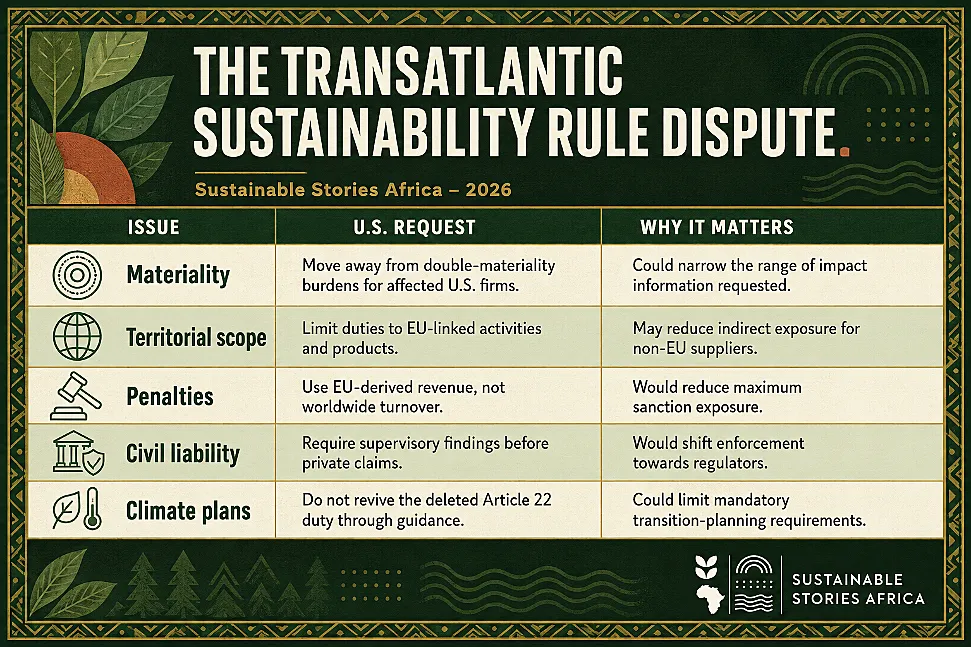
- A supplier may be asked for emissions, labour or human-rights information because a customer is covered by European rules, even when the supplier has no direct EU operation.
- The U.S. submission therefore asks Brussels to remove provisions that can bring certain non-EU companies into scope and to limit due diligence to activities and products directly linked to the EU market.
- It specifically seeks protection for producers and farmers who do not themselves sell into Europe.
Washington also wants penalties tied to EU-derived revenue rather than worldwide turnover.
- It favours regulator-led enforcement before civil claims can proceed, warning that private litigation across member states could produce inconsistent outcomes.
- It separately questions the oversight of third-party verification bodies and asks that a deleted requirement for mandatory climate-transition plans not return indirectly through guidance.
Narrower Rules Could Reduce Compliance Friction
A clearer territorial boundary could reduce duplicated questionnaires, legal uncertainty and compliance costs for companies operating across jurisdictions.
- For smaller suppliers, particularly farms and manufacturers with limited reporting capacity, proportional requirements can mean the difference between remaining in a value chain and being quietly screened out.
However, narrowing the rules too far carries a different risk.
- Sustainability harm often occurs upstream, outside the market where the final product is sold.
- If companies can ignore impacts because they occur in another jurisdiction, workers, communities and ecosystems may lose an important route to corporate accountability.
The policy challenge is therefore not simply “more” or “less” regulation; it is to design rules that are enforceable, comparable and fair to smaller businesses without erasing real impacts.
African Suppliers Need Better Regulatory Readiness
African governments and businesses should not wait for Brussels and Washington to settle the dispute.
- Exporters need to map which customers connect them to EU obligations, identify the data those customers are likely to request, and build traceable systems for environmental and social risks.
- Regulators and industry associations can help by developing shared templates, sector guidance and support for smaller suppliers.
The U.S. warned that it could take further action if what it considers unreasonable burdens remain.
That raises the prospect of extended regulatory and trade friction. African firms should use the breathing room created by any simplification to strengthen credible due diligence, not abandon it.
Part Forward – The Path From Conflict To Clarity
The immediate priority is a negotiated definition of scope, materiality and enforcement that prevents duplication while preserving accountability for serious environmental and human rights impacts.
African suppliers should prepare for either outcome: document value chain links, improve sustainability data and seek collective compliance support.
The durable advantage will come from systems that address multiple markets without pricing smaller producers out of trade.
Culled from: U.S. Government Formally Asks EU to Narrow Corporate Sustainability Due Diligence Law