South Africa's tax authority has opened public consultation on a proposed Digital VAT Model built around e-invoicing, interoperability and electronic reporting.
The reform could replace fragmented, retrospective checks with secure, near-real-time transaction data and eventually support pre-filled returns and VAT auto-assessment.
Its credibility will depend on phased adoption, affordable tools for smaller vendors, strong data safeguards and evidence that automation reduces compliance friction rather than redistributing it.
Consultation Opens on Three-Part VAT Model
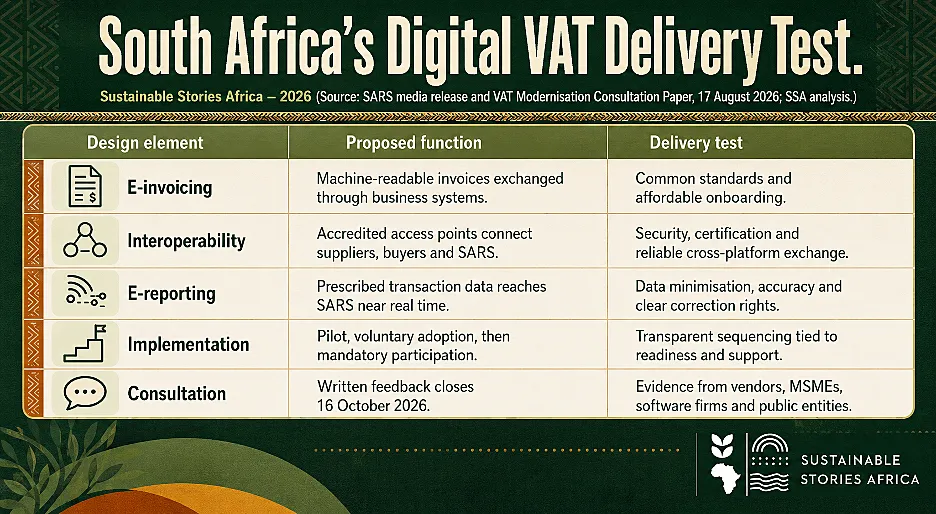
The South African Revenue Service has invited businesses, tax practitioners, software providers, public bodies and other stakeholders to comment by 16 October 2026 on a proposed model for digitising value-added tax administration.
Released on 17 August, the consultation paper combines e-invoicing, an interoperability framework and e-reporting under SARS Modernisation 3.0.
The proposal would allow structured invoice data to move securely between suppliers, buyers, service providers and SARS in near real time. It is designed to support system-based checks, more targeted compliance action and, over time, pre-filled returns and VAT auto-assessment.
SARS Commissioner Dr Johnstone Makhubu said the change would make compliance part of the systems businesses already use, while protecting revenue for development priorities.
From Retrospective Checks to Continuous Data
South Africa's VAT system is already digitised at points such as registration, filing and payment; however, SARS says it remains dependent on unstructured invoices, fragmented systems and manual administration.
That leaves the authority with limited transaction-level visibility until after returns are filed, while vendors can face repeated reconciliations, delayed certainty and slower refunds.
Under the five-corner model proposed in the paper, a supplier and buyer would exchange standardised e-invoices through accredited access points, with a fifth access point serving SARS.
- The authority would receive prescribed data for validation, risk analysis and future assessment.
- The paper proposes a pilot, then voluntary participation and finally mandatory adoption, although sector sequencing and firm dates have not yet been fixed.
Efficiency Gains Carry Uneven Readiness Costs
The potential gains are material.
- Better invoice data could reduce duplicate processing, improve the accuracy of returns, speed up refunds and help SARS focus audits on higher-risk cases.
- For businesses operating across supply chains, common standards may also reduce manual handling and make trade records easier to reconcile.
However, readiness is uneven.
- Large companies with modern enterprise systems may need upgrades rather than wholesale replacement.
- Micro, small and medium enterprises may have to move from paper, spreadsheets or emailed PDF invoices to compatible software or service-provider portals
Those costs, alongside digital literacy, connectivity, cybersecurity and business disruption, are not incidental details; they will determine whether the model widens or narrows compliance inequality.
The Test Is Trust, Access and Security
The consultation should therefore test more than technical architecture.
- Stakeholders need clarity on who may access transaction data, how service providers will be accredited, how errors will be corrected, what recourse vendors will have, and which safeguards will apply before automated assessments become routine
- Public entities will also need procurement and finance systems capable of receiving e-invoices.
SARS says workshops and structured working groups will inform the final policy.
- The release does not set a mandatory go-live date or publish a cost estimate.
- That restraint is useful only if feedback produces measurable protections: low-cost pathways for smaller firms, realistic transition periods, transparent standards and independent assurance over security and system performance.
Public Input Must Shape Phased Delivery
Vendors should use the consultation to quantify integration costs, identify sector-specific constraints and propose service levels for invoice validation, refunds and dispute resolution.
Software firms should test interoperability and portability, while SARS should publish pilot criteria and success measures before expanding participation.
A modern VAT system will be judged not by the volume of data collected, but by whether compliant taxpayers spend less time proving what reliable systems can already show.
Path Forward – Needs Inclusive Digital Tax
South Africa now has a window to build digital tax infrastructure with users, not merely for them.
The immediate priorities are evidence-based consultation, privacy-by-design, accessible tools and transparent pilot evaluation.
If those controls are built into the rollout, near-real-time VAT data could strengthen revenue integrity while reducing routine friction.
If readiness costs and safeguards remain vague, the reform risks digitising old burdens and creating new barriers for smaller businesses.