Eight African countries are entering a new phase of an AfDB-backed programme that links circular-economy planning with industrial policy, jobs and investment.
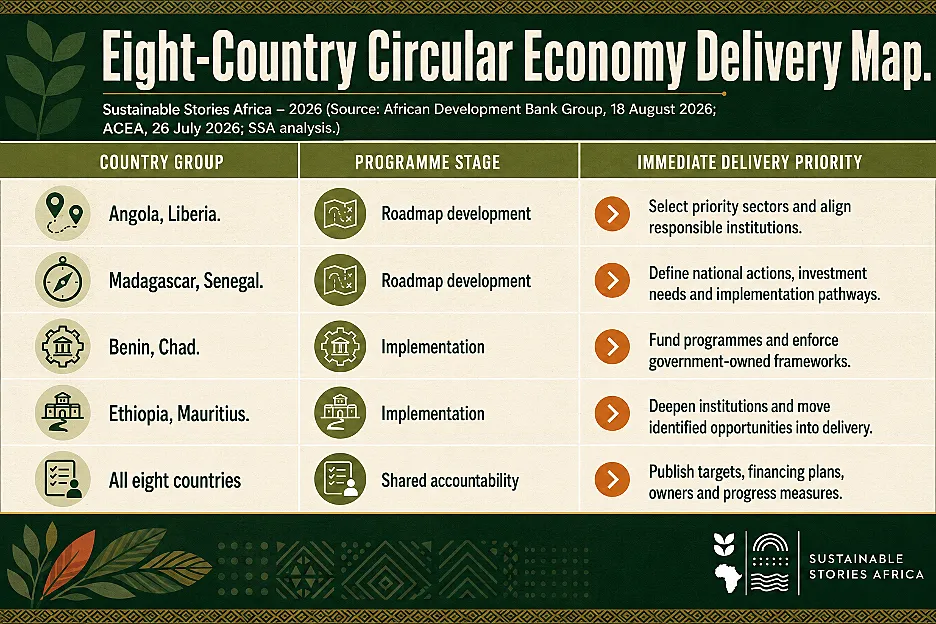
Angola, Liberia, Madagascar and Senegal will develop national roadmaps, while Benin, Chad, Ethiopia and Mauritius will move existing frameworks into implementation.
The opportunity is to retain more value from Africa's resources; the test is whether roadmaps become funded policies, capable institutions and investable projects.
Eight Countries Join Two-Track Circular Programme
Eight more African countries have joined the second phase of the National Roadmaps for the Circular Economy programme, as governments seek to connect resource efficiency with industrialisation, employment and domestic value creation.
The Africa Circular Economy Facility, a multi-donor trust fund administered by the African Development Bank Group, announced the expansion on 18 August 2026.
Angola, Liberia, Madagascar and Senegal will begin developing national roadmaps by identifying priority sectors, aligning public institutions and setting strategies suited to their productive structures.
Benin, Chad, Ethiopia and Mauritius will move into implementation, where the task is to translate government-owned frameworks into enforceable policy, financed programmes and durable institutional capacity.
Roadmaps Target Africa's Lost Domestic Value
The programme addresses a familiar structural problem:
- Africa exports substantial volumes of natural resources with limited processing, leaving much of the industrial value and many potential jobs elsewhere.
- Circular approaches seek to keep materials productive for longer through repair, reuse, recycling and more efficient design, while returning agricultural by-products and secondary raw materials to energy and manufacturing systems.
Anthony Nyong, the Bank Group's Director of Climate Change and Green Growth, linked the initiative to Africa's annual development financing gap of more than $400 billion.
In that context, a roadmap is useful only if it identifies where circular activity can generate returns, sequences policy actions and gives investors confidence about governance and project pipelines.
Early Targets Show Jobs and Recycling
The first cohort, Benin, Cameroon, Chad and Ethiopia, mapped opportunities across construction, forestry, agriculture, plastics, textiles, manufacturing, energy and water.
- Chad's roadmap targets more than 25,000 green jobs and a 40% reduction in non-recycled waste by 2035 across six sectors.
- Benin's action plan, launched in February 2026, aims within a decade to reach a 25% recycling rate, collect all municipal waste and establish 300 circular businesses.
Those targets illustrate why circularity should not be confined to sanitation departments.
Better collection can supply recycling businesses;
- Repair and reuse can extend asset life; agricultural residues can support energy systems; and secondary materials can reduce manufacturers' exposure to imported inputs.
For communities where these activities already support informal livelihoods, formalisation can improve access to finance, safety standards and markets; however, it must avoid displacing workers through poorly designed regulation.
Implementation Will Decide Whether Capital Follows
Interest is strong:
- 32 countries responded when the Facility sought expressions of interest for the second cohort.
- However, the demand for technical assistance is not the same as bankable delivery. Countries entering implementation will need budget lines, regulatory mandates, project preparation, data and procurement rules.
- Countries starting roadmaps should define measurable baselines and financing needs before publishing aspirational targets.
The Bank Group says the Facility provides technical assistance and supports the African Circular Economy Alliance.
- The announcement did not disclose country-level budgets, project timetables or a common results framework for the second phase.
- Those gaps should be closed early, because investors and citizens need to see which institution owns each action, how projects will be financed and how environmental and livelihood outcomes will be monitored.
Governments Must Convert Roadmaps Into Markets
Governments can make the roadmaps investable by pairing them with standards for recycled materials, extended producer responsibility, predictable waste and procurement rules, and pipelines that aggregate smaller projects.
Development financiers can support preparation and risk-sharing, while local banks need data to assess circular businesses whose value rests on recovered materials, service models or avoided waste.
Community organisations, waste workers, repair businesses and manufacturers must also shape the policies.
- Their participation can reveal where formal rules would strengthen livelihoods and where they might exclude the people already keeping products and materials in use.
The strongest roadmaps will connect national ambition with local enterprise, rather than treat communities as an afterthought to industrial strategy.
Path Forward – Demands Funded National Delivery
The next phase should produce public targets, named institutional owners, costed actions and investment pipelines for each country.
Roadmap development and implementation must be tracked as different stages with different evidence of progress.
If finance, regulation and community participation move together, circular policy can retain more African value, grow businesses and reduce waste.
Without funded delivery and transparent measurement, the programme could expand the number of plans without changing how resources, jobs and investment circulate through national economies.