ExxonMobil affiliates have notified the European Union of a dispute over carbon-storage obligations in the bloc’s Net-Zero Industry Act.
The challenge invokes the Energy Charter Treaty even after the EU moved to withdraw, because legacy protections can survive through a sunset clause.
The case could influence how governments design climate rules, allocate transition costs and protect policy space from investor-state claims.
Carbon obligation meets investment treaty challenge
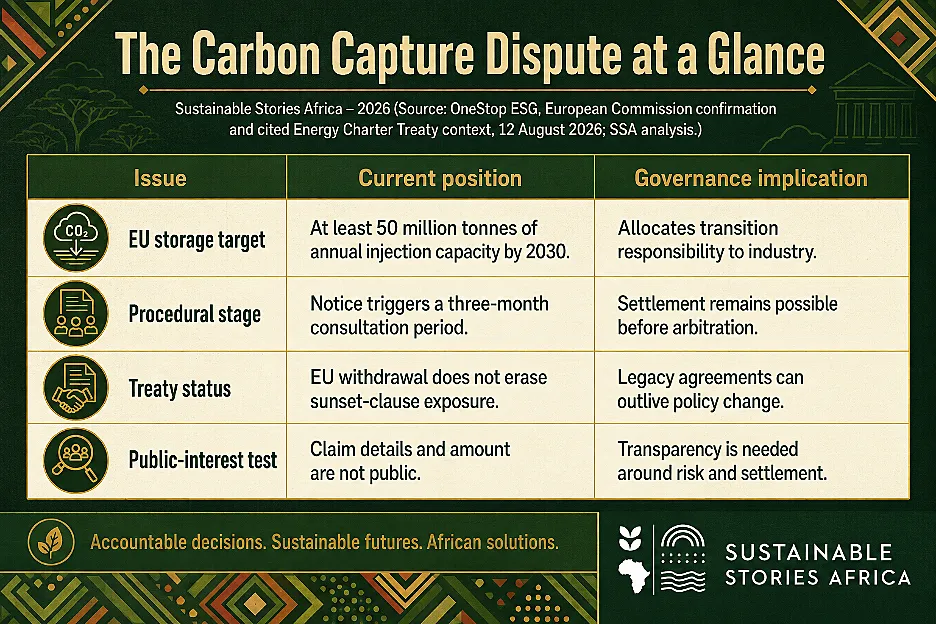
ExxonMobil affiliates have filed a notice of dispute against the European Union under the Energy Charter Treaty, challenging a requirement linked to the EU’s goal of developing capacity to inject and permanently store at least 50 million tonnes of carbon dioxide annually by 2030.
The measure is part of the 2024 Net-Zero Industry Act and places obligations on specified oil and gas producers.
A European Commission spokesperson confirmed receipt of a notice from petrochemical and energy companies incorporated in Belgium, Luxembourg and the United Kingdom, where Exxon has affiliates, and said the Commission is confident the measures comply with the treaty and international law.
The filing itself is not public, so the claimed amount and full legal arguments remain unknown.
A three-month window now opens
Under the Energy Charter Treaty’s investor-state dispute process, a notice starts three months intended for consultation or settlement before a claim can advance to arbitration.
Exxon has argued, according to the report, that the Commission is legislating in a way that disadvantages business and that the policy rationale is flawed.
The dispute turns a technical infrastructure target into a wider governance question:
- Who should carry responsibility for developing carbon-storage capacity required by a net-zero transition?
- Supporters see producer obligations as a way to align costs with firms that have extraction expertise and historical market benefits.
- Companies may argue that sudden or disproportionate obligations undermine protected investments.
The EU moved to withdraw from the treaty in 2024, citing its potential effect on climate policy.
However, sunset clauses can preserve investor protections for years after withdrawal.
At least ten countries have left the treaty, but departure does not automatically remove exposure tied to earlier investments.
The outcome reaches beyond one company
A settlement or award could affect the confidence with which governments impose transition duties on high-emitting industries.
- If legal exposure is large or unpredictable, policymakers may dilute, delay or redesign measures.
- If the EU successfully defends the rule, regulators may gain confidence that carefully framed climate obligations can coexist with investment protections.
The case also exposes an accountability imbalance that critics of investor-state arbitration highlight.
- Companies can access international panels, while communities affected by pollution, extraction or climate impacts often depend on domestic courts and administrative remedies.
- OneStop ESG cited research finding at least $82.8 billion in publicly known awards to fossil-fuel companies, while noting that confidentiality makes the full figure uncertain.
Climate rules need legal resilience
Governments should stress-test major climate laws against treaty obligations before adoption, document the public-interest evidence of the measures and show why cost allocations are proportionate.
Transparency around notices, claims and settlements is also vital where public policy and potential public liabilities are involved.
For African states, the dispute is a warning with practical relevance.
- Countries negotiating energy investments, carbon markets and transition projects should review sunset clauses, dispute forums and stabilisation provisions.
- Investment protection should not become a hidden veto over legitimate environmental regulation.
However, climate policy must also be predictable, evidence-led and procedurally fair.
Path Forward – Protect climate ambition through better rules
The EU’s immediate task is to defend the measure transparently, and to use the consultation period to clarify its design and proportionality.
Other governments should audit legacy treaties before imposing new transition obligations.
Future agreements must preserve the right to regulate for climate and public welfare, provide balanced remedies and narrow open-ended sunset exposure.
Legal certainty matters, but it should reinforce a credible transition rather than freeze yesterday’s energy bargain.
Culled from: ExxonMobil Files Dispute Against EU Carbon Capture Rule Under Energy Treaty