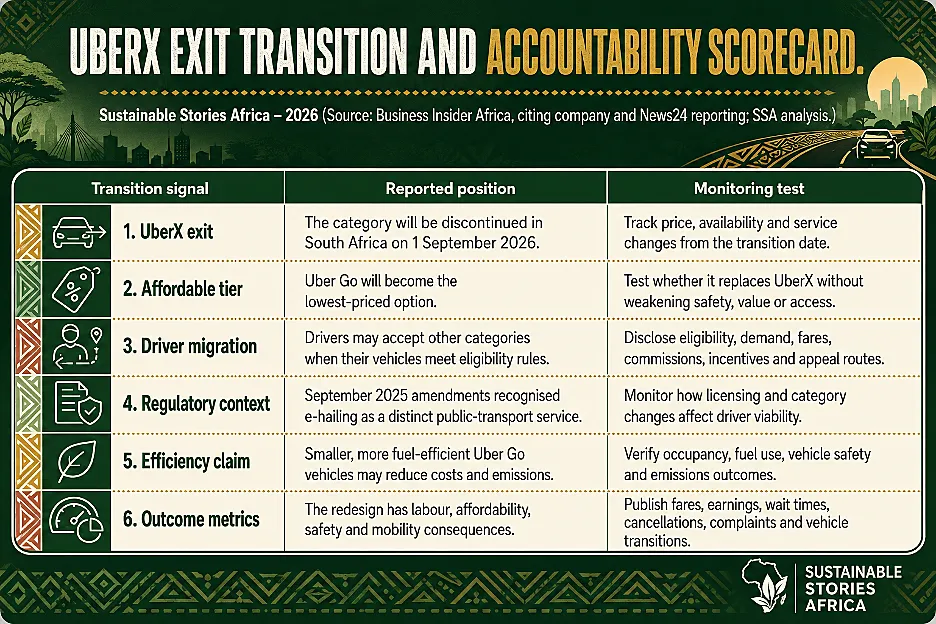
Uber will discontinue UberX in South Africa from 1 September 2026, retiring a category that helped establish ride-hailing in the country.
Uber says the change will simplify an increasingly crowded product lineup.
Uber Go will serve price-sensitive riders, while eligible drivers can move into other categories; however, the transition will test fares, vehicle eligibility and income stability in a fiercely competitive transport market.
Uber Retires Its Foundational Product Nationwide
Uber is ending UberX in South Africa on 1 September 2026, closing a chapter that began when the lower-cost service launched in Cape Town in 2014 and expanded to Johannesburg later that year.
Once described by the company as its most popular local option, UberX helped turn app-based transport from a novelty into an everyday service.
The company says the retirement is intended to simplify its portfolio and create clearer distinctions for riders and drivers.
Uber Go will occupy the lowest-priced tier, while Comfort and Black target customers seeking more space, newer vehicles or premium service. Reserve will support scheduled trips.
Simpler Menus Bring Complex Tradeoffs Ahead
Product overlap had grown as Uber added categories for price, vehicle type, trip purpose and service level.
The company told News24 that customers were finding some options difficult to distinguish and that overlap reduced the advantage available to drivers operating higher-specification vehicles.
UberX drivers will not automatically lose platform access.
They can accept trips in other categories if their vehicles satisfy eligibility rules. That qualification is central.
- A driver whose car fits Uber Go may remain active but face a different fare and trip mix; one whose vehicle does not fit another category may need to upgrade, switch platforms or leave.
For riders, the practical question is whether Uber Go can replace UberX without weakening availability, safety or value.
South Africa’s household budgets remain sensitive to transport costs, and ride-hailing competes not only with Bolt, inDrive and smaller platforms but with metered taxis, minibuses and private cars.
Transition Can Improve Market Clarity Nationwide
If managed transparently, a streamlined menu could reduce confusion and help riders understand what each fare buys.
It may also allow drivers with newer or larger vehicles to receive clearer differentiation rather than competing against an overlapping standard category.
The change arrives as South Africa formalises e-hailing regulation.
- Amendments implemented in September 2025 recognised e-hailing as a distinct public-transport service, requiring platform registration and driver operating licences while strengthening vetting, identification and safety expectations.
- A clearer commercial structure could complement those rules, provided compliance costs and category changes do not squeeze drivers beyond viability.
There is also an efficiency opportunity.
- Uber Go generally relies on smaller, more fuel-efficient vehicles.
- If the shift increases occupancy and reduces fuel use per trip without encouraging older unsafe vehicles, it could lower operating costs and emissions.
That outcome needs evidence rather than assumption.
Publish Transition Impacts For Riders And Drivers
Uber should give drivers individual eligibility information, estimated demand by category and enough notice to plan.
It should disclose how fares, commissions and incentives compare before and after the change, with accessible appeal channels for disputed vehicle classifications.
Consumer and transport regulators should monitor cancellation rates, wait times, safety complaints and price movements after 1 September.
Driver associations need a seat at the review table. A cleaner app interface is valuable; however, sustainable mobility also requires fair earning prospects, dependable service and affordable access.
Path Forward – Measure What Changes After UberX Exit
The UberX retirement is a product decision with labour, affordability and mobility consequences. Its success should be measured beyond whether the menu looks simpler.
Uber and regulators should publish evidence on fares, driver earnings, availability, safety and vehicle transitions.
If Uber Go absorbs demand without eroding service quality or livelihoods, the redesign may strengthen the market.
If gaps emerge, early corrective action will be essential.
Culled from: Uber is retiring its most popular ride option in South Africa after more than a decade | Business Insider Africa