EBID has approved $10.04 million for G Farms Limited in The Gambia.
The financing will expand poultry, dairy and feed production, with major capacity targets running to 2035.
Its food-security impact will depend on affordability, local sourcing, jobs, animal welfare and environmentally responsible growth.
Development Finance Backs Gambian Food Production
The ECOWAS Bank for Investment and Development has approved a $10.04 million financing package for G Farms Limited, supporting a major expansion of poultry, dairy and feed operations in The Gambia.
The agreement, signed on July 28, will fund modern agricultural equipment and production infrastructure.
EBID presents the investment as part of its strategy to strengthen regional food systems, expand private-sector production and reduce reliance on imported livestock products.
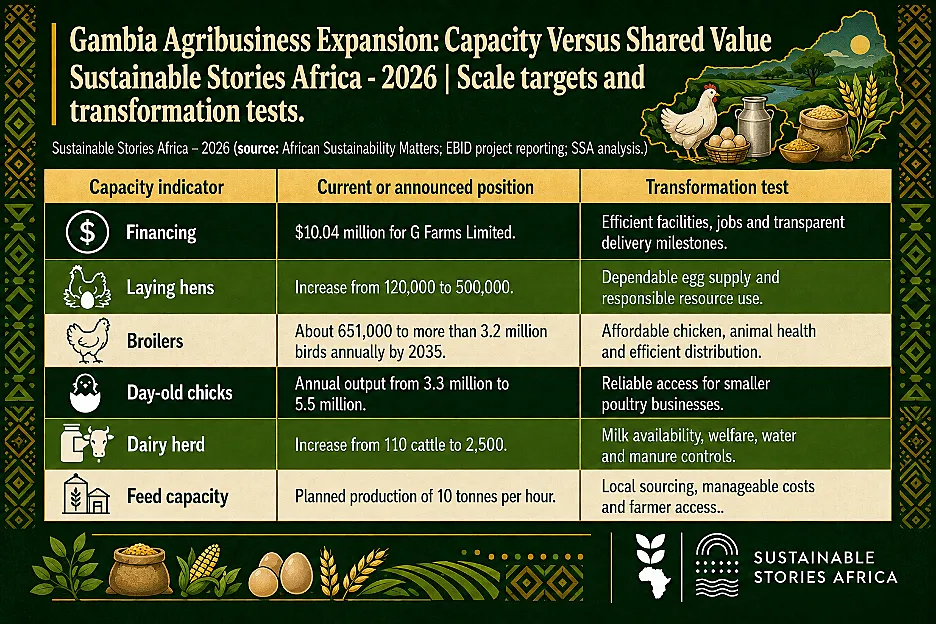
The scale-up targets are substantial. G Farms plans to increase laying hens from 120,000 to 500,000, raise annual broiler production from about 651,000 birds to more than 3.2 million by 2035 and expand day-old chick output from 3.3 million to 5.5 million annually.
Large Capacity Targets Raise Delivery Questions
The dairy operation is expected to grow from 110 cattle to 2,500, while feed manufacturing capacity is planned at 10 tonnes per hour.
If implemented, these changes could support farmers who need reliable supplies of chicks and feed, while increasing local supplies of eggs, chicken and milk.
They are, however, projected outputs. The financing announcement does not itself establish how quickly each target will be reached, how many jobs will be created, what share of inputs will be sourced locally or whether increased supply will reduce consumer prices.
Those questions matter in a region exposed to imported food inflation and foreign exchange pressure.
Expanding domestic production can improve resilience, but only if farms can manage feed costs, veterinary risks, energy needs, cold chains and market access.
Affordability should be tested at the retail end of the chain. Greater output may stabilise supply; however, households benefit only when distribution is efficient, and productivity gains are not entirely taken by feed, power, transport or financing costs.
Local Supply Chains Can Multiply Benefits
EBID President George Agyekum Donkor said the financing reflects the Bank’s commitment to food security, private-sector development and sustainable economic transformation.
G Farms Managing Director Muhammad Sanyang called it a transformative milestone for the company and the country’s agricultural sector.
The investment also reflects cooperation between EBID and the European Investment Bank. Zuzana Zatkova of the EIB’s Financial Inclusion Division linked the partnership to food security, employment and sustainable agricultural development across West Africa.
The strongest outcome would extend beyond one company.
Local grain growers could supply feed inputs; small poultry businesses could access dependable day-old chicks; transporters and processors could gain business; and consumers could benefit from more stable protein supply.
That multiplier depends on procurement policy and fair commercial relationships.
Growth Must Include Environmental Safeguards
Scaling livestock production also creates responsibilities.
Water use, manure, odour, animal health, antibiotic stewardship, worker safety and greenhouse gas emissions need to be managed from the start.
Higher efficiency per unit of output can reduce resource intensity, but total environmental pressure may still rise as production expands.
EBID and G Farms should publish phased capacity milestones, job and supplier targets, environmental indicators and animal-health controls.
Reporting should show achieved production rather than announced capacity, and explain how the project affects prices, local sourcing and small-enterprise participation.
Affordable finance for commercially viable agribusiness is important, but concentration risk must be monitored.
A resilient food system needs strong anchor companies alongside diverse farmers, processors and distributors.
Path Forward – Food Security Requires Accountable Farm Expansion
The immediate task is to turn the financing into efficient facilities, skilled jobs and stronger local supply relationships while managing environmental and animal health risks.
By 2035, success should be visible in dependable production, affordable nutrition, local enterprise growth and transparent sustainability performance.
Capacity alone will not prove transformation; shared value will.