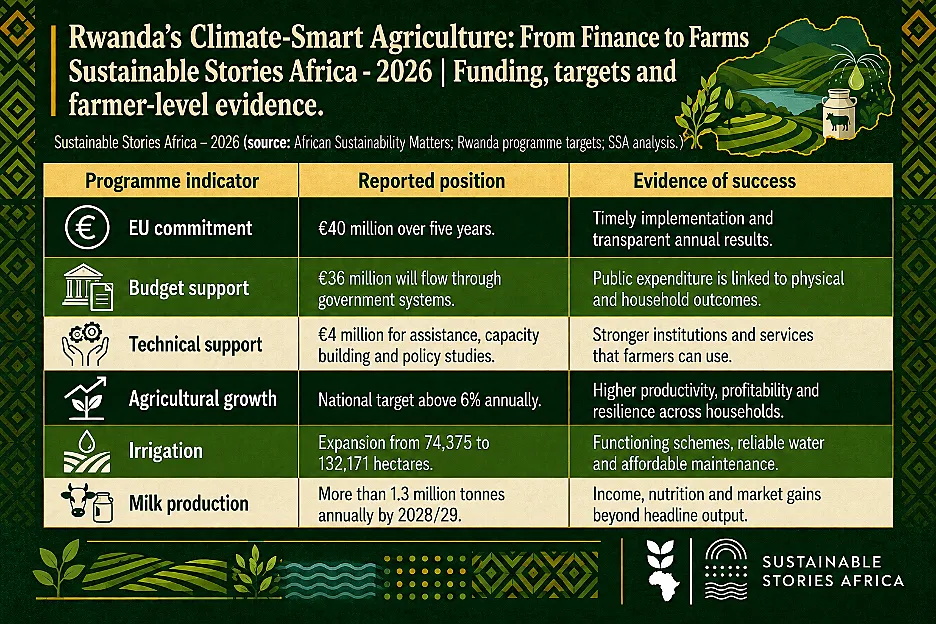
The European Union has committed €40 million over five years to Rwanda’s agricultural transformation.
Of the total, €36 million is direct budget support and €4 million will fund technical assistance, capacity building and policy studies.
The test is whether national systems convert the financing into reliable water, stronger services and higher smallholder incomes.
Climate Finance Enters Rwanda’s National Systems
The European Union has committed €40 million, about $46.2 million, over five years to support Rwanda’s climate-smart and inclusive agricultural transformation, using a financing model that enables most of the money inside government systems.
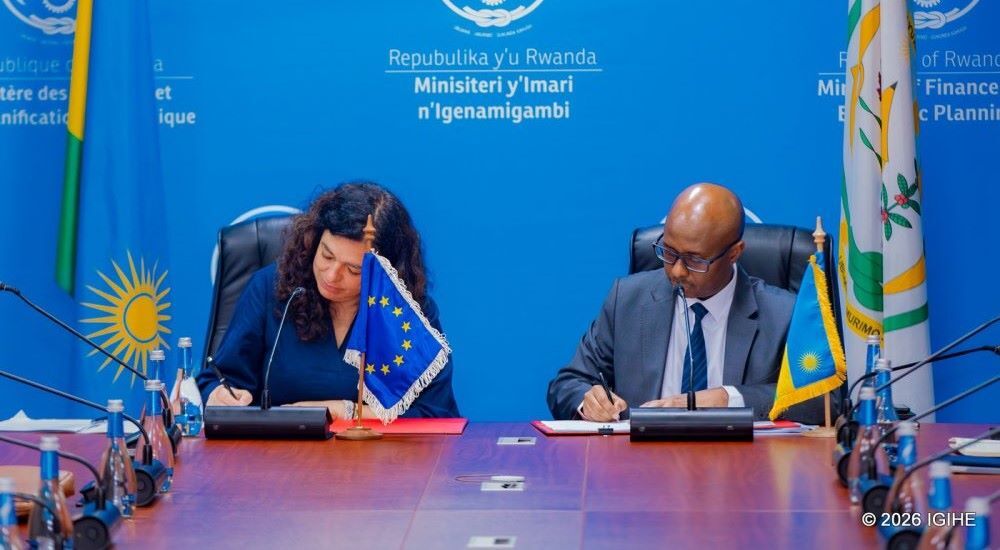
The agreement, signed in Kigali on August 4, allocates €36 million as direct budget support and €4 million for technical assistance, capacity building and policy studies.
The programme “HANGARIBIHE: Transformational Climate-Smart and Inclusive Agriculture in Rwanda” will support irrigation, sustainable land management, ecosystem restoration, agricultural value chains and climate information.
This structure matters because it is designed to reinforce Rwanda’s own policies rather than create a separate donor delivery system.
It also raises the accountability stakes: public financial management, transparent indicators and credible reporting will determine whether budget support produces benefits that farmers can see.
National-system financing must connect expenditure to physical and household outcomes, not only compliant disbursements on paper.
Irrigation Targets Meet Increasing Climate Pressure
Agriculture remains central to rural livelihoods in Rwanda, but limited land, dependence on rainfall, uneven productivity and exposure to droughts and floods constrain the sector.
For a smallholder household, one failed season can reduce income, limit food choices and increase debt.
Rwanda’s Fifth Strategic Plan for Agriculture Transformation, covering 2024-2029, puts resilient agri-food systems at the centre of policy.
Under the National Strategy for Transformation 2, the country targets annual agricultural growth above 6%, expansion of irrigated land from 74,375 hectares to 132,171 hectares and annual milk production above 1.3 million tonnes by 2028/29.
The EU funding joins other irrigation and watershed investments, including more than $78 million approved by the International Fund for Agricultural Development in 2026.
The growing pool of finance makes coordination essential so projects complement one another and do not compete for the same institutional capacity.
Water Security Can Strengthen Farm Incomes
Reliable irrigation can reduce exposure to rainfall variability, enable multiple production cycles and improve yields.
However, output alone will not guarantee higher incomes. Farmers also need storage, processing, finance, market information and dependable buyers.
The programme’s inclusion of climate information and value-chain development is therefore significant. Timely forecasts can help farmers decide when to plant or protect livestock, while stronger cooperatives and market links can improve bargaining power. Women and young people should benefit not only as programme participants but as land users, workers, suppliers and agribusiness owners.
Rwanda reportedly approaches 83% food self-sufficiency, but a national ratio can conceal differences between crops, districts and households.
Monitoring should capture nutrition, affordability, farmer profitability and resilience after climate shocks, not merely hectares equipped or funds disbursed.
Results Must Be Visible Beyond Budgets
Rwanda and the EU should publish baselines, annual targets and independently verifiable results for irrigation functionality, land restoration, service quality and beneficiary outcomes.
Budget support can strengthen institutions, but only when performance indicators are public, and underperformance leads to correction.
Maintenance financing deserves early attention.
Irrigation schemes that work at launch but deteriorate through weak governance or unaffordable fees will not deliver durable resilience.
Water-user arrangements, environmental safeguards and conflict-sensitive allocation must be designed with communities.
Path Forward – Farmers Must Define Programme Success Together
The next step is to translate the financing agreement into coordinated investments, capable institutions and services that reach farms before the next climate shock.
Success will mean more reliable water, healthier landscapes, stronger value chains and measurable income gains for smallholders.
Rwanda’s national system approach can be a model only if transparency and farmers’ experience remain central.