The African Development Bank Group has approved $255 million in lending and a $10 million grant for participation in Zambia’s Lobito Corridor.
The first phase includes about 550 kilometres of new railway and a 105-kilometre road upgrade.
Delivery will determine whether the corridor lowers logistics costs, creates durable jobs and broadens value addition of minerals.
Zambia Gains a Westward Trade Option
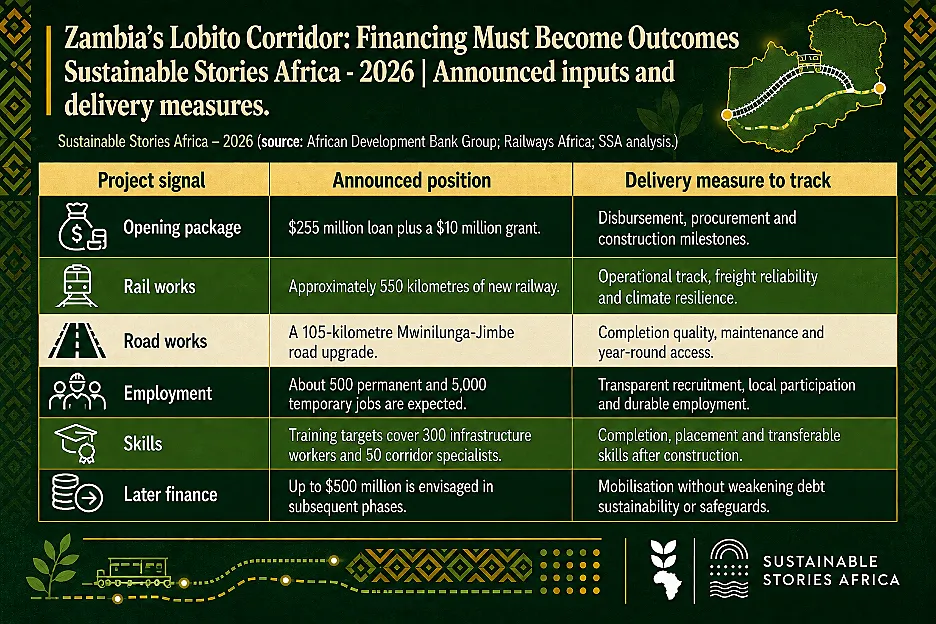
The African Development Bank Group has approved a $255 million loan and a $10 million grant to support Zambia’s participation in the Lobito Corridor, providing the first major tranche of financing for a new route linking the country toward Angola’s Atlantic coast.
The plan includes approximately 550 kilometres of new railway infrastructure in Zambia and the upgrade of 105 kilometres of the Mwinilunga-Jimbe road.
It is intended to connect Zambia’s Copperbelt and agricultural regions more efficiently with the Port of Lobito through Angola, while strengthening trade with the Democratic Republic of the Congo.
The loan will come from the African Development Fund, while the grant is provided through the Rome Process/Mattei Plan Financing Facility.
The Bank says additional resources of up to $500 million are envisaged in subsequent phases, making the current approval an opening tranche rather than the project’s full financing requirement.
A Corridor Must Move More Than Minerals
For land-linked Zambia, transport costs shape whether mines, farms and manufacturers can compete.
A westward rail route could diversify access to seaports, reduce pressure on existing corridors and improve supply-chain reliability.
However, infrastructure alone will not create an economic corridor.
The approved programme combines rail and road work with trade facilitation, institutional support and skills development.
The Bank expects about 500 permanent and 5,000 temporary jobs in construction, logistics, border operations and professional services.
At least 300 people are expected to receive training in rail and road construction and maintenance. 50 will be trained in corridor management, logistics, climate safeguards, monitoring and evaluation.
Those numbers are targets, not results.
Their credibility will depend on transparent recruitment, the participation of women and young people, local procurement and whether temporary construction work translates into transferable skills and longer-term enterprise opportunities.
Better Logistics Could Support Local Industry
The strongest development case for Lobito is not simply faster copper exports.
A reliable corridor can help farmers reach markets, improve access to machinery and inputs, encourage processing near production zones and attract private investment in logistics, energy and urban services.
AfDB Infrastructure and Urban Development Director Mike Salawou described the corridor as “more than a transport investment”, framing it as a platform for integration, industrialisation and economic transformation.
That promise will be tested by freight pricing, border efficiency and the extent to which Zambian businesses can participate in the value created.
Climate resilience also matters. Rail can move large freight volumes more efficiently than road transport, but new infrastructure must be designed for flooding, extreme heat and maintenance realities.
Environmental and social safeguards will need to protect communities and ecosystems along the route.
Delivery Discipline Must Match Financing Ambition
Zambia, the AfDB and corridor partners should publish clear milestones for land access, procurement, construction, safeguards, skills and trade facilitation.
Communities need accessible grievance mechanisms, while Parliament, civil society and financiers need data on costs, delays and achieved outcomes.
Regional coordination is equally important. Rail gauges, customs systems, border processes and operating rules must work across Zambia, Angola and the DRC.
A line that stops at an administrative bottleneck will not deliver the promised reduction in logistics costs.
Path Forward – Corridor Value Depends On Local Outcomes
The immediate priority is to move from financing approval to accountable implementation, while mobilising later phases without weakening debt sustainability or safeguards.
Success should be measured in reliable freight movement, competitive logistics costs, local jobs, value-added production and wider market access.
Zambia’s Atlantic connection will matter most if communities and domestic enterprises share its benefits.
Called From: Zambia: African Development Bank Group approves $255m loan and $10m grant to advance the Lobito Economic Corridor