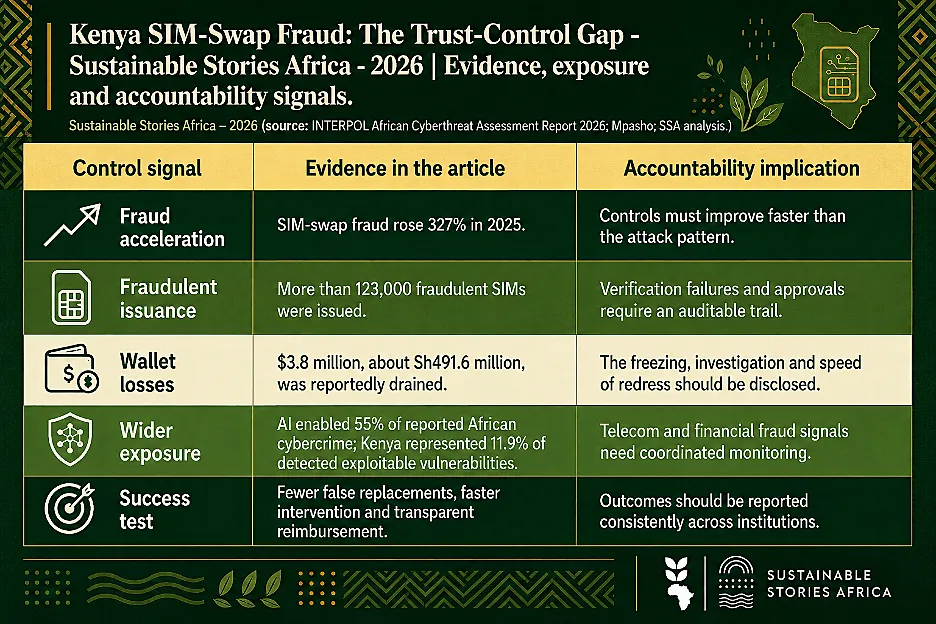
SIM-swap fraud in Kenya rose 327% in 2025, INTERPOL says.
More than 123,000 fraudulent SIMs were issued and an estimated $3.8 million, about Sh491.6 million, was drained from mobile wallets.
The losses expose a trust gap where identity checks, telecom controls and financial safeguards meet.
Mobile Trust Takes a Costly Hit
For a Kenyan mobile-money user, a phone that suddenly loses service can be more than an inconvenience.
It may be the first visible sign that a criminal has taken control of the number used to receive one-time passwords, approve transactions and recover digital accounts.
INTERPOL’s African Cyberthreat Assessment Report 2026 says SIM-swap fraud in Kenya surged by 327% in 2025.
More than 123,000 fraudulent SIMs were issued and an estimated $3.8 million, approximately Sh491.6 million, was drained from mobile wallets.
The finding places identity fraud at the centre of the country’s digital-finance risk.
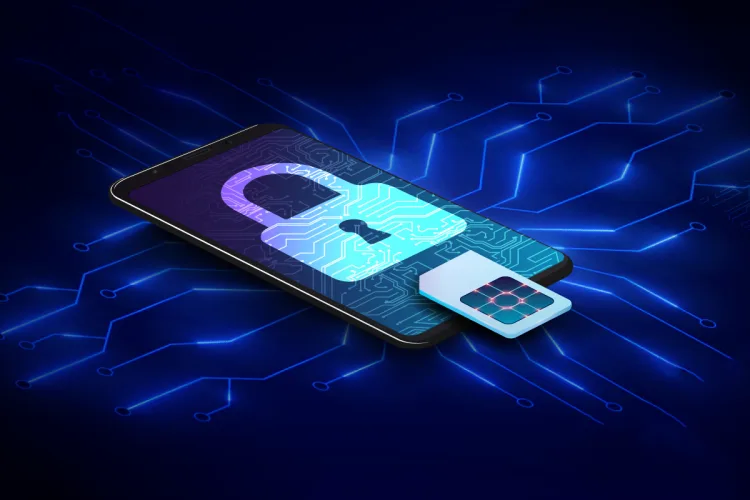
In a SIM swap, a fraudster persuades or corruptly facilitates a telecommunications carrier to transfer a victim’s number to another SIM.
Control of the number can allow the criminal to intercept security codes and reset access to mobile money, banking, email, or cryptocurrency accounts.
The attack therefore exploits both people and systems: stolen personal information, weak verification and the concentration of financial identity in a single phone number.
Digital Growth Expands the Attack Surface
Kenya’s mobile-first economy has widened access to payments and everyday financial services, but that success also raises the value of a compromised identity.
A victim can lose connectivity and money within a short window, while the institutions involved may include a telecom operator, a mobile wallet provider, a bank and law-enforcement agencies.
The Kenyan figures sit inside a wider continental warning.
- INTERPOL reported that artificial intelligence enabled 55% of reported cybercrime across Africa in 2025 and reported losses reached $484 million.
- Kenya also accounted for 11.9% of detected exploitable digital vulnerabilities in the assessment, behind South Africa.
Those statistics do not mean every Kenyan customer faces the same risk, and the Sh491.6 million estimate should not be read as the entire national cost of cybercrime.
They do show that account recovery, SIM replacement and customer identification have become financial infrastructure issues, not merely telecom service procedures.
Stronger Controls Can Restore Confidence
The immediate opportunity is to make fraudulent number transfers harder, but not blocking legitimate customers who have lost or damaged their phones.
Telecom operators and financial institutions can combine stronger identity checks with real-time alerts, cooling-off periods for high-risk transactions after a SIM change and rapid account-freezing channels.
Customers also need simple warnings about the danger of unexpected signal loss, unsolicited requests for personal data and calls asking for security codes.
A well-designed response should allow a user to report a suspected swap through another device or trusted channel before funds leave the account.
Better controls would protect more than individual balances.
They would strengthen confidence in the mobile-payment ecosystem on which households, traders and small businesses depend.
If users begin to view the phone number as an unreliable security credential, the cost will appear in reduced trust as well as direct losses.
Accountability Must Follow Every SIM Replacement
Kenya’s regulators, telecom operators, banks and mobile-money providers should treat SIM replacement as a shared-risk event.
That means clear responsibility for verification, auditable approval records, data sharing within lawful limits and public reporting on fraud attempts, confirmed losses and customer redress.
Enforcement must also reach insiders and organised networks that turn stolen identity data into fraudulent SIMs.
Stronger prosecution, regional intelligence sharing and common evidence standards are essential because the people collecting personal information, issuing a SIM and moving money may operate across different institutions or borders.
Path Forward – Safer Mobile Finance Requires Shared Accountability
Kenya can preserve the convenience of mobile finance while reducing the power attached to a single phone number.
The priority is a coordinated security standard that detects risky SIM changes before accounts are emptied.
Progress should be measured through fewer fraudulent replacements, faster intervention, transparent reimbursement outcomes and sustained public education.
Trust will recover when responsibility travels with every transaction.