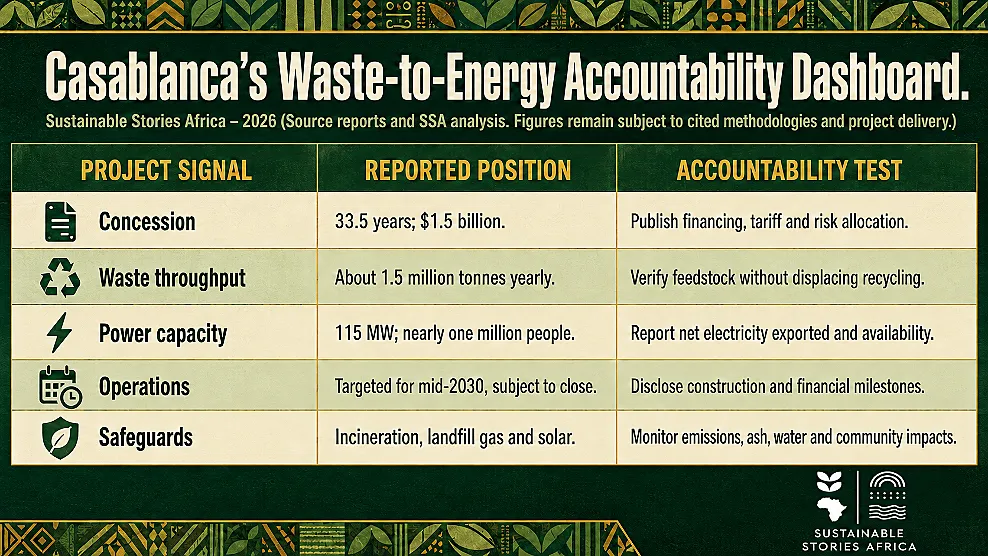
Casablanca has awarded a 33.5-year concession for a $1.5 billion waste-to-energy complex at the Mediouna landfill.
The planned 115-megawatt facility could process 1.5 million tonnes of waste yearly and serve nearly one million people.
Its real test is whether energy recovery complements recycling, protects nearby communities and reaches financial close.
A Landfill Liability Becomes Power Infrastructure
Casablanca has selected a four-company consortium to build and operate a $1.5 billion waste-to-energy complex, turning one of Morocco’s most visible urban liabilities into a proposed source of electricity.
The 33.5-year concession covers a 115-megawatt plant at the Mediouna landfill, with commercial operation targeted for mid-2030, subject to financing.
The consortium brings together Kanadevia Inova, Morocco’s Nareva, Japan’s Itochu Corporation and construction company Somagec. Plans reported by African Sustainability Matters indicate that the facility would handle about 1.5 million metric tonnes of municipal waste each year and generate enough electricity for almost one million people, approximately one-quarter of Casablanca’s population.
Scale Meets A Pressing Urban Problem
Mediouna has received Casablanca’s waste for decades.
The disposal site is reported to rise nearly 70 metres and to be approaching capacity, while surrounding communities and farmland face risks associated with groundwater pollution, methane and unmanaged dumping.
- For residents, therefore, the project is not only an energy investment.
- It is a test of whether a megacity can improve sanitation and environmental health while demand for electricity keeps rising.
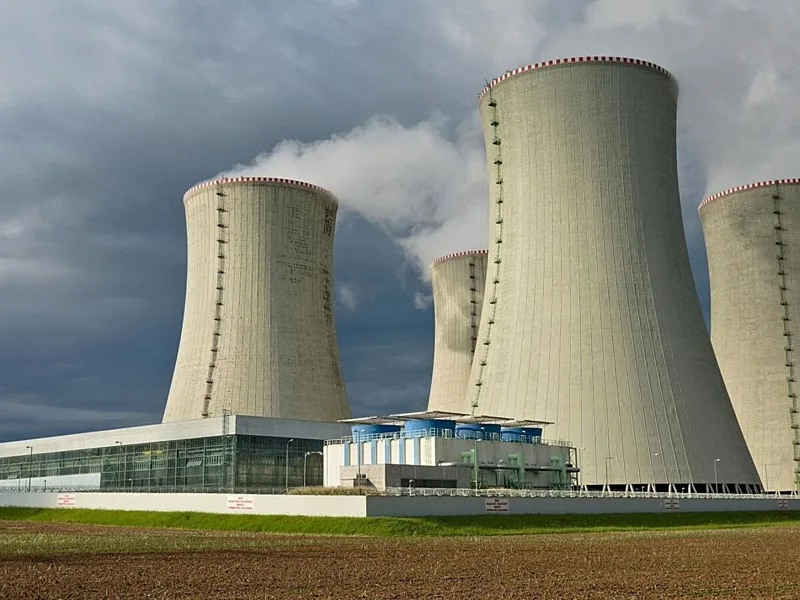
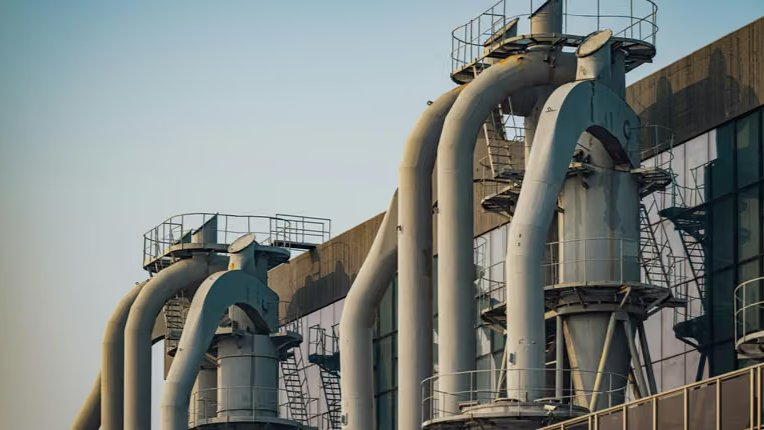
The proposed system combines municipal waste incineration, landfill gas recovery and on-site solar generation.
Long-term power-purchase arrangements with Morocco’s National Office of Electricity and Drinking Water and regional utility SRM Casablanca-Settat are intended to anchor revenues.
Financing is expected from Moroccan banks, but financial close remains a decisive milestone before construction can begin.
The numbers explain the continental interest.
The World Bank has projected that annual waste generation in sub-Saharan Africa will more than triple by 2050.
- Cities must fund collection, sorting and safe disposal even as landfills fill up.
- A facility that diverts residual waste and produces dependable power can relieve two infrastructure pressures at once.
However, only if the waste system feeding it works reliably.
Circular Gains Depend On Strong Safeguards
If delivered well, the plant could reduce dependence on landfill, capture methane-linked value and add electricity outside Morocco’s conventional wind and solar portfolio.
It may also provide an investable model for cities struggling to finance modern waste services. Morocco’s target of renewables exceeding 52% of installed power capacity by 2030 provides the project a wider energy-transition context, although incineration is not equivalent to wind or solar.
The trade-off is equally important.
- Large incinerators require regular feedstock, which can weaken incentives to reduce waste or recycle valuable materials.
- Poor emissions control can expose communities to particulates and other pollutants.
- The circular-economy case is strongest when prevention, reuse, recycling and composting come first, leaving energy recovery for genuinely non-recyclable waste rather than allowing the furnace to dictate the waste hierarchy.
Publish Measured Performance Before Replication Begins
Casablanca’s authorities and concession partners should disclose the financial close timetable, waste-composition assumptions, emissions standards, ash-disposal plan and independent monitoring arrangements.
Public reporting should track tonnes received, materials recovered, electricity exported, plant availability, air pollutants and complaints from neighbouring communities.
Procurement must also protect waste pickers and informal recyclers whose livelihoods can disappear when waste flows are centralised.
Skills pathways, formal contracts and access to sorted materials should be built into implementation.
Transparent tariffs and clear municipal payment obligations will matter just as much as engineering, because a technologically impressive plant can still fail if collection, feedstock or revenue systems break down.
Path Forward – Build A Circular System Around Recovery
The next step is financial close backed by enforceable environmental and social conditions, not a blank cheque for construction.
Casablanca should publish a citywide materials strategy that shows how recycling and composting will grow alongside energy recovery.
If verified performance follows, Mediouna could be a useful reference.
Its legacy, however, will be measured by cleaner neighbourhoods, protected livelihoods and accountable emissions, rather than by the size of the furnace or its headline investment value.