Where a job is located is re-entering the talent equation, even as hybrid work expands.
New research across more than 80 cities finds that workers value whether daily urban life feels better, rather than how many amenities exist.
For African employers and city leaders, the finding reframes transport, safety, public space and culture as economic infrastructure capable of attracting scarce skills and anchoring long-term investment.
Urban Place Returns To Talent Strategy
The office may be more flexible, but the city decides whether many workers stay.
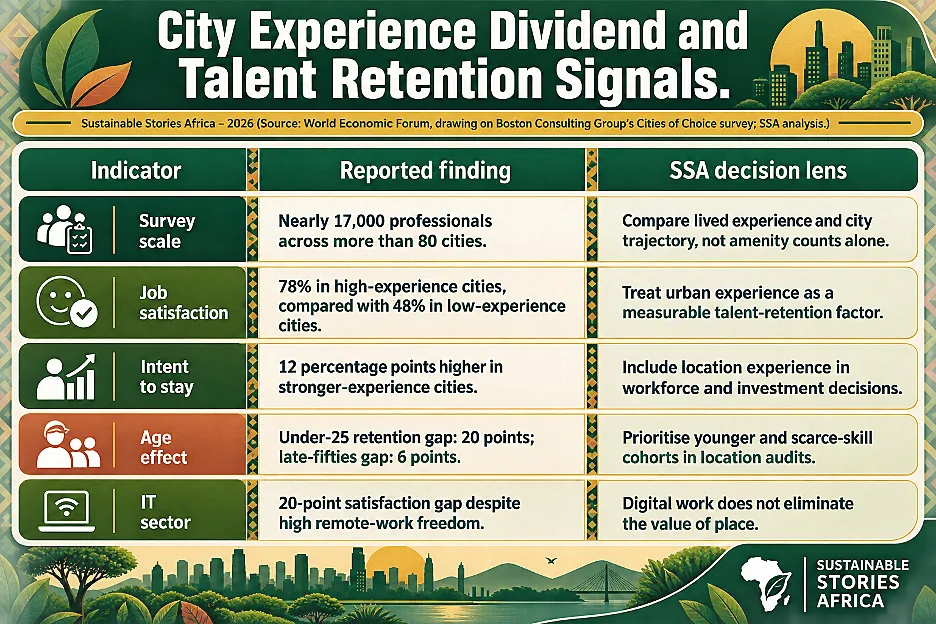
A World Economic Forum article drawing on Boston Consulting Group’s Cities of Choice survey of nearly 17,000 professionals across more than 80 cities argues that employers gain an “experience dividend” when their locations make everyday life easier, richer and visibly better.
The result challenges a familiar corporate assumption: salary, benefits, culture and management are sufficient to win talent.
Those factors remain essential; however, the study suggests they sit within a wider lived experience shaped by commuting time, access to public space, safety, leisure, social connection and the friction involved in using a city.
City Trajectory Matters More Than Inventory
The surprise is that more amenities do not automatically produce happier workers.
The researchers found a negative relationship between the density of venues, such as restaurants, bars, concerts and museums, and job satisfaction.
What predicted satisfaction was whether residents felt the experience of their city was improving.
In cities rated highly for experiential quality;
- 78% of respondents said they liked their jobs, compared with 48% in low-experience cities.
- Workers in the stronger tier were also 12 percentage points more likely to intend to stay.
- Among people under 25, the retention gap widened to 20 points, against 6 points for workers in their late fifties.
That distinction matters across Africa, where employers often compete for engineers, digital professionals, health workers and finance specialists while cities wrestle with congestion, unreliable services and high housing costs.
A business park can offer a polished office; however, it can still lose talent if a two-hour commute consumes family time or unreliable electricity turns remote work into a daily negotiation.
Cities Can Convert Livability Into Growth
The finding creates an opportunity for emerging cities.
- They do not need to outspend London, Paris or Tokyo on cultural inventory.
- They can compete by making existing assets easier to reach and safer to use
- By showing residents that conditions are improving.
For companies, this opens a broader location scorecard.
- Rental cost and tax incentives can be assessed alongside commute reliability, housing accessibility, broadband, public safety, schools, green space and the social life available after work.
For municipal governments;
- Investment in walkability, reliable transport and welcoming public places becomes part of industrial and employment policy, not a cosmetic extra.
The study also found the experience effect across income levels and sectors.
In information technology, arguably the sector with the greatest remote-work freedom, the job-satisfaction gap between high- and low-experience cities was still 20 points.
Place has not disappeared; the choice of a worker has made it more visible.
Build Talent Partnerships Beyond Office Walls
African employers should measure why people reject offers, relocate or resign, then share anonymised findings with city authorities, developers and transport operators.
Location decisions should include employee experience audits and scenario testing, particularly for younger workers and critical roles.
Cities, meanwhile, need transparent indicators that capture journey times, service reliability, safety, public-space use and resident sentiment.
The objective is not to manufacture nightlife or copy global capitals. It is to reduce friction and deliver credible improvement.
When workers can see a city moving forward, attachment and the investment that follows it can deepen.
Path Forward – Make Everyday Experience Economic Infrastructure Now
Employers should treat urban experience as a measurable retention risk, while city leaders integrate talent outcomes into transport, housing, safety and public-realm investment.
The competitive prize is larger than happier employees.
African cities that steadily improve daily life can retain skills, attract firms and build a more durable tax and investment base, turning livability into inclusive economic infrastructure.
Culled from: Why a job's location still matters in attracting talent: Data | World Economic Forum