Vodacom has outlined a phased board transition spanning October 2026 to July 2027.
Former Airtel Africa chief Segun Ogunsanya will join as an independent non-executive director, while two directors retire and the chairmanship changes hands.
The governance test is whether the planned succession preserves oversight, committee capacity and strategic continuity during the execution of Vodacom’s Vision 2030.
Vodacom sets a phased board transition
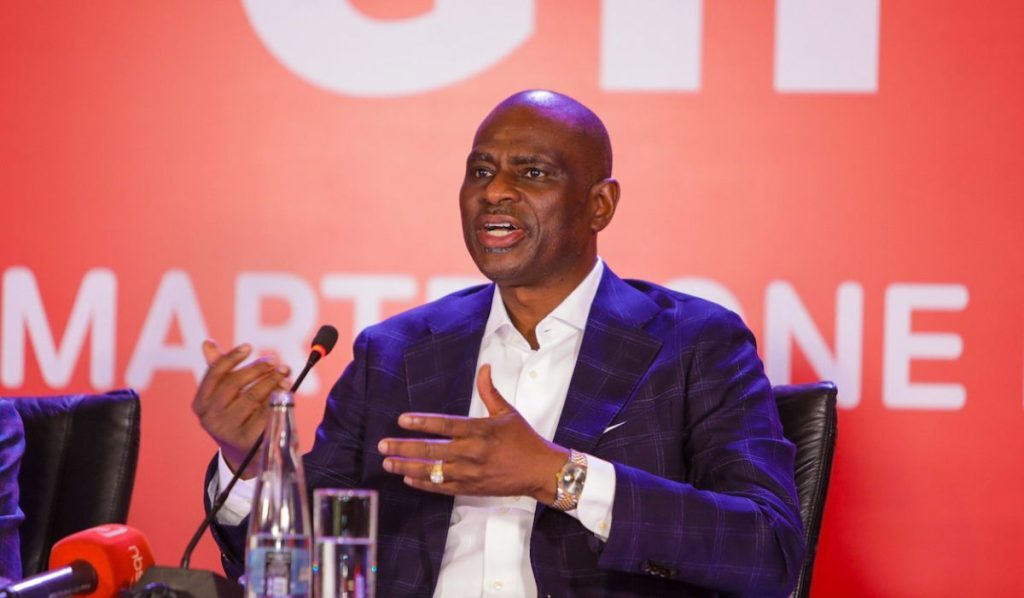
Vodacom Group has announced several board and committee changes that will bring former Airtel Africa chief executive Segun Ogunsanya into the company as an independent non-executive director and transfer the chairmanship from Saki Macozoma to Khumo Shuenyane in July 2027.
The changes were disclosed through the JSE’s Stock Exchange News Service on 12 August 2026, in a company notice dated 11 August.
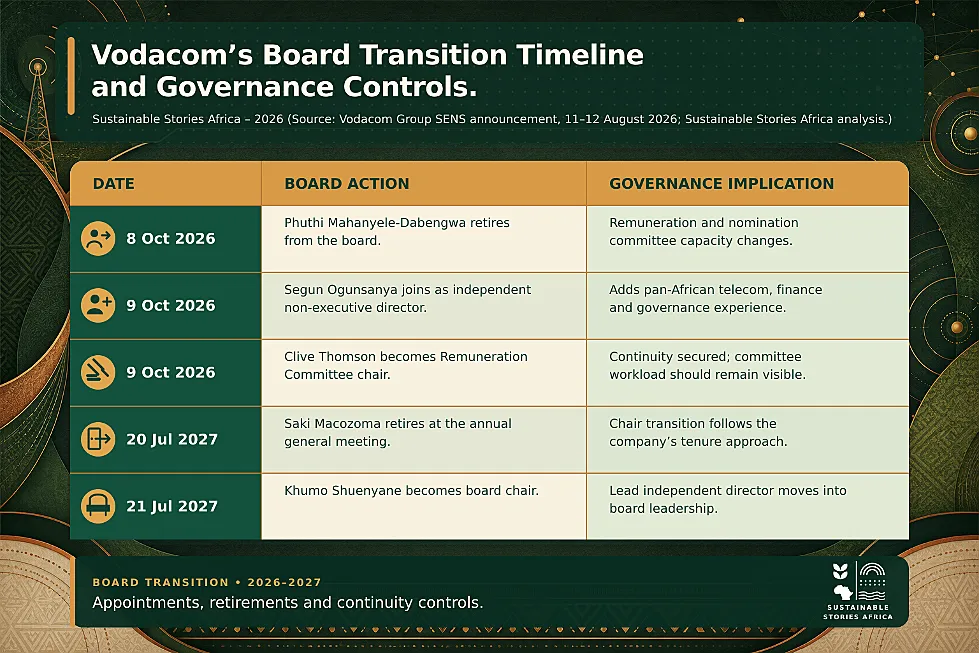
Phuthi Mahanyele-Dabengwa will retire from the board on 8 October 2026. Ogunsanya’s appointment takes effect the following day, when Clive Thomson will become chair of the Remuneration Committee while continuing to chair the Audit, Risk and Compliance Committee.
Vodacom said further committee composition changes would be announced later.
Succession dates clarify governance continuity
Macozoma, who joined the board in July 2017, will retire at Vodacom’s annual general meeting on 20 July 2027 in line with the company’s self-imposed 10-year tenure approach.
Shuenyane, currently lead independent director, is scheduled to become chair on 21 July 2027.
Publishing the timetable nearly a year in advance gives investors a clear line of sight over the leadership handover.
The transition also changes the board’s committee architecture.
- Mahanyele-Dabengwa, appointed in January 2019, has chaired the Remuneration Committee and served on the Nomination Committee.
- Thomson’s additional remuneration role provides immediate continuity, although combining two major committee chair responsibilities will make the eventual committee reallocation important for oversight capacity and workload balance.
Ogunsanya adds cross-market operating experience
Ogunsanya brings more than 35 years of experience across telecommunications, banking, consumer goods, finance and corporate governance.
- He retired in June 2024 as Airtel Africa’s group chief executive and managing director after leading a mobile telecommunications and financial-services business operating across 14 African countries.
- Earlier roles included leadership positions at Nigerian Bottling Company, Coca-Cola operations in Kenya and Ghana, and Ecobank’s retail business across 28 African markets.
He also chairs the Nigeria Sovereign Investment Authority and sits on the board of the Nigeria Economic Summit Group.
That combination gives Vodacom exposure to operating-market knowledge, public investment governance and regional policy networks at a time when African telecom groups are balancing network investment, financial services, digital inclusion, data governance and capital discipline.
Vodacom said it completed the required fit-and-proper assessment under paragraph 6.73 of the JSE Listings Requirements and was satisfied with the outcome.
It also reported no positive integrity information requiring disclosure from the director’s declaration.
The announcement did not identify Ogunsanya’s committee assignments, which remain a key detail for understanding how his experience will be deployed.
Investors need the committee end-state
The strength of the plan lies in its sequencing:
- Retirement, appointment and committee succession dates are defined rather than left to an abrupt announcement.
- The unanswered question is the end-state.
Shareholders still need the full committee map, clarity on how independence and specialist skills are distributed, and evidence that board renewal supports rather than disrupts Vision 2030 execution.
Vodacom should use the remaining transition period to explain the skills matrix behind the appointments and the succession risks being managed.
Disclosure should cover committee memberships, director capacity, board evaluation priorities and how technology, cyber risk, customer trust, climate exposure and human-capital oversight are represented.
Those issues increasingly sit at the centre of telecom governance, not at its margins.
Path Forward – Planned succession now needs visible outcomes
Vodacom has provided dates and named successors; it must now show how the reconfigured board will strengthen accountability and strategic challenge.
Timely disclosure of remaining committee changes will allow investors to assess independence, workload and expertise before the transitions take effect.
The broader opportunity is to turn leadership continuity into governance renewal.
A board that combines institutional memory with regional operating experience can better oversee the social, technological and financial choices shaping Africa’s connected economy.