The African Development Bank and Italy’s Cassa Depositi e Prestiti will invest a combined $35 million in RMBV North Africa Fund III.
The fund will back mid-market companies in consumer services, healthcare, education and financial services while providing managerial support.
The development case rests on whether equity capital converts into scalable businesses, quality jobs and wider access to essential services.
Development finance targets the missing middle
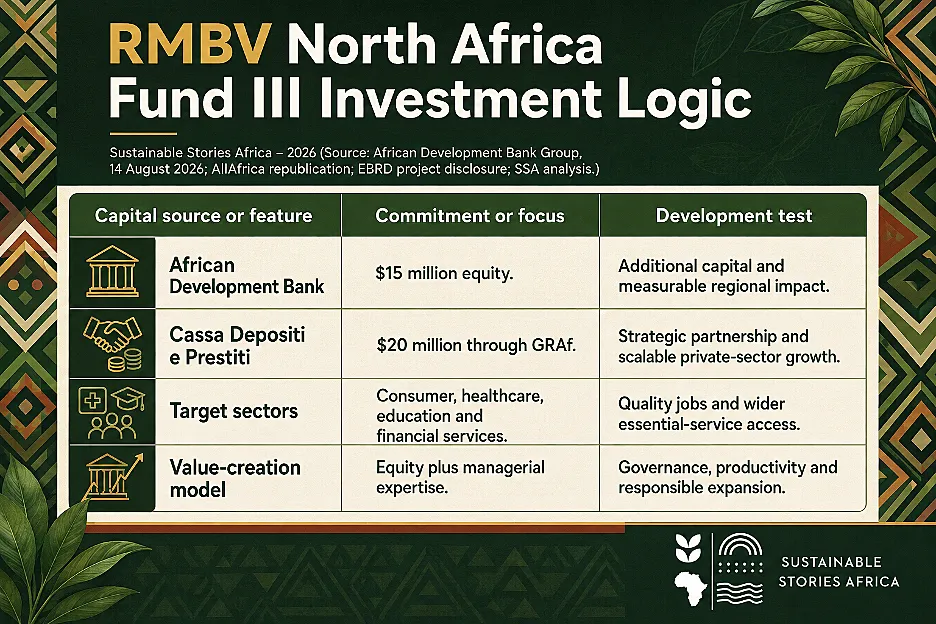
The African Development Bank Group has approved a $15 million equity investment in RMBV North Africa Fund III, joining a $20 million commitment from Italy’s development finance institution, Cassa Depositi e Prestiti.
The combined $35 million investment will support mid-market growth companies across North Africa.
The transaction targets a familiar financing gap.
- Mid-sized businesses can be too large for conventional small-business programmes but too small, closely held or operationally complex for public markets and large institutional investors.
- Patient equity, accompanied by management expertise, can help such firms professionalise, expand and attract later capital.
Capital will target essential service sectors
RMBV North Africa Fund III plans to invest in consumer goods and services, healthcare, education and financial services.
The AfDB said the focus is on expanding access to jobs and quality goods and services, while the fund will provide managerial expertise alongside capital.
CDP’s investment will be made through the Growth and Resilience Platform for Africa, a co-investment partnership promoted by Italy and the AfDB and anchored in Italy’s Mattei Plan for Africa.
The platform is intended to deepen economic cooperation and strategic partnerships between Italy and African countries and institutions.
The new commitments sit within a wider institutional capital stack.
- The European Bank for Reconstruction and Development previously disclosed an investment of up to $80 million in the fund.
- This is based on their commitment to funding $300 million in total project cost and a primary focus on mid-cap companies in Egypt, Morocco and Tunisia.
Equity can build firms, jobs and access
Growth capital can enable;
- A healthcare provider to add clinics
- An education company to widen delivery
- A financial-services firm to reach underserved customers or a consumer business to strengthen local supply chains.
Managerial support can improve governance, digital systems, talent, risk controls and expansion discipline.
Those gains are not automatic.
- Private-equity success is often measured through revenue growth and exit value, while development institutions must also show additionality and impact.
- The public interest therefore depends on credible indicators for job quality, gender inclusion, service affordability, geographic reach and environmental and social performance.
Impact must be measured beyond deployment
The fund manager and development-finance partners should disclose a consistent impact framework, portfolio-level safeguards and aggregated results.
They should distinguish between jobs retained and jobs created, count access using actual customers served and explain how managerial support changed company performance.
Portfolio companies should have functioning grievance channels and proportionate environmental and social controls.
Where expansion affects pricing in healthcare, education or financial services, investors should monitor whether growth widens access or primarily serves already-profitable segments.
Strong governance will also be essential when preparing eventual exits so that impact is not lost after ownership changes.
Local pension funds, insurers and banks should be engaged where risk and mandate allow.
Their participation can deepen regional capital markets and reduce long-term dependence on external anchors.
It can also build a stronger pipeline of African institutional investors capable of evaluating private-equity performance, safeguards and development outcomes.
Path Forward – Make every investment prove development value
The next step is transparent deployment into firms that can scale responsibly and demonstrate additionality.
AfDB, CDP and RMBV should publish portfolio objectives, baseline indicators and annual aggregated outcomes.
Success should mean more than capital committed: stronger companies, quality employment and affordable essential services across North Africa.
Managerial support, safeguards and responsible exits must preserve that value throughout the investment cycle.