Historical emissions remain useful, but they can tell investors where a company has been, rather than whether its business model can survive a lower-carbon economy.
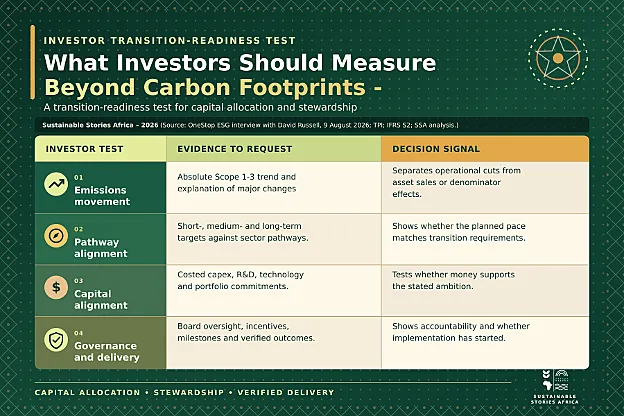
Transition Pathway Initiative chair David Russell says capital expenditure, governance, technology choices and delivery milestones provide the more decision-useful test.
Emissions Data Shows Only Yesterday's Position
A company can report a lower carbon intensity and still make little real-world progress.
That is the warning from David Russell, chair of the Transition Pathway Initiative, who argues that investors relying on a single footprint risk mistaking accounting movement for genuine business transition.
In an interview published by OneStop ESG on 9 August 2026, Russell said emissions data can be one, two or more years old.
It records a past position, while investment decisions depend on future cash flows, regulatory exposure, technology choices and the ability to compete as energy systems change.
The distinction matters in Africa and other emerging markets, where utilities, cement makers, miners, transport operators and industrial companies may begin with high emissions but also face large development needs.
A high footprint does not prove a company is uninvestable; a falling footprint does not prove it is transforming.
Investors Need Strategy Behind The Numbers
Russell identified several ways carbon intensity can flatter performance.
- The denominator can grow faster than emissions, a company can sell a high-emitting asset, or activities can move into the value chain.
- In each case, the reported ratio improves even when total emissions or the wider economy's exposure barely changes.
TPI's evidence points to a credibility gap.
- Russell said about 30% of roughly 2,000 companies assessed on transition governance have Paris-aligned 2050 targets.
- However, far fewer publish short- and medium-term milestones, costed plans, aligned capital expenditure and proof of delivery.
- Long-term ambition is therefore becoming the start of the assessment, rather than the conclusion.
This approach is consistent with IFRS S2, which requires decision-useful disclosure on governance, strategy, risk management, metrics and targets.
- It also identifies capital deployed towards climate risks and opportunities and transition plans as relevant information.
- For investors, the question is whether those disclosures connect to budgets and operating decisions.
Disclosure progress still leaves room for misinterpretation.
- An IFRS Foundation review of 3,814 public companies found that 82% reported against at least one TCFD-recommended disclosure for the 2023 financial year; however, only about 2% to 3% covered all 11.
- More reporting does not automatically mean more transition readiness; investors still need to test completeness, consistency and execution.
Forward-Looking Tests Reveal Real Transition Capacity
A forward-looking assessment gives investors a fairer comparison between companies with similar footprints.
- One may be financing renewable power, low-carbon materials or cleaner logistics; another may be delaying change.
- The current emissions number cannot distinguish between them, but a financed implementation plan can.
For African businesses, this can prevent a crude low-carbon screen from starving transition assets of capital.
Banks and asset owners can price the quality of the journey: the commercial viability of technology, access to power and infrastructure, the sequencing of investments, worker and community impacts, and resilience under different policy scenarios.
Capital Must Follow Evidence, Not Labels
Asset owners should require companies to reconcile emissions targets with approved budgets, procurement, research spending and asset lives.
- Stewardship teams can set dated milestones, vote against weak oversight and escalate where management repeatedly misses delivery without credible explanation.
Companies, meanwhile, should publish the drivers behind every material change of emissions.
- That means disclosing whether progress came from efficiency, fuel switching, technology deployment, output movements, divestment or methodology changes.
- The aim is not to abandon carbon footprints, but to place them inside a fuller test of strategy and execution.
Lenders can embed the same tests in transition-finance terms.
- Pricing incentives should depend on independently checked milestones, while missed targets should trigger explanation, remediation and, where appropriate, revised financing terms.
Fund managers should also report portfolio emissions and portfolio transition quality separately, because a low-emissions portfolio may avoid the sectors where real-economy decarbonisation is most needed.
Path Forward – Build Decisions Around Delivery, Not Promises
Investors should retain historical emissions as a baseline, then add sector pathways, costed capital plans, governance and evidence of delivery.
Together, those measures show whether a company can move, how quickly and at what risk.
For African markets, the priority is credible transition finance that rewards real-economy change.
Capital should follow companies that connect targets to investment, protect affected communities and report progress transparently.