The African Development Bank says its Great Green Wall initiative has grown into a multibillion-dollar portfolio spanning national and cross-border projects.
The initiative now extends beyond tree planting to farms, ecosystem management, climate-resilient infrastructure, governance and institutional capacity.
Its success will depend on whether finance reaches communities quickly enough to restore land, strengthen food systems and create durable rural jobs before the 2030 deadline.
A Green Wall Becomes Development Infrastructure
Africa’s Great Green Wall is no longer best understood as a continuous line of trees across the Sahel
- It has evolved into a portfolio of farms, restored ecosystems, renewable energy, water systems, rural enterprises and stronger institutions intended to make vulnerable landscapes productive again.
The African Development Bank’s initiative page says that, from 2021 to its 2024 update, the Bank had committed $3.32 billion through 83 national and 29 multinational projects.
That was almost 51% of the $6.5 billion the Bank pledged to help mobilise for the initiative.
The scale makes the Great Green Wall a test of whether climate finance can connect landscape recovery to daily economic needs.
Five Pillars Connect Land And Livelihoods
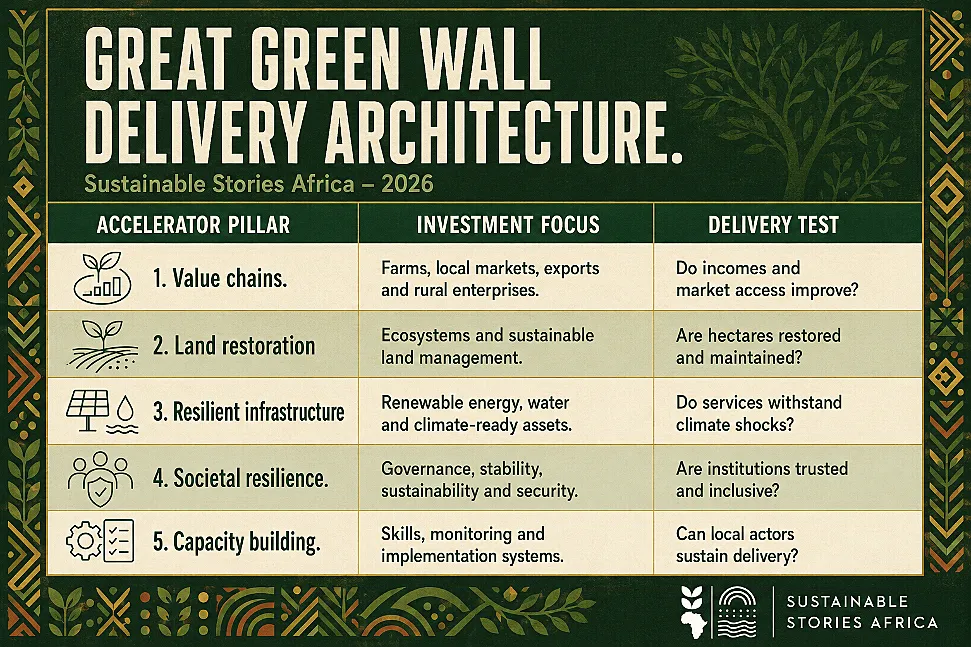
The Great Green Wall Accelerator organises investment around five pillars.
- The first supports small and medium-sized farms, value chains, local markets and exports.
- The second focuses on land restoration and sustainable ecosystem management.
- The third covers climate-resilient infrastructure and renewable energy.
- The fourth supports governance, stability and security
- The fifth builds institutional and technical capacity.
This design recognises that degraded land is rarely a stand-alone environmental problem.
- When soil loses fertility and water becomes unreliable, harvests fall, livestock routes come under pressure and rural incomes weaken.
- Families may be forced to migrate, while competition over scarce resources can deepen instability.
- Restoration must therefore work with markets, finance and public services rather than sit beside them as an isolated planting campaign.
The AfDB page reported that;
- 38% of projects contributed to the farm-and-value-chain pillar, representing about $1.50 billion in commitments
- 2% supported land restoration and ecosystem management directly, representing about $55.9 million.
The distribution highlights how much implementation is being channelled through productive sectors.
However, it also raises a question about monitoring: every investment labelled as supportive should demonstrate measurable outcomes regarding land and livelihoods.
Local Ownership Can Turn Finance Productive
The initiative’s 2030 ambition is formidable:
- Restore 100 million hectares of degraded land.
- Create 10 million green jobs.
- Sequester 250 million tonnes of carbon.
Earlier implementation reporting cited by the Bank recorded 20 million hectares restored and 350,000 jobs created between 2007 and 2018.
Progress exists; however, the remaining distance is substantial.
Communities stand to gain when projects protect water, increase yields, strengthen pastoral systems and create enterprises around seeds, nurseries, forest products and climate-smart agriculture.
Women and young people can benefit most when land rights, finance, training and market access are designed into projects from the beginning.
Without those safeguards, capital can produce infrastructure without building ownership or resilient livelihoods.
Delivery Must Be Measured Beyond Commitments
Governments, the Bank and implementation partners
- Should publish comparable data on money committed, money disbursed, hectares restored, survival of planted vegetation, jobs sustained and income changes.
- Reporting should distinguish between finance that broadly supports resilience and finance that produces verified restoration outcomes.
Projects also need local maintenance plans.
- A nursery, water structure or solar installation creates durable value only when communities have the skills, authority and resources to manage it.
The Great Green Wall’s credibility will be built village by village, rather than by the size of announcements alone.
For investors, the opportunity lies in treating restoration as economic infrastructure.
Blended finance, local financial institutions and patient capital can help viable rural businesses grow while public finance carries early-stage and climate risks.
Path Forward – The Path From Portfolio To Proof
The priority is to convert commitments into transparent disbursements and locally owned projects across the five Accelerator pillars.
Every project should report land, livelihood and inclusion outcomes.
Governments and financiers should build maintenance, community rights and enterprise support into delivery.
The Great Green Wall will succeed when restored landscapes generate food, income, resilience and trusted evidence at scale.
Culled from: Great Green Wall Initiative