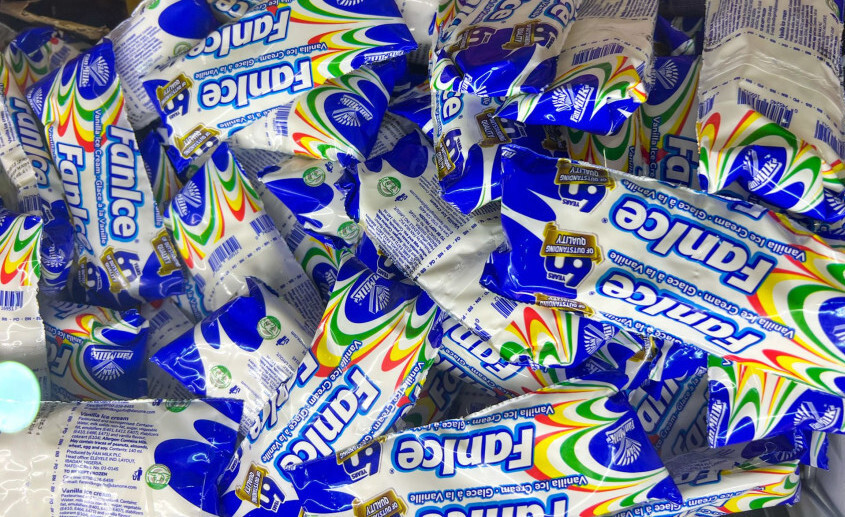
Fan Ice moved from its Danish founders to Abraaj and then to Danone, without losing the everyday market presence that made the brand recognisable across Ghana.
Its history shows that resilient African consumer brands are built on local relevance, dependable distribution, and governance systems that withstand the top-down changes.
A Ghanaian Brand Survived Corporate Upheaval
Fan Ice's ownership changed, but its customer promise remained visible on streets, near schools and inside neighbourhoods.
That continuity is the core lesson in a July 2026 analysis by Ghanaian brand strategist Karen Punch:
- Corporate control may transcend borders; however, a brand can endure when customers experience it as part of daily life.
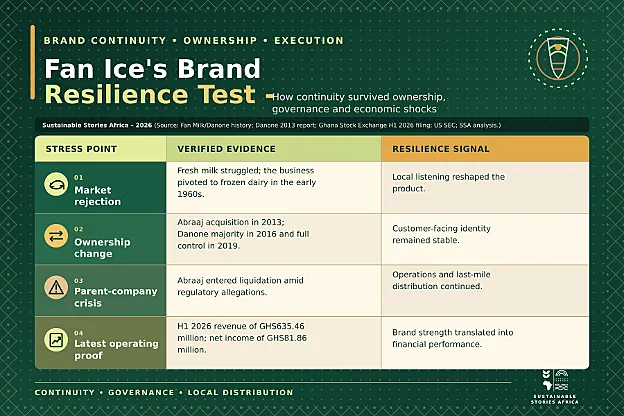
The business began in 1959 as Ghana Cold Store, selling fresh pasteurised milk.
When the original offering struggled against longer-lasting imported products, the company pivoted towards frozen dairy and community distribution.
It became Fan Milk in 1962 and diversified its reach through independent vendors that use bicycles and insulated boxes.
Local Relevance Became A Business Moat
That route-to-market turned distribution into social infrastructure.
- The vendor was not simply a sales channel
- The vendor was the last-mile face of the company, creating familiarity, convenience and livelihood opportunities.
- The Ghana network had grown by 2024 to about 800 agents, 21 key distributors and nearly 7,000 vendors.
The ownership milestones were significant.
- Abraaj acquired Fan Milk International in 2013
- Danone took a large minority stake.
- Danone became the majority owner in 2016 and completed full ownership in 2019.
During the same period, Abraaj entered liquidation after serious allegations over investor funds; a 2019 US Securities and Exchange Commission complaint alleged more than $230 million was misappropriated from a healthcare fund.
- The scandal affected the parent investor; however, the consumer proposition kept functioning.
- That separation suggests the operating brand, distribution routines, local knowledge and frontline relationships had enough institutional depth to outlast ownership turbulence.
Latest Results Strengthen The Resilience Case
The latest financial evidence extends the story beyond nostalgia.
- Fan Milk's Ghana Stock Exchange filing for the first half of 2026 reported revenue of GHS635.46 million, up from GHS506.56 million a year earlier.
- Net income rose to GHS81.86 million from GHS26.05 million.
These unaudited figures do not prove that heritage alone drove growth, but they show the business remains commercially relevant decades after its first pivot.
The trend was already visible in 2025, when revenue rose 46.3% to about GHS1.0 billion, and profit after tax increased 36% to GHS67.4 million, according to the company's annual disclosures.
The sequence matters:
- Brand trust created demand, but production capacity, working capital, pricing and distribution had to convert that demand into financial performance.
Resilience also requires investment behind the brand.
- Fan Milk has pursued cold-chain expansion and environmental upgrades, including wastewater treatment, biomass and solar projects.
Such spending connects brand continuity to operating efficiency, resource management and the livelihoods of vendors whose income depends on reliable refrigeration and product availability.
Those vendor relationships carry social and governance duties.
- Growth should improve route safety, equipment access, income visibility and grievance channels for the people selling the product.
- Environmental upgrades should also reduce operating risk without transferring unaffordable costs to micro-distributors.
- A resilient brand protects the network that makes its promise real.
Ownership Changes Demand Governance Continuity Plans
African consumer businesses should document the capabilities customers rely on before any acquisition:
- Product accessibility, distributor economics, local decision rights, quality controls and the people who carry trust into communities.
- Buyers should protect these assets during integration instead of treating them as replaceable legacy practices.
Boards should also test whether the brand can continue through leadership turnover, currency pressure, supply disruption or parent-company distress.
- That requires ring-fenced operating controls, vendor support, transparent stakeholder communication and investment plans that preserve affordability without weakening product quality.
Acquirers should publish integration guardrails before closing:
- Which local capabilities will be preserved, who owns consumer insight, how vendors will be consulted and which service levels cannot be compromised
- Post-deal reporting should then track customer availability, distributor retention, complaints, safety and sustainability performance alongside revenue and profit.
Path Forward – Protect The Trust That Customers Built
Fan Ice's history shows that ownership is not the same as belonging.
A brand becomes durable when its product, price and distribution repeatedly solve a local problem.
The next test is to keep vendors, consumers and environmental performance inside every strategic decision.
Corporate structures may change again; the trust infrastructure should not.