South Africa’s draft Natural Scientific Professions Bill would bar unregistered people from practising in prescribed fields and allow fines or up to 12 months’ imprisonment for violations.
The proposal seeks stronger ethics and public protection but has alarmed researchers who fear broad definitions and criminal penalties.
Parliamentary scrutiny must now clarify scope, exemptions and safeguards for independent science.
Draft Law Raises the Stakes for Scientists
South Africa is debating a far-reaching overhaul of how natural scientists are regulated.
The draft Natural Scientific Professions Bill would require people practising in prescribed fields to register with the South African Council for Natural Scientific Professions and would make non-compliant practice a criminal offence carrying a fine, imprisonment for up to 12 months, or both.
Published for public comment in March 2026, the bill is intended to replace the 2003 Act, continue the Council and strengthen ethical standards, public protection and environmental responsibility.
However, many researchers reportedly remain unaware of its reach, and concern is growing that a framework designed for professional accountability could capture academic and public-interest research too broadly.
Broad Definitions Create Practical Uncertainty
The bill defines practice as providing a service or advice in natural science, for payment or free, while excluding teaching at recognised institutions and government policy development.
It applies to anyone practising in designated fields, barring unregistered persons from practising, claiming registration or using protected titles.
That wording raises unresolved questions.
A university researcher may teach, publish, advise communities and consult for government within the same week; however, it remains unclear which activities require registration, how interdisciplinary fields would be treated, or whether early-career researchers could work without delay.
The proposed Council would assess qualifications, manage professional development and investigate misconduct, functions that can protect the public where scientific advice affects health, infrastructure or environmental permits.
The challenge lies in proportionality.
Implementation capacity is another test. Mandatory registration creates costs for applicants and the regulator, while delays could disrupt projects and professional mobility.
Since the bill leaves the Council to determine registration periods, fees and rules, later regulations will shape how the law actually operates.
Parliament should embed clear principles, consultation duties and transition deadlines directly in the primary legislation, rather than leaving these consequential boundaries entirely to subordinate rules.
Credible Regulation Needs Scientific Trust
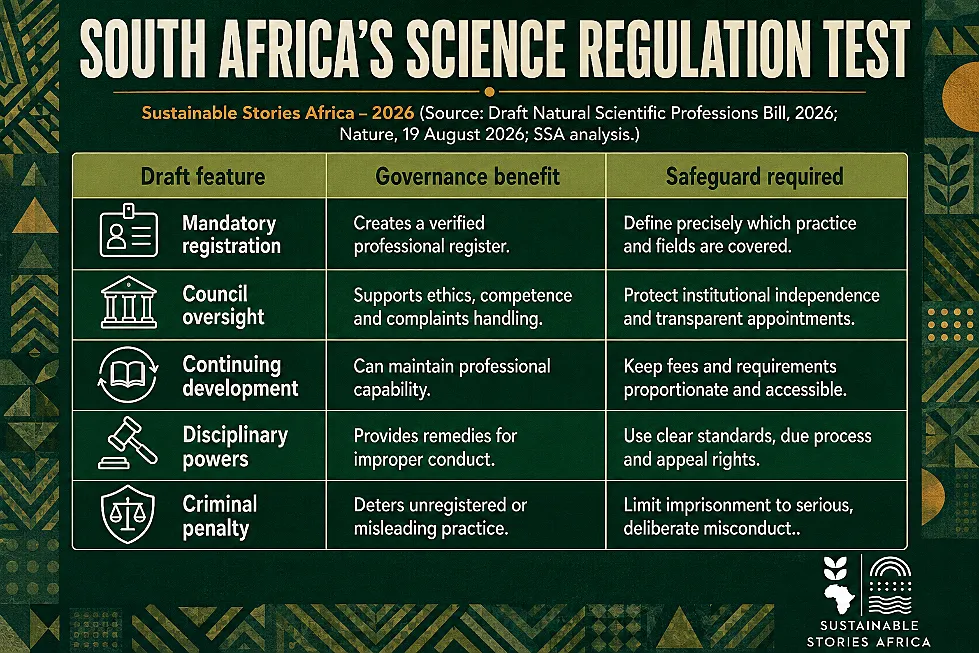
Professional registration can signal competence, establish ethical duties and create routes for complaints.
- It may also strengthen accountability for environmental assessments and technical services whose failures can cause lasting harm.
Those are legitimate sustainability and governance objectives.
However, criminal sanctions and expansive regulatory discretion can chill research, discourage collaboration or make scientists cautious about communicating contested evidence.
- A regulator must not become a mechanism for suppressing unpopular findings.
Clear statutory boundaries, independent appointments, transparent disciplinary standards and judicial review are essential.
Parliament Must Narrow and Clarify Scope
Lawmakers should test the bill against real research pathways before enactment.
Universities, professional associations, labour organisations, environmental groups and early-career scientists should map which activities create genuine public risk and which belong within academic freedom.
The final law should distinguish protected professional services from ordinary research and communication, provide a workable transitional registration, recognise equivalent credentials and reserve criminal penalties for deliberate, harmful or fraudulent conduct.
Public safety and scientific freedom are not opposing goals; careful drafting is what allows both to endure.
Path Forward – Protect Public Trust Without Chilling Science
South Africa’s Parliament should clarify the bill’s scope, exemptions and transition arrangements before creating criminal exposure for unregistered scientific practice.
A credible framework should regulate high-risk professional services, preserve independent inquiry and guarantee due process.
Scientists and public-interest groups must participate actively so the final law strengthens ethical accountability without discouraging research, collaboration or evidence-based criticism.
Culled from: South Africa’s scientists must register with official body or risk prison, according to draft law | Nature