
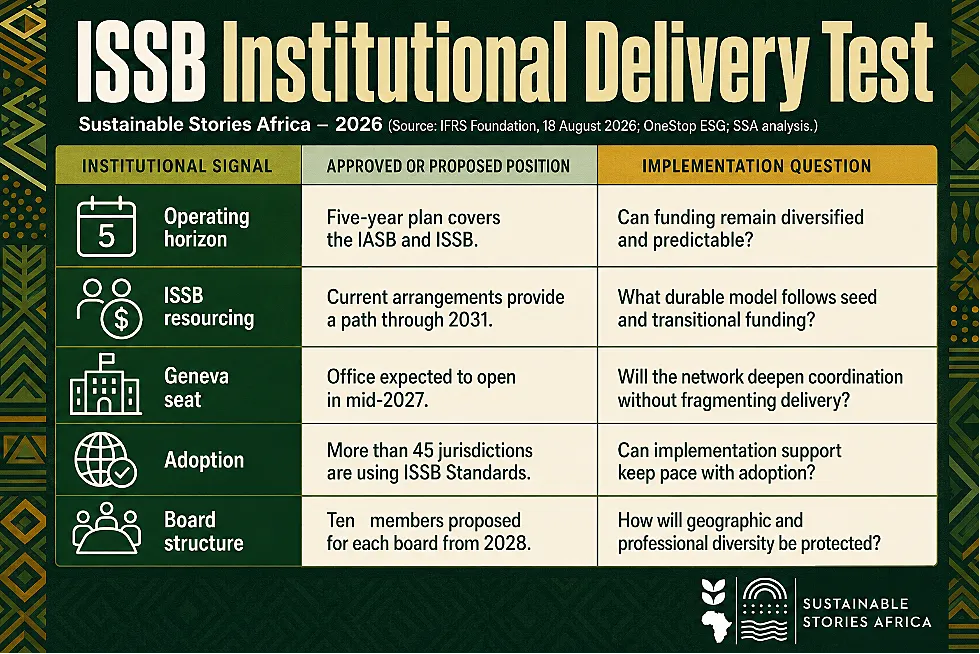
The IFRS Foundation has approved a five-year operating and financing plan and will establish Geneva as the ISSB’s seat in 2027.
Funding arrangements provide a path through 2031 as adoption spreads across more than 45 jurisdictions.
Proposed constitutional changes would reduce both standards-setting boards to 10 members from 2028, renewing questions about representation.
Global Disclosure Architecture Gains New Runway
The IFRS Foundation has strengthened the institutional foundations of global sustainability reporting with a five-year operating and financing plan, a new Geneva seat for the International Sustainability Standards Board and proposed constitutional amendments affecting the size of its two standard-setting boards.
The ISSB office is expected to open in mid-2027.
Geneva will join a multi-location network that includes Beijing, Frankfurt, Montreal and Tokyo, while Frankfurt remains the hub for European Union engagement and Montreal continues to host key functions.
For companies and regulators in Africa, the decision matters because sustainability disclosure is moving rapidly from voluntary experimentation towards capital-market infrastructure.
Adoption Growth Raises Capacity Questions
More than 45 jurisdictions are already using ISSB Standards, according to the Foundation, and companies in 18 jurisdictions are expected to issue reports under the framework by 2027.
Funding already secured, together with existing agreements and earned revenue, provides a pathway for the ISSB to deliver its priorities through 2031 before moving towards a more durable long-term model.
The plan recognises that the ISSB, created in 2021, has not yet developed a diversified funding base like the older International Accounting Standards Board.
It also establishes a principle of shared responsibility: jurisdictions and capital-market participants that benefit from globally comparable standards should contribute to maintaining them.
The Trustees have separately proposed reducing the IASB and ISSB to 10 members each from 2028.
- Comments are open until 16 November 2026.
- Smaller boards may make deliberation more efficient, but fewer seats increase the importance of preserving geographic, professional and market diversity.
Geneva’s role adds political and operational significance.
- The city hosts institutions involved in trade, labour, human rights, development and sustainable finance, giving the ISSB proximity to debates that increasingly shape corporate disclosure.
The opportunity is better coordination;
- The risk is that a geographically distributed organisation becomes harder to govern or appears distant from adopting markets.
Clear responsibilities across offices, transparent implementation measures and support will be important.
Africa Needs Voice and Implementation Support
For African jurisdictions, a stable ISSB can improve investor confidence and reduce the cost of navigating multiple disclosure frameworks.
Comparable information on climate and other sustainability-related risks can help lenders and investors distinguish resilient companies from those relying on broad claims.
The benefit will depend on implementation capacity.
- Many businesses still face weak emissions data, fragmented supplier information, limited assurance expertise and high first-year reporting costs.
- If emerging-market representation narrows while requirements expand, standards may overlook the realities of smaller issuers, informal value chains and data-constrained economies.
Use Consultation to Protect Global Legitimacy
African regulators, professional bodies, stock exchanges, preparers and investors should respond to the constitutional consultation with evidence about representation and implementation needs.
They should also build coordinated roadmaps for training, digital reporting, assurance and proportional relief.
The Foundation’s new funding runway creates time to mature the system.
- That time should be used to ensure the global baseline remains technically rigorous, financially sustainable and responsive to the markets expected to apply it.
Path Forward – Funding Must Support Inclusive Global Implementation
The IFRS Foundation should translate its new runway into transparent funding, strong implementation support and credible representation across developed and emerging markets.
African stakeholders should engage the constitutional consultation before 16 November 2026 and coordinate national adoption plans.
A global baseline will gain legitimacy only if jurisdictions can apply it consistently and affordably with confidence that their market realities are understood.
Culled from: IFRS Foundation Opens New ISSB Seat in Geneva, Approves Five-Year Funding Plan